HAP Networks for the Future: Applications in Sensing, Computing, and Communication
High Altitude Platforms (HAPs) are a major advancement in non-terrestrial networks, offering broad coverage and unique capabilities. They form a vital link between satellite systems and terrestrial networks and play a key role in next-generation communication technologies. This study reviews HAP network applications, focusing on advanced airborne communications, integrated sensing, and airborne informatics. Our survey assesses the current state of HAP-centric applications by examining data processing, network performance, computational and storage requirements, economic feasibility, and regulatory challenges. The analysis highlights the evolving role of HAPs in global communication and identifies future research directions to support their deployment.
💡 Research Summary
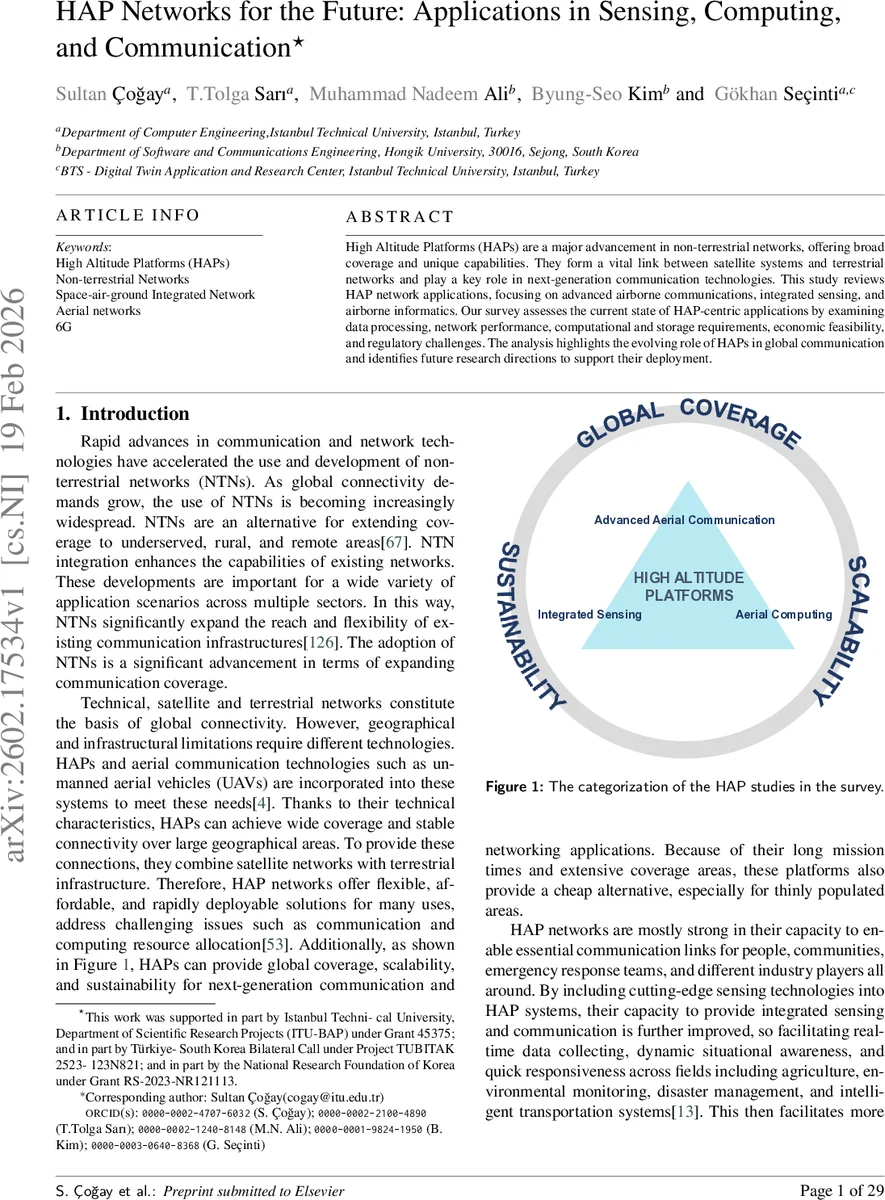
The paper provides a comprehensive survey of High‑Altitude Platforms (HAPs) as a pivotal component of non‑terrestrial networks (NTNs) and outlines their emerging roles in advanced aerial communication, integrated sensing, and aerial computing. After introducing the rapid growth of NTNs and the unique position of HAPs—operating at 20‑50 km altitude, offering wide‑area coverage, low latency, and high bandwidth—the authors categorize the literature into three functional pillars.
In the communication and networking section, the authors discuss HAP‑UAV‑satellite collaborative architectures that exploit millimeter‑wave and free‑space optical links, as well as Reconfigurable Intelligent Surfaces (RIS) mounted on HAPs to dynamically shape propagation paths. They demonstrate how such systems can dramatically improve reliability and throughput in rural, disaster‑affected, and maritime scenarios, achieving latency reductions of up to an order of magnitude compared with GEO satellites.
The sensing segment reviews payloads such as high‑resolution optical, radar, and multispectral sensors that enable real‑time environmental monitoring, precision agriculture, maritime surveillance, and smart‑city applications. By performing on‑board preprocessing and compression, HAPs reduce backhaul traffic while delivering near‑continuous revisit times that surpass conventional satellite observations.
The computing section focuses on HAP‑enabled Mobile Edge Computing (MEC). With powerful processors and storage, HAPs act as edge servers, supporting task offloading, content caching, and federated learning across distributed ground devices and UAVs. The authors provide performance comparisons showing 2‑3× improvements in latency and bandwidth for latency‑critical workloads such as autonomous driving, AR/VR, and real‑time video analytics, while also highlighting energy‑efficiency gains and privacy preservation.
A quantitative evaluation across five key metrics—bandwidth, latency, coverage, energy consumption, and cost efficiency—shows that HAP‑based solutions can achieve up to 30 % lower total cost of ownership over the long term, despite higher upfront capital expenditures.
Finally, the paper addresses regulatory and standardization challenges, including international spectrum allocation, cross‑border flight permissions, data‑privacy frameworks, and cybersecurity safeguards. The authors argue that successful large‑scale deployment of HAPs will require coordinated policy development, interoperable hardware standards, and robust security architectures.
Future research directions are identified: real‑time topology management, energy‑aware trajectory optimization, AI‑driven self‑diagnosis and recovery, and distributed control algorithms for massive HAP constellations. In sum, the survey positions HAPs as a versatile, cost‑effective bridge between space and terrestrial networks, essential for realizing the ultra‑dense, low‑latency, and intelligent services envisioned for 6G and beyond.
Comments & Academic Discussion
Loading comments...
Leave a Comment