Fine-Grained Uncertainty Quantification for Long-Form Language Model Outputs: A Comparative Study
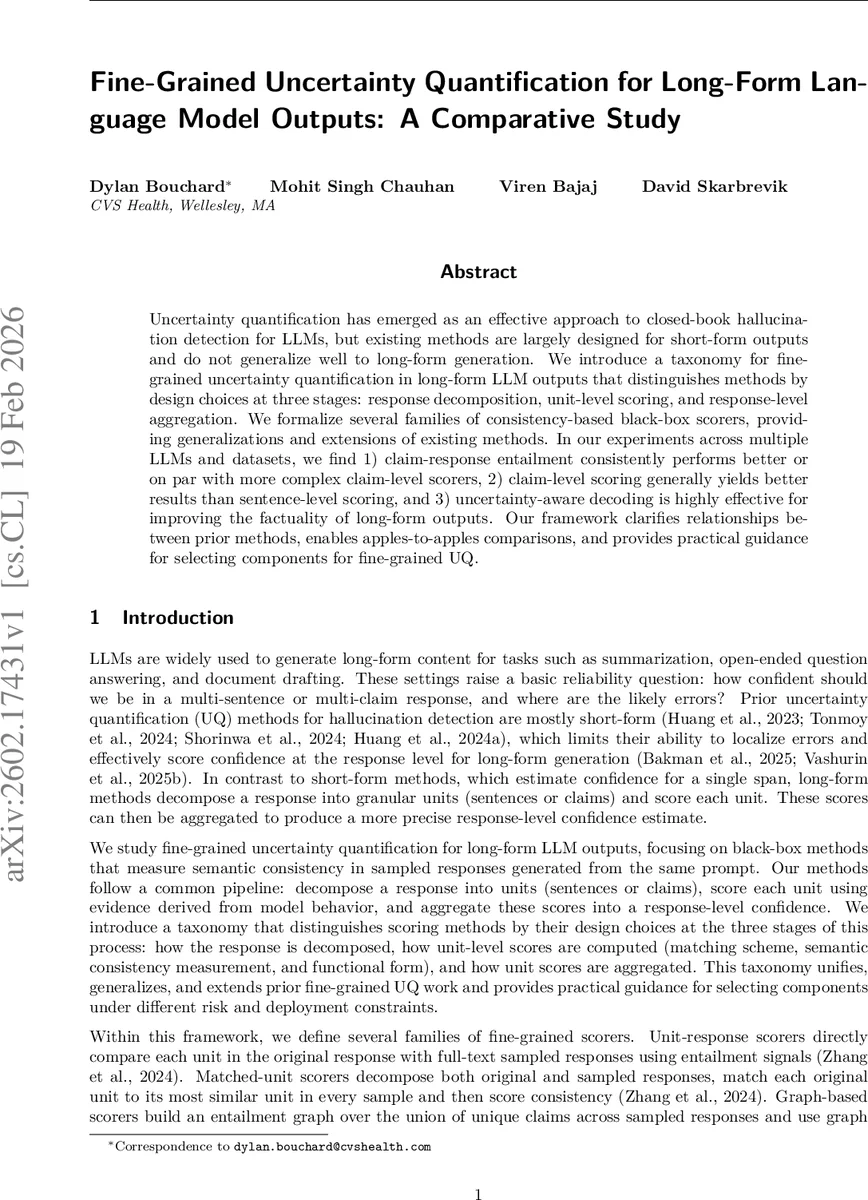
Uncertainty quantification has emerged as an effective approach to closed-book hallucination detection for LLMs, but existing methods are largely designed for short-form outputs and do not generalize well to long-form generation. We introduce a taxonomy for fine-grained uncertainty quantification in long-form LLM outputs that distinguishes methods by design choices at three stages: response decomposition, unit-level scoring, and response-level aggregation. We formalize several families of consistency-based black-box scorers, providing generalizations and extensions of existing methods. In our experiments across multiple LLMs and datasets, we find 1) claim-response entailment consistently performs better or on par with more complex claim-level scorers, 2) claim-level scoring generally yields better results than sentence-level scoring, and 3) uncertainty-aware decoding is highly effective for improving the factuality of long-form outputs. Our framework clarifies relationships between prior methods, enables apples-to-apples comparisons, and provides practical guidance for selecting components for fine-grained UQ.
💡 Research Summary
This paper addresses the pressing problem of hallucinations in long-form outputs generated by large language models (LLMs). While uncertainty quantification (UQ) has proven effective for detecting hallucinations in short-form responses, those methods do not readily extend to multi‑sentence or multi‑claim generations where errors need to be localized and confidence estimated at a finer granularity. To fill this gap, the authors propose a unified three‑stage pipeline for fine‑grained UQ of long‑form LLM outputs: (1) response decomposition, (2) unit‑level scoring, and (3) response‑level aggregation. They introduce a taxonomy that categorizes design choices at each stage, thereby clarifying the relationships among many previously proposed methods and enabling apples‑to‑apples comparisons.
In the decomposition stage, a response is split either into sentences or into atomic claims. Sentence segmentation can be rule‑based or model‑based, while claim extraction relies on LLM‑driven prompting or dedicated extraction models. The claim granularity is motivated by the observation that factual errors often correspond to individual claims rather than whole sentences, especially in domains such as medicine or law.
The core contribution lies in the definition of four families of black‑box unit scorers, each differing in how they match units and what semantic consistency function they employ:
-
Unit‑Response Scorers compare each original unit directly against the full set of sampled responses. They use natural‑language‑inference (NLI) scores – entailment probability (p_e), non‑contradiction probability (1-p_c), or a contrastive entailment formulation (p_e p_e/(p_e+p_c)) – averaged across samples. This family corresponds to the previously introduced LUQ and LUQ‑atomic methods but is extended with the contrastive variant.
-
Matched‑Unit Scorers first decompose every sampled response as well, then for each original unit find the most similar unit in each sample (using NLI, cosine similarity, or BERTScore). The best‑match scores are averaged across samples. When instantiated with sentence granularity and NLI‑based contrastive entailment, this reproduces LUQ‑pair; the authors also explore cosine and BERTScore extensions.
-
Unit‑QA Scorers convert each unit into a question via a prompting function, generate multiple answers to that question, and assess consistency among the answers using NLI or embedding similarity. This generalizes the “semantic entropy” approach, allowing alternative consistency functions and supporting both sentence and claim granularity.
-
Graph‑Based Scorers aggregate all claims from the original and sampled responses into a bipartite graph where edges represent entailment between a claim and a response. Various bounded graph centrality metrics—betweenness, closeness, harmonic, Laplacian energy drop, and PageRank—are then used to assign an uncertainty score to each claim. This family builds on Jiang et al. (2024) but adds several centrality measures while omitting unbounded eigenvector centrality.
After unit scores are obtained, the response‑level aggregation stage maps a set of scores to a single confidence value. Simple operators such as mean or min are considered, but the authors also evaluate “uncertainty‑aware decoding” where low‑confidence claims are filtered or decoding hyper‑parameters (temperature, top‑p) are adjusted based on unit‑level uncertainty. This decoding strategy proves highly effective at reducing hallucinations in the final output.
The experimental evaluation spans multiple LLMs (e.g., GPT‑3.5, LLaMA‑2‑70B, Claude‑2) and diverse long‑form benchmarks, including summarization (SummEval), long‑question answering (LongQA), and medical report generation. Metrics cover unit‑level precision/recall, calibration error (ECE), response‑level F1, and the proportion of hallucinated statements before and after applying uncertainty‑aware decoding.
Key findings are:
- Claim‑Response Entailment Dominates – The contrastive entailment score (p_e p_e/(p_e+p_c)) consistently outperforms more complex variants across all models and datasets, delivering the best trade‑off between precision and calibration.
- Claim Granularity Beats Sentence Granularity – Scoring at the claim level yields higher overall F1 and lower calibration error, especially in domains where a single sentence contains multiple factual claims.
- Uncertainty‑Aware Decoding Improves Factuality – Incorporating unit‑level uncertainty into the decoding process raises average entailment scores by 0.08–0.12 and cuts hallucination rates by over 30 % relative to standard sampling.
- Complementarity Among Scorer Families – While claim‑response entailment is the strongest overall, matched‑unit and graph‑based scorers provide marginal gains in precision for specialized domains (e.g., legal text) by exploiting structural consistency across samples.
Based on these results, the authors propose practical guidelines: when computational resources permit, use claim extraction → claim‑response contrastive entailment → uncertainty‑aware decoding for the most robust pipeline. When resources are limited, sentence‑level matched‑unit scoring with simple averaging offers a strong baseline. For domains where claim inter‑dependencies matter, augment the pipeline with graph‑based centrality scores.
All methods, datasets, and evaluation scripts are released as part of the open‑source toolkit uqlm (https://github.com/cvs-health/uqlm), ensuring reproducibility and facilitating future research.
In summary, the paper delivers a comprehensive taxonomy, formalizes several previously disparate fine‑grained UQ approaches, provides extensive empirical evidence of their relative merits, and demonstrates that fine‑grained uncertainty estimation combined with uncertainty‑aware decoding is a powerful recipe for improving the factual reliability of long‑form LLM generations.
Comments & Academic Discussion
Loading comments...
Leave a Comment