Quantum Scrambling Born Machine
Quantum generative modeling, where the Born rule naturally defines probability distributions through measurement of parameterized quantum states, is a promising near-term application of quantum computing. We propose a Quantum Scrambling Born Machine in which a fixed entangling unitary – acting as a scrambling reservoir – provides multi-qubit entanglement, while only single-qubit rotations are optimized. We consider three entangling unitaries – a Haar random unitary and two physically realizable approximations, a finite-depth brickwork random circuit and analog time evolution under nearest-neighbor spin-chain Hamiltonians – and show that, for the benchmark distributions and system sizes considered, once the entangler produces near-Haar-typical entanglement the model learns the target distribution with weak sensitivity to the scrambler’s microscopic origin. Finally, promoting the Hamiltonian couplings to trainable parameters casts the generative task as a variational Hamiltonian problem, with performance competitive with representative classical generative models at matched parameter count.
💡 Research Summary
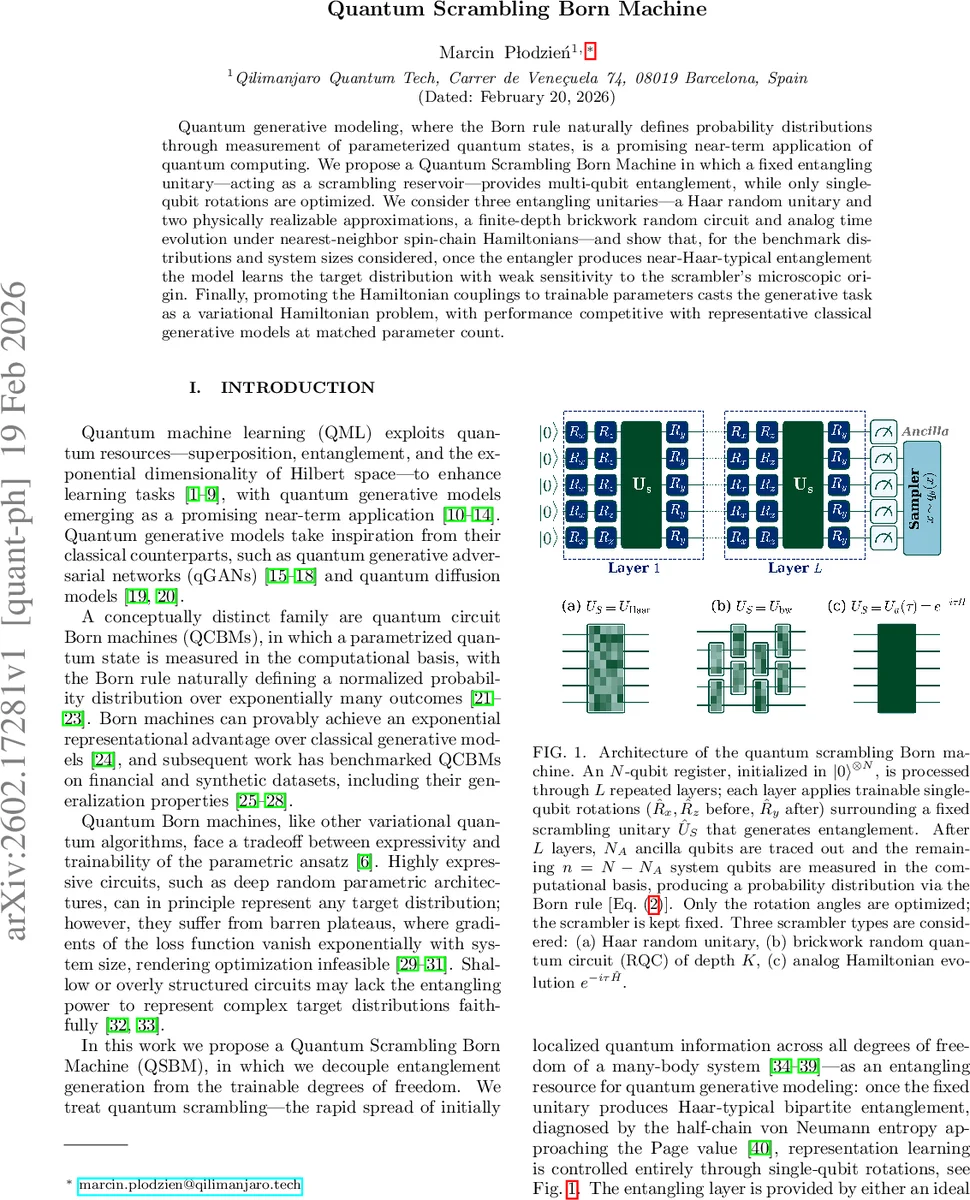
The paper introduces a novel quantum generative model called the Quantum Scrambling Born Machine (QSBM). Unlike conventional quantum circuit Born machines (QCBMs) that parameterize every gate, QSBM separates the generation of entanglement from the trainable degrees of freedom. The architecture consists of L repeated layers; each layer applies trainable single‑qubit rotations (R_x, R_z before, and R_y after) on every qubit, surrounding a fixed multi‑qubit entangling unitary U_S that acts as a scrambling reservoir. Only the rotation angles are optimized, so the total number of trainable parameters scales linearly as 3 × L × N (N = total qubits).
Three types of scramblers are investigated: (i) an ideal Haar‑random unitary, (ii) a finite‑depth brickwork random quantum circuit (RQC), and (iii) analog time evolution under nearest‑neighbor spin‑chain Hamiltonians (the transverse‑field Ising model and an XX model with transverse field). The Haar unitary provides maximal bipartite entanglement, characterized by the Page entropy. The RQC approximates a 2‑design when its depth K grows proportionally to N, while the analog Hamiltonians generate Haar‑like entanglement after sufficiently long evolution time τ.
Training minimizes the negative log‑likelihood (NLL), which is equivalent to minimizing the Kullback‑Leibler divergence D_KL(p‖q_θ) because the target entropy H(p) is constant. Experiments use up to N = 8 (and occasionally N ≤ 10) qubits, with 5‑peak multimodal 1‑D distributions and 2‑D Gaussian mixtures as targets. Optimization employs Adam (learning rate 0.01) with gradient norm clipping, running for 2000 epochs and averaging over 20 random initializations of both the scrambler and the rotation parameters.
Results with the Haar scrambler show that, for pure‑state output (no ancillas, N_A = 0), the model reaches low KLD (≈10⁻²) once L ≥ 6, indicating that the expressive power of the single‑qubit rotations suffices when maximal entanglement is already present. Adding ancilla qubits (N_A = 1, 2) and tracing them out increases the rank of the reduced density matrix, effectively providing a mixed‑state representation that improves performance for shallow circuits (L ≤ 5).
For the brickwork RQC, depth K = 1 (nearest‑neighbor entanglement only) yields poor performance, with KLD saturating far above the Haar baseline. Already at K = 2 the KLD drops substantially, and for K ≥ 5 (≈N/2) the performance collapses onto the Haar level across all L and ancilla settings, confirming that an O(N) depth brickwork circuit approximates a 2‑design. Ancilla qubits again shift the entire KLD surface downward by roughly an order of magnitude.
Analog Hamiltonian scramblers exhibit a clear transition as τ increases. For very short times (τ ≪ 1) the unitary is close to identity, generating negligible entanglement and resulting in high KLD regardless of L. Around τ ≈ 0.5 J⁻¹, the half‑chain entropy approaches the Page value, and KLD drops sharply. For L ≥ 5 the KLD saturates at the Haar benchmark for both TFIM and XX models, while ancilla qubits provide the most noticeable benefit for shallow layers (L < 3).
The authors further promote the Hamiltonian couplings to trainable parameters, turning the generative task into a variational Hamiltonian problem. With a comparable parameter budget (~200 parameters), the QSBM matches or slightly outperforms representative classical generative models—generative adversarial networks (GANs), variational autoencoders (VAEs), and restricted Boltzmann machines (RBMs)—on the same 2‑D benchmarks.
Key insights:
- A fixed, highly entangling scrambler decouples entanglement generation from optimization, avoiding barren‑plateau issues associated with deep parametrized circuits.
- Once the scrambler achieves near‑Haar bipartite entanglement, the specific physical implementation (digital random circuit vs. analog Hamiltonian evolution) has minimal impact on final performance.
- Tracing out ancilla qubits provides a controllable trade‑off between output resolution and mixed‑state expressive power, beneficial for hardware‑constrained NISQ devices.
- Variational Hamiltonian learning extends the framework, demonstrating that quantum generative models can be competitive with classical counterparts even at modest parameter counts.
Overall, the QSBM offers a hardware‑friendly, scalable route to quantum generative modeling, leveraging quantum scrambling as a reusable resource while keeping the trainable portion simple and shallow. This architecture aligns well with near‑term quantum processors, where multi‑qubit gate calibration is costly, and suggests a promising pathway for practical quantum advantage in generative tasks.
Comments & Academic Discussion
Loading comments...
Leave a Comment