TAPO-Structured Description Logic for Information Behavior: Procedural and Oracle-Based Extensions
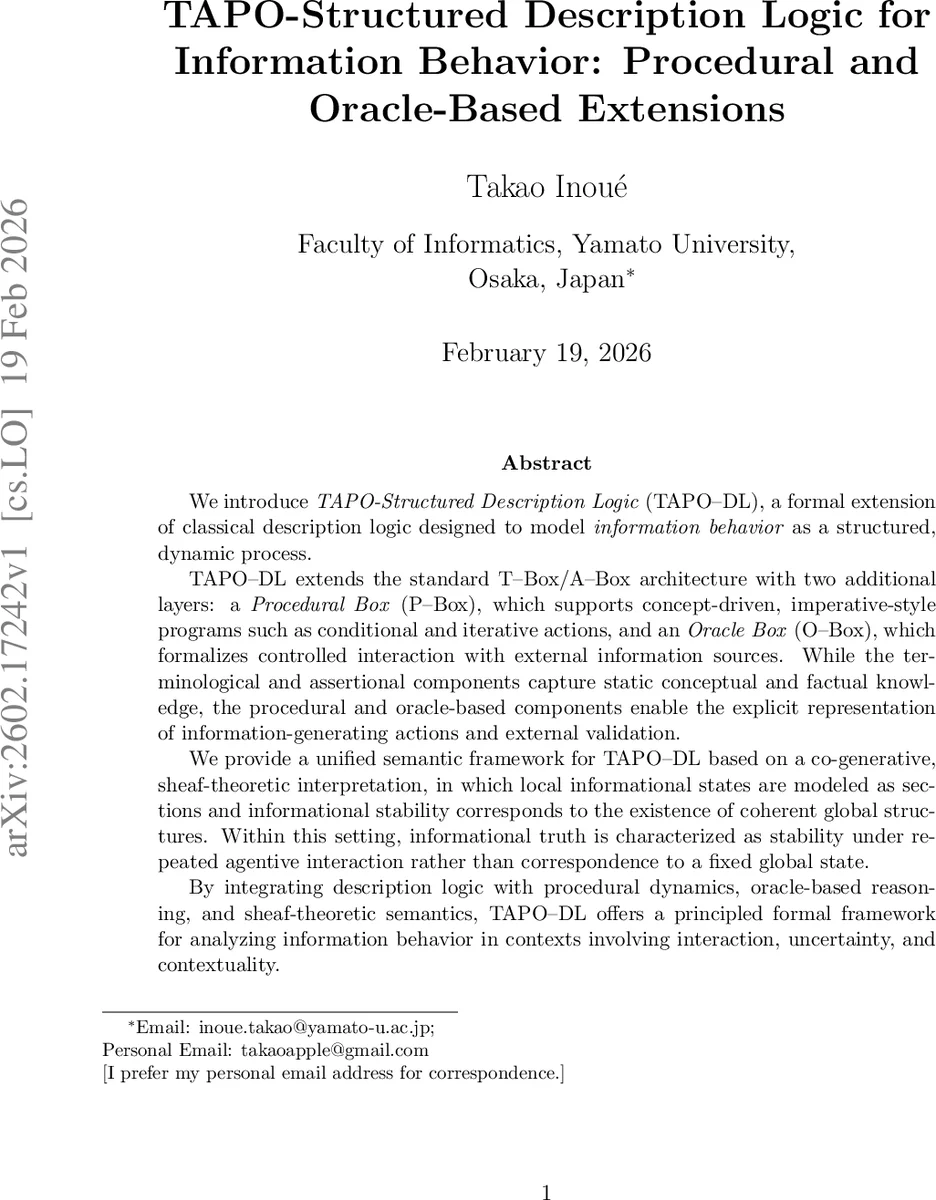
We introduce \emph{TAPO-Structured Description Logic} (TAPO–DL), a formal extension of classical description logic designed to model \emph{information behavior} as a structured, dynamic process. TAPO–DL extends the standard T–Box/A–Box architecture with two additional layers: a \emph{Procedural Box} (P–Box), which supports concept-driven, imperative-style programs such as conditional and iterative actions, and an \emph{Oracle Box} (O–Box), which formalizes controlled interaction with external information sources. While the terminological and assertional components capture static conceptual and factual knowledge, the procedural and oracle-based components enable the explicit representation of information-generating actions and external validation. We provide a unified semantic framework for TAPO–DL based on a co-generative, sheaf-theoretic interpretation, in which local informational states are modeled as sections and informational stability corresponds to the existence of coherent global structures. Within this setting, informational truth is characterized as stability under repeated agentive interaction rather than correspondence to a fixed global state. By integrating description logic with procedural dynamics, oracle-based reasoning, and sheaf-theoretic semantics, TAPO–DL offers a principled formal framework for analyzing information behavior in contexts involving interaction, uncertainty, and contextuality.
💡 Research Summary
The paper introduces TAPO‑Structured Description Logic (TAPO‑DL), an extension of classical description logics (DL) that adds two new layers—Procedural Box (P‑Box) and Oracle Box (O‑Box)—to the traditional T‑Box (terminological axioms) and A‑Box (assertional facts). The motivation is that standard DLs excel at representing static knowledge but cannot directly capture dynamic information‑behaviour phenomena such as iterative search, conditional actions based on partial data, and controlled interaction with external resources.
Signature and Concept Language
The authors start with a standard ALC‑style signature Σ = (N_C, N_R, N_I, U), where U denotes a collection of contextual domains (situations, information states, etc.). Concept expressions are built from the usual constructors (⊤, ⊥, concept names, conjunction, disjunction, negation, existential and universal restrictions). Each assertion is annotated with a context label “@U”, indicating that the statement holds with respect to the information available in that domain. This annotation makes the semantics explicitly contextual.
T‑Box and A‑Box
T‑Box axioms are global inclusions C ⊑ D, independent of any context. A‑Box assertions have the form a : C @ U (and role assertions (a,b) : r @ U). A monotonicity condition is imposed: if V ⊆ U then any assertion true in U is also true in V, reflecting that information can be “restricted” to smaller contexts.
Procedural Box (P‑Box)
P‑Box provides a minimal imperative language. Guards φ are built from atomic conditions (concept assertions, role assertions, or T‑Box inclusions) combined with classical Boolean operators. Programs P are generated by the grammar: skip | add β | del β | P;P | if φ then P else P | while φ do P, where β ranges over A‑Box assertions. The operational semantics is given as a big‑step relation ⟨P, Σ⟩⇓Σ′, where Σ = (T, A) is the current knowledge state. The rules for skip, add, delete, sequencing, conditionals, and while‑loops are standard; the while construct is intentionally partial, allowing non‑termination to model open‑ended information‑seeking processes.
Oracle Box (O‑Box)
O‑Box captures admissible interactions with external information sources (oracles). Formally it is a binary relation J ⊆ (T×A) × (T×A) that records externally justified transitions from one knowledge state to another. The justification may come from API responses, human judgments, sensor readings, etc., and is not derived from the internal inference machinery. This layer makes the system “open” to its environment.
Sheaf‑Theoretic Semantics
Contexts are interpreted as objects of a site (U, ⊆) or, equivalently, as opens of a topological space. Each concept C is interpreted as a sheaf over this site: for every context U, C(U) is the set of individuals satisfying C under the information available in U. Restriction maps ρ_UV : C(U) → C(V) enforce contextual monotonicity. Local informational states correspond to sections of these sheaves; a family of compatible local sections over a covering can be uniquely glued into a global section, representing a coherent informational entity.
Co‑generative Information Behaviour
The authors propose a co‑generative ontology: an epistemic agent e, a latent informational structure i (in a domain P of structural potential), and a manifested informational object m (in a domain M). The interaction (e, i) ↦ m is not a mere revelation of pre‑existing facts but a constitutive process that creates meaning for the agent. Different agents or different internal states may stabilize distinct manifested objects from the same latent structure.
Stability and Informational Truth
Truth is re‑interpreted as stability under repeated agent‑structure interactions. An informational object m is “stable” if successive interactions consistently regenerate m. Stability thus serves as a non‑arbitrary, agent‑relative criterion for truth, constrained by the underlying structural potential P.
Minimal Example – Sensor System
A concrete illustration involves a distributed sensor network. Raw sensor signals reside in P as latent data. An agent runs a protocol (expressed in the P‑Box language) that repeatedly adds, deletes, or tests assertions based on sensor readings. When a pattern (e.g., “obstacle detected”) is repeatedly stabilized, a global section emerges, representing the manifested informational object. The example demonstrates how procedural actions, oracle calls (e.g., sensor APIs), and sheaf‑theoretic gluing work together.
Sheaf‑Theoretic Deepening
The paper formalizes informational domains as a site (C, J) and defines a presheaf I : Cᵒᵖ → Set of latent structures. An epistemic agent assigns, for each context U, a (possibly partial) selection of sections s_U ∈ I(U). The sheaf condition guarantees that compatible local sections over a covering admit a unique gluing s ∈ I(U), interpreted as the emergence of a coherent informational object at a higher level. Manifested objects correspond to globally stabilized sections that remain invariant under further contextual refinements.
Conclusion and Future Work
TAPO‑DL extends DLs beyond static knowledge representation by integrating a programmable procedural layer and explicit oracle interaction, and by providing a sheaf‑theoretic semantics that captures locality, coherence, and stability. The authors outline several future directions: a fully sheaf‑theoretic implementation, richer oracle compositionality, integration with existing DL reasoners, and application to real‑time distributed systems.
Overall, the paper offers a novel, mathematically grounded framework for modeling information behaviour, bridging the gap between logical knowledge representation, procedural programming, and contextual, interactive information dynamics.
Comments & Academic Discussion
Loading comments...
Leave a Comment