The general Brannan coefficient conjecture and Watson's lemma
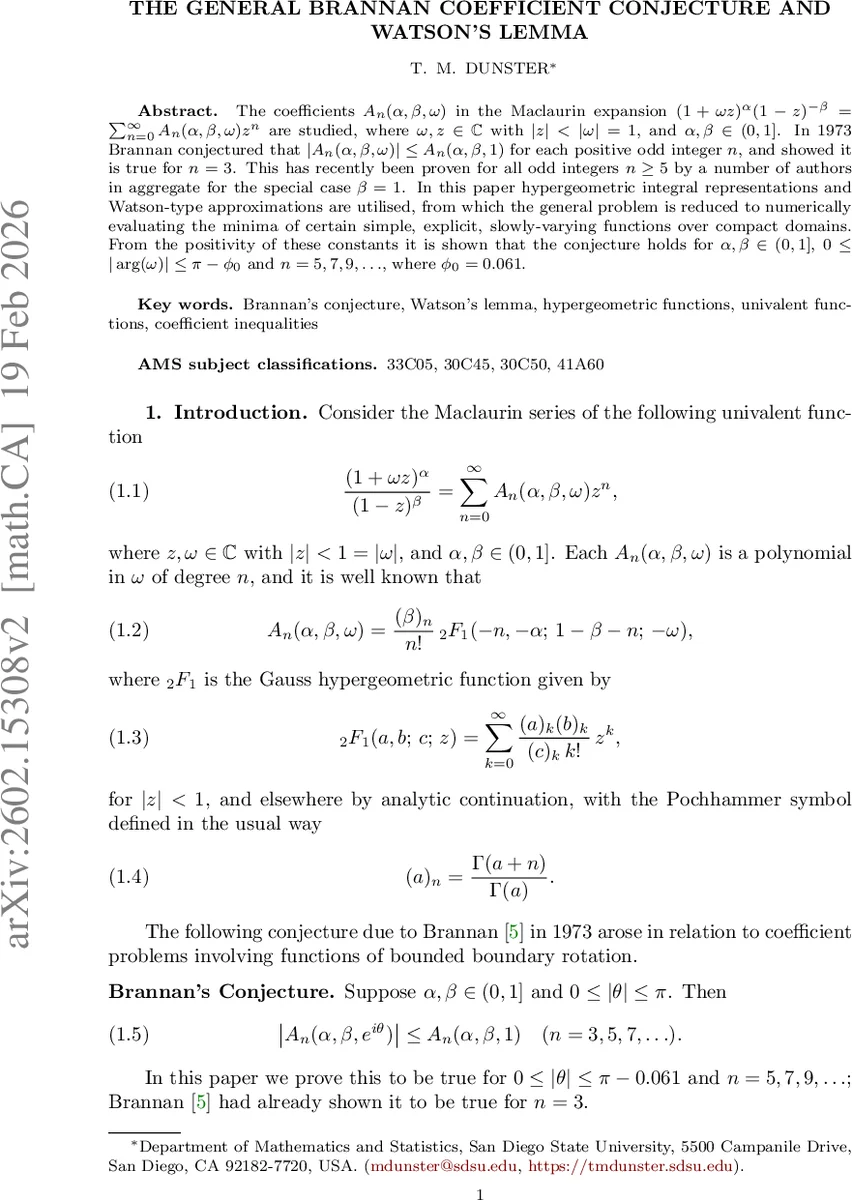
The coefficients $A_n(α,β,ω)$ in the Maclaurin expansion $(1+ωz)^α(1-z)^{-β}= \sum_{n=0}^{\infty} A_n(α,β,ω)z^n$ are studied, where $ω,z \in \mathbb{C}$ with $|z| < |ω|=1$, and $α,β\in (0,1]$. In 1973 Brannan conjectured that $|A_n(α,β,ω)|\le A_n(α,β,1)$ for each positive odd integer $n$, and showed it is true for $n=3$. This has recently been proven for all odd integers $n\ge5$ by a number of authors in aggregate for the special case $β=1$. In this paper hypergeometric integral representations and Watson-type approximations are utilised, from which the general problem is reduced to numerically evaluating the minima of certain simple, explicit, slowly-varying functions over compact domains. From the positivity of these constants it is shown that the conjecture holds for $α, β\in (0,1]$, $0 \le |\arg(ω)| \le π-ϕ_0$ and $n=5,7,9,\ldots$, where $ϕ_0=0.061$.
💡 Research Summary
The paper investigates the coefficients (A_n(\alpha,\beta,\omega)) in the Maclaurin expansion
\
Comments & Academic Discussion
Loading comments...
Leave a Comment