Ferrocene-functionalized covalent organic framework exceeding the ultimate hydrogen storage targets: a first-principles multiscale computational study
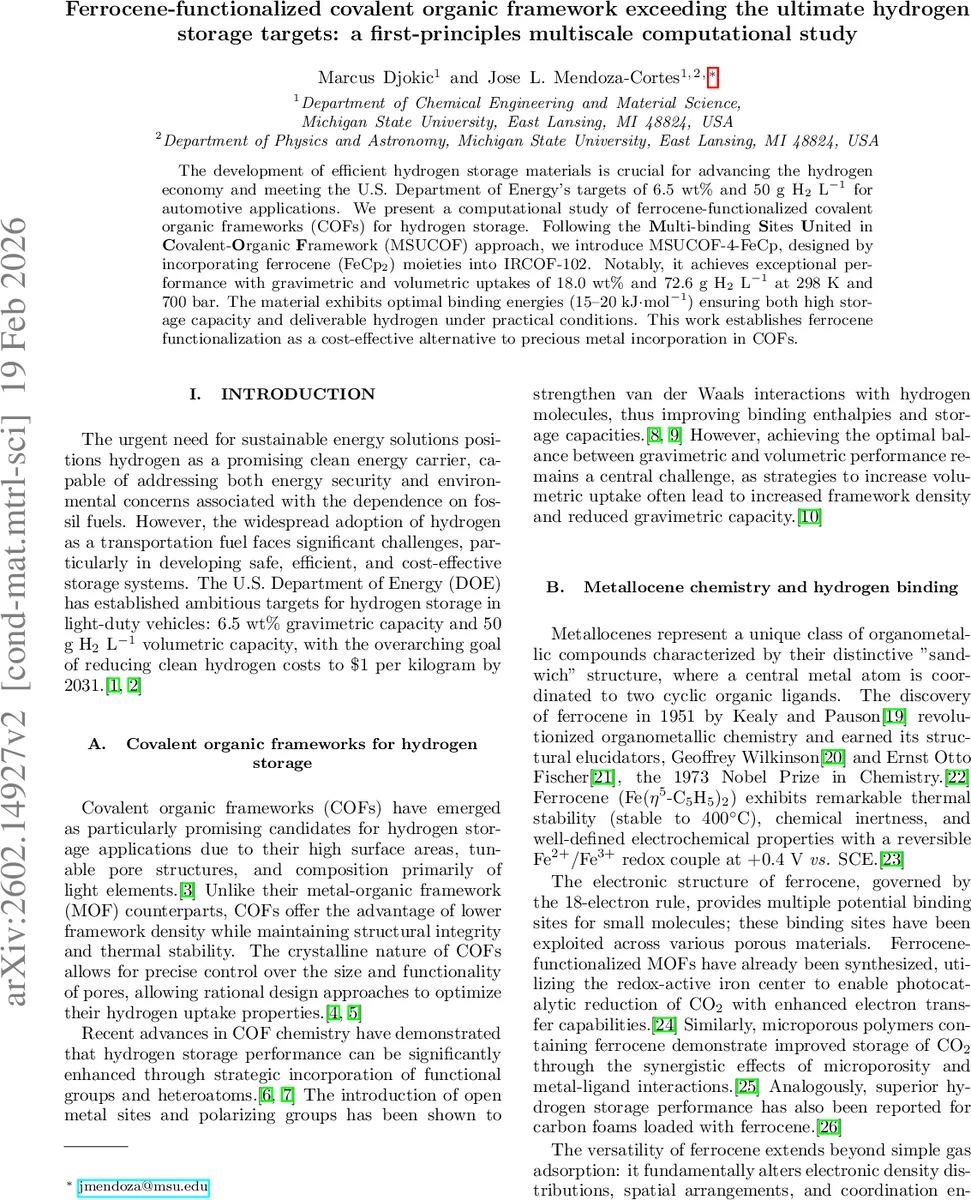
The development of efficient hydrogen storage materials is crucial for advancing the hydrogen economy and meeting the U.S. Department of Energy’s targets of 6.5 wt% and 50 g H2/L for automotive applications. We present a computational study of ferrocene-functionalized covalent organic frameworks (COFs) for hydrogen storage. Following the Multi-binding Sites United in Covalent-Organic Framework (MSUCOF) approach, we introduce MSUCOF-4-FeCp, designed by incorporating ferrocene (FeCp2) moieties into IRCOF-102. Notably, it achieves exceptional performance with gravimetric and volumetric uptakes of 18.0 wt% and 72.6 g H2/L at 298 K and 700 bar. The material exhibits optimal binding energies (15-20 kJ/mol) ensuring both high storage capacity and deliverable hydrogen under practical conditions. This work establishes ferrocene functionalization as a cost-effective alternative to precious metal incorporation in COFs.
💡 Research Summary
The authors present a comprehensive computational investigation of a ferrocene‑functionalized covalent organic framework (COF) designed to meet and exceed the U.S. Department of Energy (DOE) ultimate hydrogen storage targets. Starting from the three‑dimensional boroxine‑linked IR‑COF‑102, they replace the biphenyl linkers with indene‑derived linkers that incorporate a cyclopentadienyl (Cp) moiety. Post‑synthetic metallation with FeCl₂ and NaCp converts the Cp‑bearing linker into a ferrocene (FeCp₂) unit, yielding the material designated MSUCOF‑4‑FeCp. This strategy creates tritopic pore regions where each ferrocene provides multiple binding sites (the iron center and the π‑electron‑rich Cp rings) without significantly increasing the framework mass, thereby addressing the typical trade‑off between gravimetric and volumetric performance.
Density functional theory (DFT) calculations were performed using the CRYSTAL23 package. Fragment calculations employed the M06 functional with a p‑ob‑TZVP‑rev2 basis set to obtain accurate electronic structures and binding energies of ferrocene‑containing motifs. Periodic calculations with the HSE06‑D3 functional provided band gaps, density of states, and optimized lattice parameters for the parent IR‑COF‑102, the intermediate MSUCOF‑4, and the final MSUCOF‑4‑FeCp. The iron centers adopt a low‑spin Fe²⁺ configuration, and the eclipsed orientation of the Cp rings—forced by the confined pore geometry—produces a deep, broad potential well for H₂ adsorption.
To enable large‑scale Monte Carlo simulations, the authors derived a quantum‑mechanics‑fitted (QM‑FF) Morse potential for H₂‑ferrocene interactions. The fitted parameters (D₀ = 1.987 kcal mol⁻¹, α = 0.466 Å⁻¹, r₀ = 2.476 Å) describe a significantly stronger and longer‑range interaction than previously reported FeCl₂‑based sites, reflecting the synergistic contribution of the iron center and the π‑system of the Cp rings. Validation against a test set of hydrogen configurations yielded a mean absolute error below 0.5 kJ mol⁻¹, confirming the reliability of the force field.
Grand Canonical Monte Carlo (GCMC) simulations were carried out in Materials Studio at 298 K over a pressure range of 1–700 bar. The van der Waals equation of state (a = 0.2476 L² bar mol⁻², b = 0.02661 L mol⁻¹) was used to convert fugacity to pressure, ensuring accurate comparison with experimental conditions. The simulated isotherms predict a gravimetric uptake of 18.0 wt% and a volumetric uptake of 72.6 g L⁻¹ at 700 bar, surpassing the DOE ultimate targets of 6.5 wt% and 50 g L⁻¹, respectively. The isosteric heat of adsorption remains in the optimal 15–20 kJ mol⁻¹ range, indicating that hydrogen can be released under near‑ambient conditions without excessive energy penalties.
Economic analysis underscores the advantage of using iron. With a market price of roughly $0.10 kg⁻¹, iron is over 400,000 times cheaper than platinum or palladium, which exceed $40,000 kg⁻¹. Ferrocene’s thermal stability up to 400 °C and chemical inertness further enhance its suitability for repeated charge‑discharge cycles, mitigating degradation concerns that plague many metal‑decorated adsorbents.
In summary, the paper delivers (1) a rational design framework that embeds multiple, high‑affinity hydrogen binding sites via ferrocene without compromising framework density, (2) a validated multiscale computational workflow that integrates DFT, QM‑fitted force fields, and GCMC to predict performance metrics with high fidelity, and (3) a compelling case that ferrocene‑functionalized COFs can achieve unprecedented hydrogen storage capacities at a fraction of the cost of precious‑metal‑based materials. This work therefore represents a significant step toward practical, low‑cost hydrogen storage solutions for automotive applications.
Comments & Academic Discussion
Loading comments...
Leave a Comment