Sub Specie Aeternitatis: Fourier Transforms from the Theory of Heat to Musical Signals
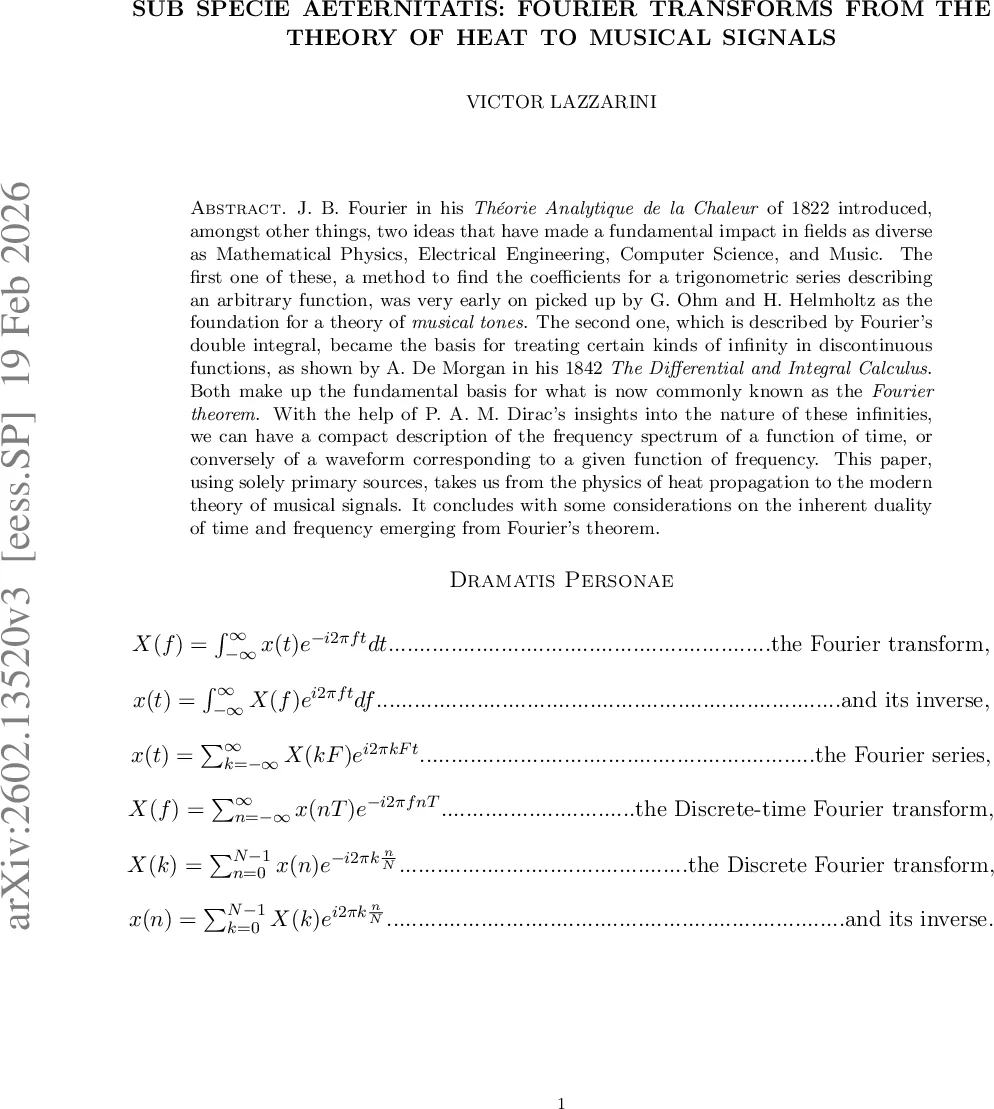
J. B. Fourier in his \emph{Théorie Analytique de la Chaleur} of 1822 introduced, amongst other things, two ideas that have made a fundamental impact in fields as diverse as Mathematical Physics, Electrical Engineering, Computer Science, and Music. The first one of these, a method to find the coefficients for a trigonometric series describing an arbitrary function, was very early on picked up by G. Ohm and H. Helmholtz as the foundation for a theory of \emph{musical tones}. The second one, which is described by Fourier’s double integral, became the basis for treating certain kinds of infinity in discontinuous functions, as shown by A. De Morgan in his 1842 \emph{The Differential and Integral Calculus}. Both make up the fundamental basis for what is now commonly known as the \emph{Fourier theorem}. With the help of P. A. M. Dirac’s insights into the nature of these infinities, we can have a compact description of the frequency spectrum of a function of time, or conversely of a waveform corresponding to a given function of frequency. This paper, using solely primary sources, takes us from the physics of heat propagation to the modern theory of musical signals. It concludes with some considerations on the inherent duality of time and frequency emerging from Fourier’s theorem.
💡 Research Summary
**
The paper traces a continuous intellectual line from Fourier’s 1822 Théorie Analytique de la Chaleur to today’s theory of musical signal processing. It begins with Fourier’s original trigonometric series: any real‑valued function defined on a finite interval can be expanded into a sum of sines and cosines, with coefficients given by explicit integrals (Eqs. 1‑3). Fourier observed that when the interval length tends to infinity each term shrinks, turning the series into an integral – the seed of what later becomes the Fourier integral.
The author then shows how the kernel (\frac12+\sum_{i=0}^{\infty}\cos i(x-\alpha)) introduced by Fourier was later formalised by Dirichlet as the Dirichlet kernel, a central tool for studying convergence and the Gibbs phenomenon. This kernel bridges the gap between discrete series and continuous integrals.
In the mid‑19th century, G. Ohm adopted Fourier’s series to argue that a complex tone can be represented as a sum of simple sinusoidal partials (Eqs. 7‑8). Helmholtz built on Ohm’s mathematical framework to propose a physiological basis: the ear performs a Fourier‑like analysis, detecting individual partials. The paper notes that Ohm’s formulation implicitly assumes periodicity (period (2\ell)), a point later rigorously proved by J. O’Kinealy in 1874.
Arthur De Morgan’s contribution is examined next. Using Fourier’s integral form (Eqs. 15‑16), De Morgan showed how to represent discontinuous signals—rectangular pulses, ramps, and piecewise‑defined functions—by integrating the cosine kernel over finite intervals. He introduced the operator (F_{ba}) to denote the contribution of a segment (
Comments & Academic Discussion
Loading comments...
Leave a Comment