Rigidity Criterion for Certain Calabi-Yau families
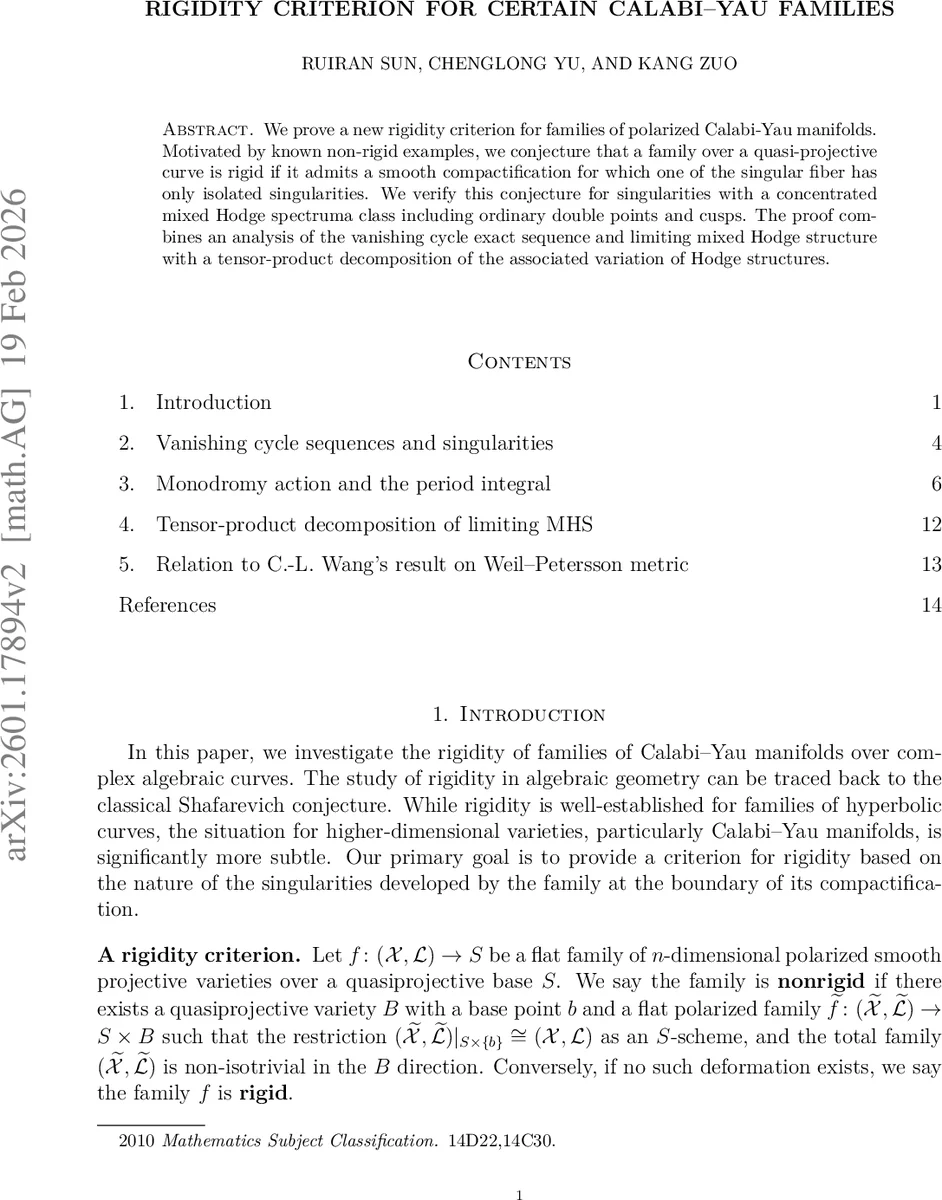
We prove a new rigidity criterion for families of polarized Calabi-Yau manifolds. Motivated by known non-rigid examples, we conjecture that a family over a quasi-projective curve is rigid if it admits a smooth compactification whose singular fiber has only isolated singularities. We verify this conjecture for singularities with a concentrated mixed Hodge spectrum class including ordinary double points and cusps. The proof combines an analysis of the vanishing cycle exact sequence and limiting mixed Hodge structure with a tensor-product decomposition of the associated variation of Hodge structures.
💡 Research Summary
The paper “Rigidity Criterion for Certain Calabi–Yau families” by Ruiran Sun, Chenglong Yu, and Kang Zuo proposes and proves a new rigidity criterion for families of polarized Calabi–Yau manifolds over a quasi‑projective curve. The authors observe that known non‑rigid examples (e.g., those of Viehweg–Zuo) always develop singular fibers whose singular locus has positive dimension, whereas the families they consider have a singular fiber with only isolated singularities. This motivates the central conjecture: a family over a curve is rigid if it admits a smooth compactification whose boundary fiber has only isolated singularities.
Main Setting (Assumption 1.1).
Let (f:(X,L)\to S) be a flat family of (n)-dimensional polarized smooth Calabi–Yau manifolds over a smooth quasi‑projective curve (S). Assume that (S) admits a smooth projective compactification (\bar S) with a boundary point (0\in\bar S\setminus S), and that the family extends flatly to (\bar f:X\to\bar S) with total space (X) smooth. The central fiber (X_0=\bar f^{-1}(0)) is assumed to have only isolated singularities.
Conjecture 1.2. Under these hypotheses the family (f) is rigid, i.e. it admits no non‑trivial deformation over a second base curve.
Theorem 1.3 (Main Result). The conjecture holds when the isolated singularities of (X_0) have a concentrated mixed Hodge spectrum (Definition 2.2). Roughly, for each eigenvalue (\lambda) of the semisimple part of the monodromy on the Milnor fiber, there is at most one Hodge weight occurring. Ordinary double points (ODP) and cusp singularities satisfy this condition (Example 2.3), yielding:
Corollary 1.4. If the only singularities of (X_0) are ODPs or cusps, then the family is rigid.
Context and Prior Work.
Rigidity for families of hyperbolic curves follows from the Shafarevich conjecture (Parshin, Arakelov). In higher dimensions, rigidity is subtler: Faltings gave a criterion for abelian varieties, Peters studied variations of Hodge structures (VHS), and Saito–Zucker classified non‑rigid K3 families via endomorphism algebras. For Calabi–Yau families, Liu–Todorov–Yau–Zuo proved rigidity when a Yukawa coupling does not vanish, while Zhang showed rigidity under maximal unipotent monodromy (large complex structure limit). Non‑rigid Calabi–Yau families do exist (Viehweg–Zuo’s quintic threefolds), and these examples typically exhibit a tensor‑product decomposition of the VHS arising from a “motivic” factor and a fixed factor.
Key Technical Tools.
- Vanishing Cycle Exact Sequence.
For a family (f:X\to\Delta) with isolated singularities (p_i) in the central fiber, the exact sequence
\
Comments & Academic Discussion
Loading comments...
Leave a Comment