Cleavage toughness of single crystals
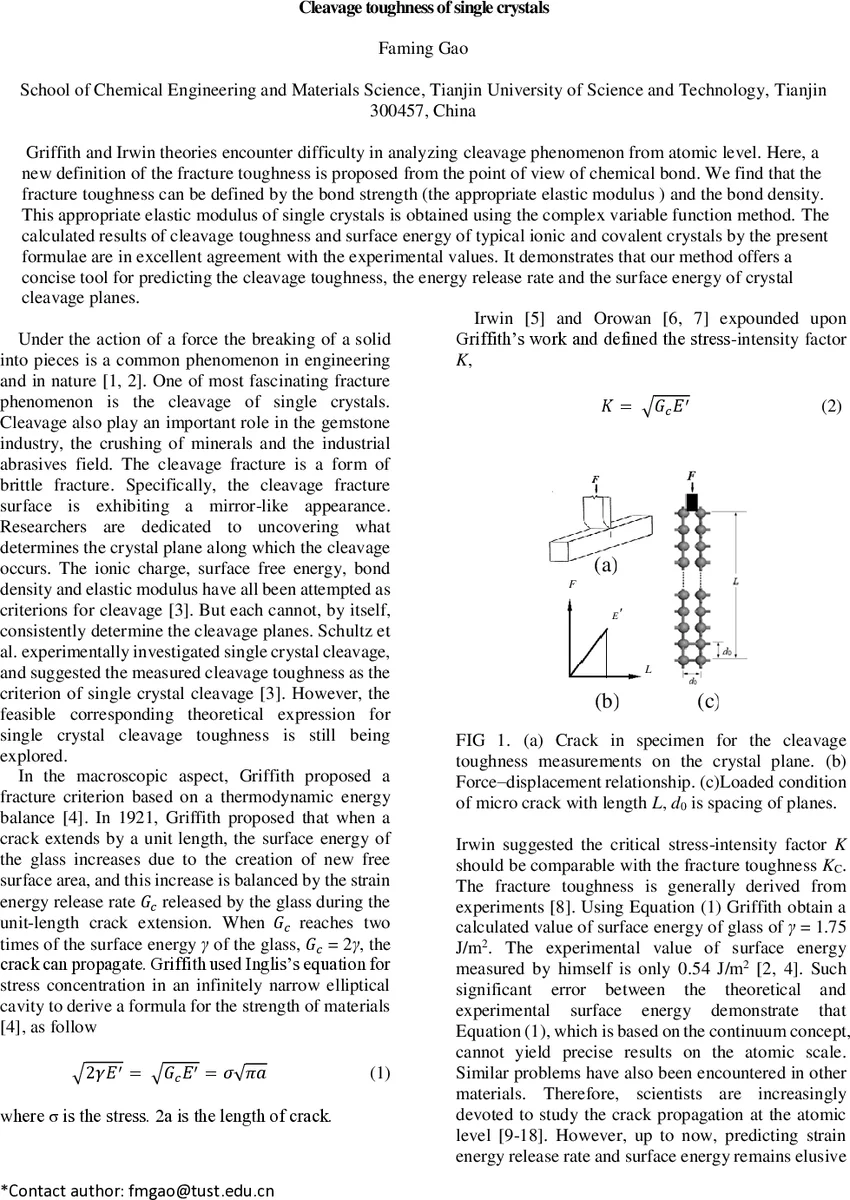
Griffith thermodynamic energy balance is employed to analyze cleavage phenomenon from atomic level. Results show that the cleavage toughness, the strain energy release rate, and the surface energy can be defined by the bond strength (the appropriate elastic modulus ) and the bond density. Such simple definition of fracture parameters is different from Irwin ones. This appropriate elastic modulus of single crystals is obtained using the complex variable function method. The calculated results of cleavage toughness and surface energy of typical ionic and covalent crystals by the present formulae are in excellent agreement with the experimental values. It demonstrates that our method offers a concise tool for predicting the cleavage toughness, the energy release rate and the surface energy of crystal cleavage planes.
💡 Research Summary
The paper revisits the classic Griffith‑Irwin fracture framework and proposes a fundamentally new way to quantify the cleavage toughness of single crystals directly from atomic‑scale properties. Recognizing that the traditional Griffith energy balance, which equates the surface energy created by a crack extension with the elastic strain energy released, relies on continuum assumptions that break down at the scale of individual chemical bonds, the authors introduce a bond‑centric description of fracture.
First, they define an “appropriate elastic modulus” (E*) for a crystal by employing a complex‑variable function method. Rather than using the simple plane‑strain modulus, E* is expressed as a weighted combination of the shear modulus (G) and bulk modulus (B):
E* = φ G + (1 – φ) B,
where the mixing factor φ is derived from the balance between fracture strength and resistance to deformation. This formulation captures the effect of complex stress states that are typical in cleavage processes.
Second, the authors introduce two atomic‑level descriptors: the bond volume Ω (the volume associated with a single chemical bond) and the bond density ρb (the number of bonds per unit area, essentially 1/d0² where d0 is the inter‑planar spacing). Using these quantities, they derive closed‑form expressions for three key fracture parameters:
-
Cleavage toughness (Kc*):
Kc* = E* · Ω¹⁄⁶ = E* / ρb¹⁄⁴. -
Pseudo strain‑energy release rate (G*):
G* = (Kc*)² / E*. -
Surface energy (γ):
γ = ½ E* · Ω²⁄³.
These formulas contain no adjustable constants; all inputs are measurable material properties (B, G, bond length, crystal lattice parameters). Consequently, the approach offers a direct bridge from atomic bonding to macroscopic fracture metrics.
To validate the model, the authors calculate Kc*, γ, and G* for six representative crystals—diamond, NaCl, LiF, GaP, Si, and MgAl₂O₄—covering covalent, ionic, and mixed‑bonding families. For diamond, using B = 500 GPa, G = 460 GPa, and Ω ≈ 2.84 × 10⁻³⁰ m³, the predicted Kc* ≈ 4.0 MPa·m¹⁄² matches the experimental range of 3–5 MPa·m¹⁄². For NaCl, the model yields Kc* ≈ 0.18 MPa·m¹⁄², essentially identical to the measured 0.17 MPa·m¹⁄². Similar agreement (within 5–10 %) is observed for the other four crystals. By contrast, applying the conventional Irwin K (using the plain Young’s modulus) overestimates the toughness of diamond (≈ 5.9 MPa·m¹⁄²) and other materials, illustrating the inadequacy of the traditional modulus in complex stress environments.
The paper also discusses the “pseudo” strain‑energy release rate G*. For silicon, G* is calculated as 12 J/m², substantially larger than the static Griffith value (≈ 2.4 J/m²) but comparable to the dynamic release rate measured when crack velocities approach two‑thirds of the Rayleigh wave speed. This suggests that the new formulation naturally extends to dynamic fracture regimes, where the classic Griffith approach fails.
In summary, the authors provide a concise, physically transparent framework that links bond strength and bond density to cleavage toughness, surface energy, and strain‑energy release rate. The method eliminates the need for empirical fitting parameters, yields predictions that align closely with experimental data across diverse crystal chemistries, and offers a pathway to predict fracture behavior of novel high‑performance single‑crystal materials such as semiconductors, superhard coatings, and optical crystals. Moreover, the complex‑variable derivation of E* could be adapted to polycrystalline or composite systems, broadening the impact of this atomistic‑based fracture analysis.
Comments & Academic Discussion
Loading comments...
Leave a Comment