Diverse stages of star formation in the IRAS 18162-2048 region. Emergence of UV Feedback
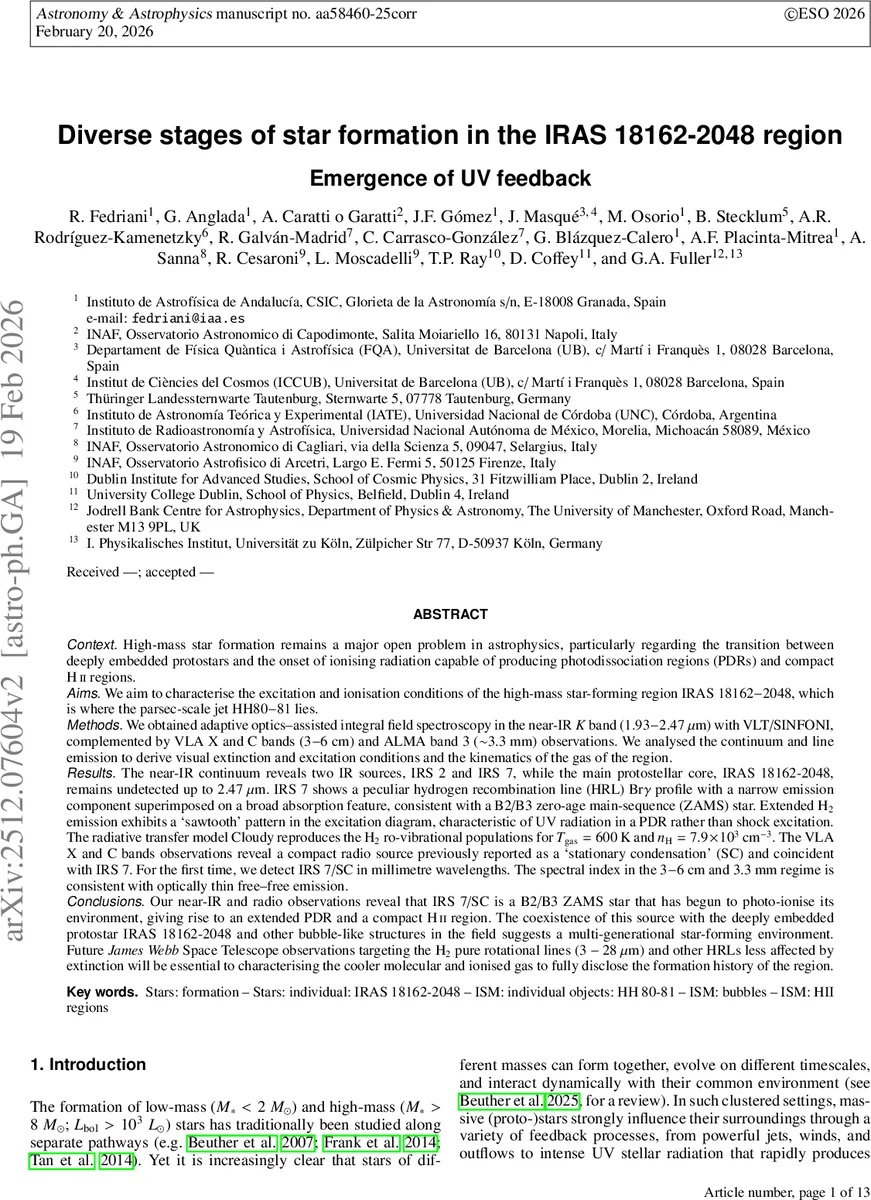
Methods: We obtained adaptive optics-assisted integral field spectroscopy in the near-infrared (IR) $K$ band ($1.93-2.47 \mathrm{μm}$) with VLT/SINFONI, complemented by VLA X and C bands (3$-$6 cm) and ALMA band 3 ($\sim$3.3 mm) observations. Results: The near-IR continuum reveals two infrared sources, IRS 2 and IRS 7, while the main protostellar core IRAS 18162-2048 remains undetected up to $2.47 \mathrm{μm}$. IRS 7 shows a peculiar Hydrogen Recombination Line Br$γ$ profile with a narrow emission component superimposed on a broad absorption feature, consistent with a B2/B3 zero-age main-sequence star. Extended H$2$ emission exhibits a `sawtooth’ pattern in the excitation diagram, characteristic of UV radiation in a PDR rather than shock excitation. The radiative transfer model Cloudy reproduces the H$2$ ro-vibrational populations for $T\mathrm{gas}=600$ K and $n\mathrm{H}=7.9\times10^3 \mathrm{cm^{-3}}$. VLA X and C bands observations reveal a compact radio source previously reported as a stationary condensation (SC) and coincident with IRS 7. For the first time, we detect IRS 7/SC in mm wavelengths. The spectral index in the 3$-$6 cm and 3.3 mm regime is consistent with optically thin free-free emission. Conclusions: Our near-IR and radio observations reveal that IRS 7/SC is a B2/B3 ZAMS star that has begun to photoionise its environment, giving rise to an extended PDR and a compact \ion{H}{ii} region. The coexistence of this source with the deeply embedded protostar IRAS 18162-2048 and other bubble-like structures in the field, suggests a multigenerational star-forming environment. Future \textit{James Webb Space Telescope} observations targeting the H$_2$ pure rotational lines ($3-28 \mathrm{μm}$) and other HRLs less affected by extinction will be essential to characterise the cooler molecular and ionised gas to fully disclose the formation history of the region.
💡 Research Summary
The authors present a multi‑wavelength study of the high‑mass star‑forming region IRAS 18162‑2048, combining adaptive‑optics assisted near‑infrared integral‑field spectroscopy (VLT/SINFONI, K‑band 1.93–2.47 µm, R≈4000) with high‑resolution radio continuum imaging (VLA X‑band 8–12 GHz and C‑band 4–8 GHz, A‑configuration) and millimetre continuum (ALMA Band 3, ~99 GHz, 3.3 mm). The near‑IR data cover an 8″×8″ field (≈1.1×10⁴ au at 1.4 kpc) with ~0.6″ angular resolution.
Continuum imaging reveals two previously known infrared sources, IRS 2 and IRS 7, while the deeply embedded primary protostar (IRAS 18162‑2048) is completely invisible in the K‑band, implying visual extinctions well above 30 mag. IRS 7 shows a modest K‑band magnitude (K_s≈11.5 mag) consistent with historic measurements, and an extended halo interpreted as scattered light.
Spectrally, the field is dominated by molecular hydrogen emission. Over two dozen H₂ ro‑vibrational lines are detected, ranging from 1‑0 S(1) at 2.12 µm to higher‑order Q‑branch transitions. The excitation diagram displays a characteristic “saw‑tooth” pattern: lower‑energy levels are over‑populated relative to a pure thermal distribution, a hallmark of UV‑pumped fluorescence rather than shock heating. No typical accretion/ejection tracers such as
Comments & Academic Discussion
Loading comments...
Leave a Comment