Manifold Learning for Source Separation in Confusion-Limited Gravitational-Wave Data
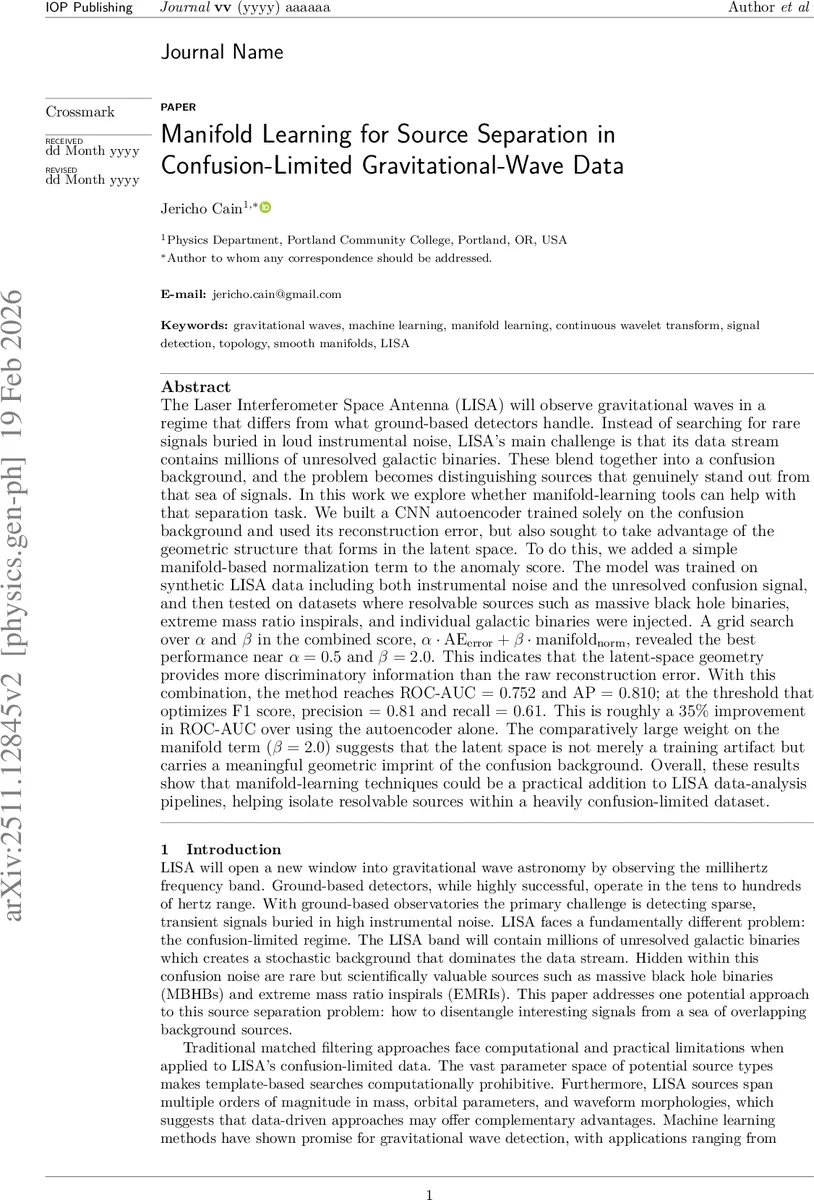
The Laser Interferometer Space Antenna (LISA) will observe gravitational waves in a regime that differs sharply from what ground-based detectors such as LIGO handle. Instead of searching for rare signals buried in loud instrumental noise, LISA’s main challenge is that its data stream contains millions of unresolved galactic binaries. These blend into a confusion background, and the task becomes identifying sources that stand out from that signal population. We explore whether manifold-learning tools can help with this separation problem. We built a CNN autoencoder trained on the confusion background and used its reconstruction error, while also taking advantage of geometric structure in the latent space by adding a manifold-based normalization term to the anomaly score. The model was trained on synthetic LISA data with instrumental noise and confusion background, and tested on datasets with injected resolvable sources such as massive black hole binaries, extreme mass ratio inspirals, and individual galactic binaries. A grid search over $α$ and $β$ in the combined score $α\cdot \mathrm{AE}{\mathrm{error}} + β\cdot \mathrm{manifold}{\mathrm{norm}}$ found optimal performance near $α= 0.5$ and $β= 2.0$, indicating that latent-space geometry provides more discriminatory information than reconstruction error alone. With this combination, the method achieves an AUC of $0.752$, precision $0.81$, and recall $0.61$, a $35%$ improvement over the autoencoder alone. These results suggest that manifold-learning techniques could complement LISA data-analysis pipelines in identifying resolvable sources within confusion-limited data.
💡 Research Summary
The paper addresses a fundamental challenge for the Laser Interferometer Space Antenna (LISA): the data stream will be dominated by a stochastic “confusion” background generated by millions of unresolved galactic binaries, making the identification of resolvable sources such as massive black‑hole binaries (MBHBs), extreme‑mass‑ratio inspirals (EMRIs), and individual galactic binaries (GBs) a difficult source‑separation problem. Traditional matched‑filter searches are computationally prohibitive in this regime because the parameter space is enormous and many signals overlap in the time‑frequency domain.
To tackle this, the authors propose a two‑stage, unsupervised machine‑learning pipeline that combines a convolutional auto‑encoder (CNN‑AE) trained only on the confusion background with a manifold‑based normalization term derived from the geometry of the latent space. The workflow is as follows:
-
Synthetic Data Generation – Instrumental noise is modeled using LISA’s published power‑spectral‑density (PSD) for acceleration and optical‑metrology noise. Three astrophysical signal families are simulated with analytical waveforms: (i) post‑Newtonian chirps for MBHBs, (ii) multi‑harmonic quasi‑periodic waveforms for EMRIs, and (iii) nearly monochromatic sinusoids for GBs. The confusion background is built by incoherently summing 1 000 weak GBs per 1‑hour segment (SNR 0.1–2.0). Training data consist of 5 000 background‑only segments; test data contain 200 background‑only and 400 signal‑plus‑background segments, with signal SNRs in the range 10–50.
-
Time‑Frequency Pre‑processing – Each 1‑hour, 1 Hz‑sampled time series is transformed with a continuous wavelet transform (CWT) using a Morlet wavelet, covering 0.1 mHz–100 mHz with 140 logarithmically spaced scales. The magnitude of the complex coefficients is log‑scaled, normalized to zero mean and unit variance, and resized to a fixed 100 × 3600 image (frequency × time). This representation preserves the geometric patterns of different source types (horizontal lines for GBs, slowly curving tracks for EMRIs, rapid chirps for MBHBs) while providing a compact input for the CNN.
-
Convolutional Auto‑Encoder – The encoder maps the 100 × 3600 scalograms to a 32‑dimensional latent vector; the decoder reconstructs the scalogram. Training minimizes mean‑squared reconstruction error on background‑only data, encouraging the network to learn the low‑dimensional manifold on which the confusion background resides.
-
Manifold Normalization – In the latent space, a k‑nearest‑neighbors (k = 15) graph is built for each test point. The average distance to the k neighbors, μ(z), quantifies how far a point lies from the learned manifold. This distance is multiplied by a weight β and added to the auto‑encoder reconstruction error weighted by α, forming a combined anomaly score:
Score = α·AE_error + β·μ(z). -
Hyper‑parameter Search – A grid search over α and β reveals optimal performance at α = 0.5 and β = 2.0, indicating that the manifold term contributes roughly four times more discriminative power than reconstruction error alone.
-
Results – Using the combined score, the method achieves:
- ROC‑AUC = 0.752
- Average precision (AP) = 0.810
- At the F1‑optimal threshold: precision = 0.81, recall = 0.61
This represents a ~35 % improvement over using the auto‑encoder reconstruction error alone. Performance varies by source class: MBHBs (high‑frequency chirps) are detected most reliably, EMRIs show moderate success, and individual GBs (low‑frequency, near‑monochromatic) are the hardest to separate because their morphology overlaps heavily with the confusion background.
-
Analysis of Latent Space – t‑SNE/UMAP visualizations of the 32‑dimensional latent vectors show a dense cluster for pure background and distinct sub‑clusters for each injected source type, confirming that the auto‑encoder learns a meaningful geometric structure rather than a trivial mapping.
-
Limitations and Future Work – The confusion background is modeled with 1 000 sources per segment, far fewer than the true millions, so scaling effects remain untested. The k‑NN distance computation scales poorly with dataset size, suggesting the need for approximate nearest‑neighbor libraries (e.g., FAISS) for full‑mission data. The current pipeline processes independent 1‑hour windows; extending to continuous multi‑hour observations will require strategies for latent‑space temporal coherence. Overlapping multiple resolvable signals pose an additional challenge not addressed here.
Future directions include: integrating the manifold‑based anomaly score as a pre‑filter for downstream matched‑filter or Bayesian inference pipelines; applying density‑based clustering (DBSCAN) in latent space to automatically label sub‑manifolds; employing multi‑resolution CWTs to capture both low‑ and high‑frequency structures; and testing the approach on publicly released LISA Data Challenge (LDC) datasets to assess real‑world applicability.
Conclusion – By training a CNN auto‑encoder on the confusion background and augmenting its reconstruction error with a manifold‑derived distance metric, the authors demonstrate a viable, unsupervised method for flagging resolvable gravitational‑wave sources in LISA’s confusion‑limited data. The combined anomaly score substantially outperforms reconstruction error alone, indicating that the latent‑space geometry encodes valuable discriminative information. This work opens a pathway for incorporating manifold learning into LISA’s data‑analysis pipelines, potentially reducing the computational burden of exhaustive template searches while preserving sensitivity to a broad class of astrophysical signals.
Comments & Academic Discussion
Loading comments...
Leave a Comment