Finding Partite Hypergraphs Efficiently
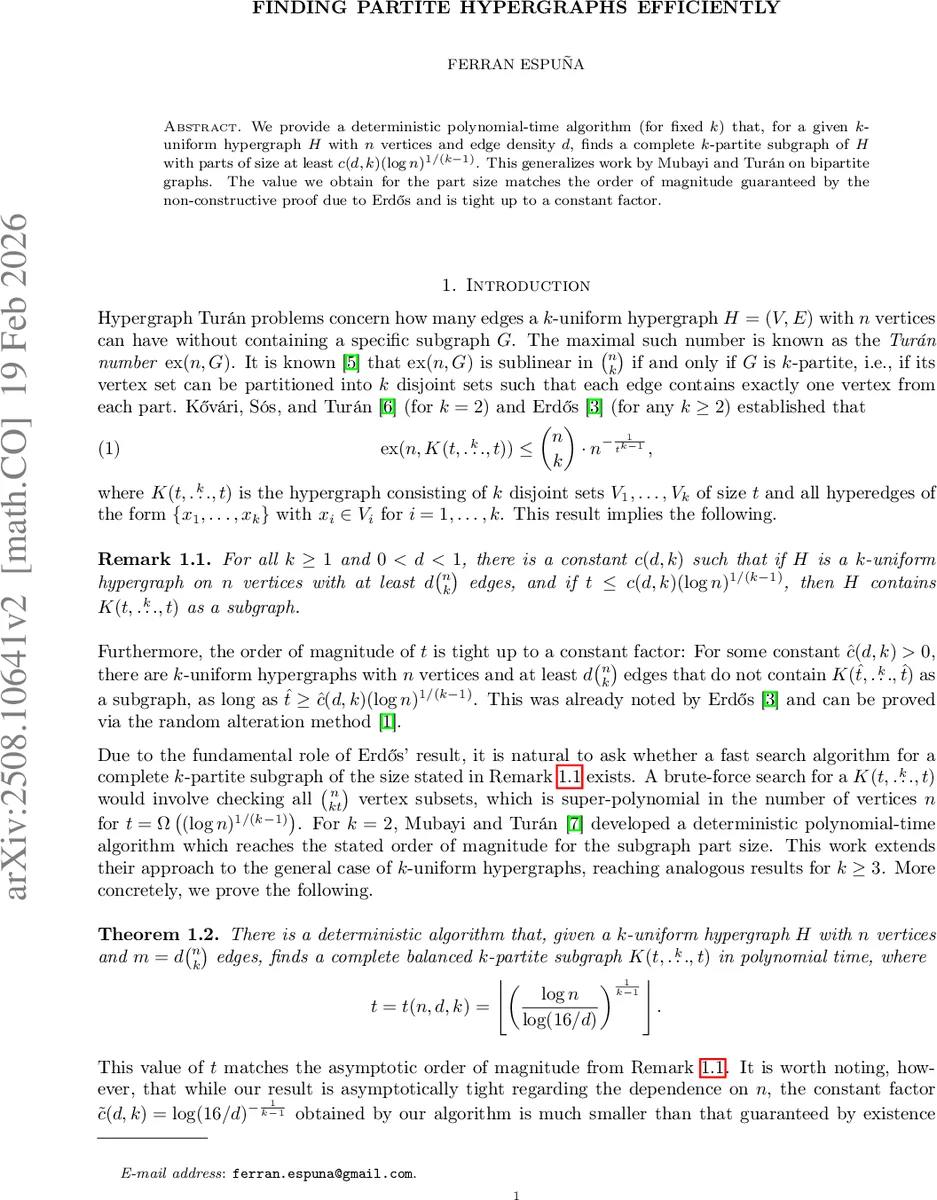
We provide a deterministic polynomial-time algorithm that, for a given $k$-uniform hypergraph $H$ with $n$ vertices and edge density $d$, finds a complete $k$-partite subgraph of $H$ with parts of size at least ${c(d, k)(\log n)^{1/(k-1)}}$. This generalizes work by Mubayi and Turán on bipartite graphs. The value we obtain for the part size matches the order of magnitude guaranteed by the non-constructive proof due to Erdős and is tight up to a constant factor.
💡 Research Summary
The paper “Finding Partite Hypergraphs Efficiently” addresses a fundamental gap in extremal hypergraph theory: while Erdős’ non‑constructive result guarantees that any sufficiently dense k‑uniform hypergraph on n vertices contains a complete balanced k‑partite subhypergraph K(t,…,t) with part size t = Θ((log n)^{1/(k‑1)}), no polynomial‑time algorithm was known for locating such a structure when k ≥ 3. The authors fill this gap by presenting a deterministic algorithm that, for any fixed uniformity k, finds a complete k‑partite subgraph of size at least
t = ⌈(log n·log(16/d))^{1/(k‑1)}⌉
where d is the edge density (m = d·n^{k}) of the input hypergraph H. This bound matches the asymptotic order of Erdős’ existence theorem and improves the constant factor compared with the naïve existential bound c(d,k)=log(1/d)/(k‑1).
Algorithmic framework
The core routine, named FindPartite, works recursively. For a k‑uniform hypergraph H it first computes three parameters: the target part size t, a “high‑degree” set size w = ⌈4t/d⌉, and a threshold s = ⌈(d/4)·t·n^{k‑1}⌉. It then selects the w vertices of highest degree (the set W). For every t‑subset T⊆W the algorithm constructs the set
S = { y ⊆ V^{k‑1} : ∀ x∈T, {x}∪y ∈ E(H) }
i.e., all (k‑1)-tuples that together with every vertex of T form an edge. If |S| ≥ s, the algorithm builds a (k‑1)-uniform hypergraph H′ whose edge set is S and recurses on (H′, k‑1). The recursion returns k‑1 disjoint vertex sets V₁,…,V_{k‑1} each of size at least t. Adding the original T as the k‑th part yields a complete K(t,…,t) in the original hypergraph.
Correctness proof
Correctness hinges on a quantitative version of the Kővári‑Sós‑Turán theorem. By viewing the relationship between W and the (k‑1)-tuples as a bipartite graph B, the authors show that B contains at least w·d·n^{k‑1} edges. The theorem guarantees that if this edge count exceeds a certain threshold, then B must contain a complete bipartite subgraph B
Comments & Academic Discussion
Loading comments...
Leave a Comment