A Note on Inferential Decisions, Errors and Path-Dependency
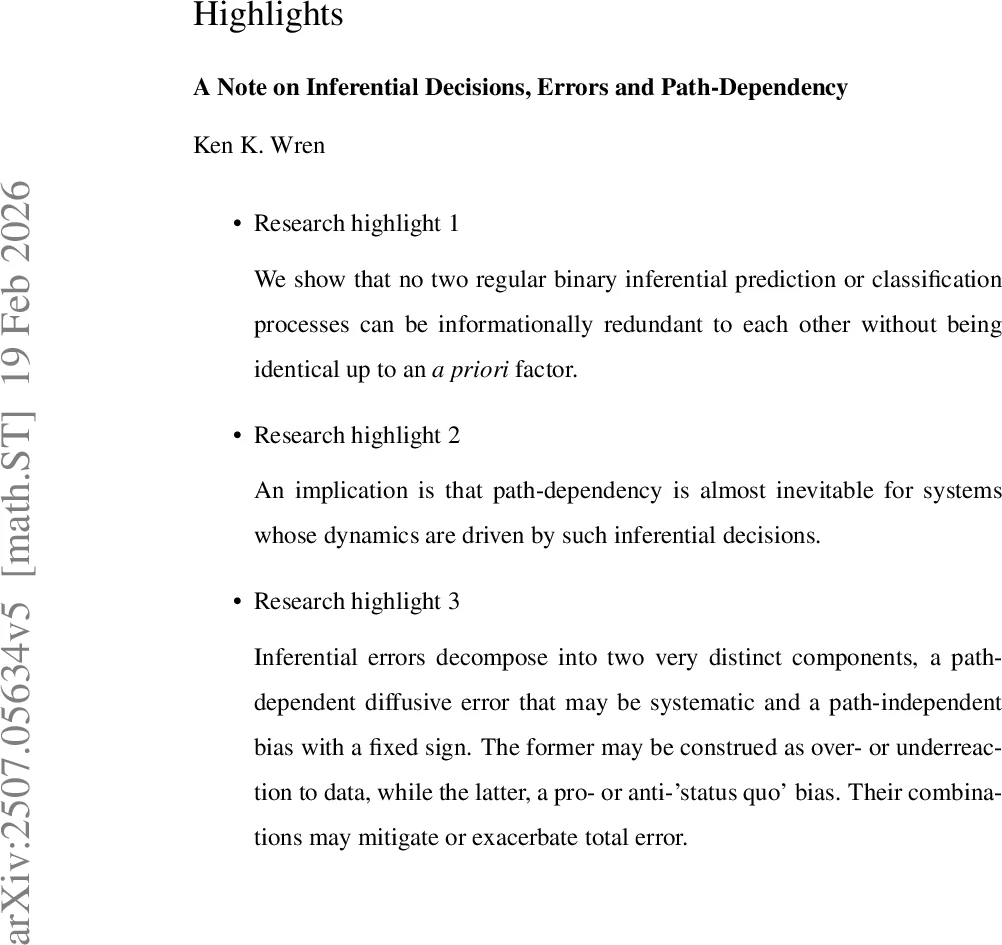
Consider the sequential testing of binary outcomes. The a posteriori belief process and its objective conditional-probability counterpart generally differ but converge to the same result in well-defined tests. We show that unless the two processes are ’essentially identical’, differing only by an a priori factor, time-homogeneous continuous decisions based on the former are path-dependent with respect to state-variables based on the latter or any other non-essentially-identical processes. Inferential error decomposes into a path-dependent and a path-independent component, whose distinct properties are relevant to error mitigation.
💡 Research Summary
The paper investigates sequential testing of binary outcomes and the relationship between the posterior belief process (the agent’s subjective probability) and its objective conditional‑probability counterpart. While both processes converge in well‑defined tests, they generally differ during the learning horizon. The author introduces the notion of “informational redundancy” between two inference procedures that use the same data stream but possibly different likelihood models. Redundancy is defined by three conditions: (1) the log‑likelihood ratios of the two procedures stay within a finite bound, (2) the posterior beliefs of one can be obtained from the other via a continuous mapping at each time step, and (3) this mapping is time‑homogeneous (the same function at all times).
Lemma 1, the central theoretical result, proves that for regular (resolving) binary inference, the only way two procedures can be informationally redundant is if they are identical up to a constant a‑priori factor. The proof exploits the Bayes rule, the Cauchy functional equation, and the continuity and time‑homogeneity constraints to show that any admissible mapping must be a simple multiplicative scaling of odds. Consequently, unless the two processes differ solely by an a‑priori constant, they are not redundant.
From this lemma the paper derives a powerful implication: any decision rule that depends only on the posterior belief (e.g., a function u(πₙ)) is inevitably path‑dependent with respect to any state variable that is a function of the true conditional probability (e.g., v(pₙ)). In other words, the same belief level can arise via different histories, and the decision outcome will differ depending on that history. This intrinsic source of path‑dependency is shown to be unavoidable in social‑dynamic systems such as markets, elections, or organizational learning, where agents repeatedly update beliefs based on streaming data.
The author then decomposes inferential error into two orthogonal components. The first component is a fixed‑sign bias that depends only on the ratio ρ between the odds of a “would‑be” belief (the belief that would be obtained if the true prior were known) and the actual posterior belief. This bias is path‑independent and reflects a systematic tendency to favor or oppose the status‑quo. The second component is a diffusive, stochastic error driven by the difference between the signal‑to‑noise ratios of the log‑likelihood processes for the true model and the agent’s model. In continuous time, this component is expressed as an integral of σ_ℓ² – σ_l², and its sign (positive for under‑reaction, negative for over‑reaction) tends to persist, making it path‑dependent. The two components can either mitigate each other (e.g., a status‑quo bias offsetting an over‑reaction) or exacerbate total error.
The paper applies these insights to asset‑pricing theory. In a standard model with zero risk‑free rate, the ex‑ante risk premium is path‑independent, but the realized premium, which depends on the true data‑generating law P_B, becomes path‑dependent when the agent’s model Q_B differs from P_B. This highlights the practical importance of accounting for model misspecification in risk‑premium estimation.
Appendices provide the detailed proof of Lemma 1, showing how the Cauchy equation forces the redundancy mapping to be a power function, and how the adjacency condition eliminates any exponent other than one. Appendix B discusses the properties of the log‑likelihood process, its continuous‑time limit (a Wiener process with constant or time‑varying volatility), and how Ito’s lemma characterises admissible transformations between two such processes.
Overall, the paper delivers a rigorous mathematical foundation for the near‑inevitability of path‑dependency in sequential binary inference, clarifies the precise conditions under which two inference procedures can be considered informationally redundant, and offers a clean decomposition of inferential error into a path‑independent bias and a path‑dependent diffusion term. These results have direct implications for designing robust decision‑making algorithms, improving error‑mitigation strategies, and understanding the dynamics of belief‑driven economic systems.
Comments & Academic Discussion
Loading comments...
Leave a Comment