Counting degree-constrained orientations
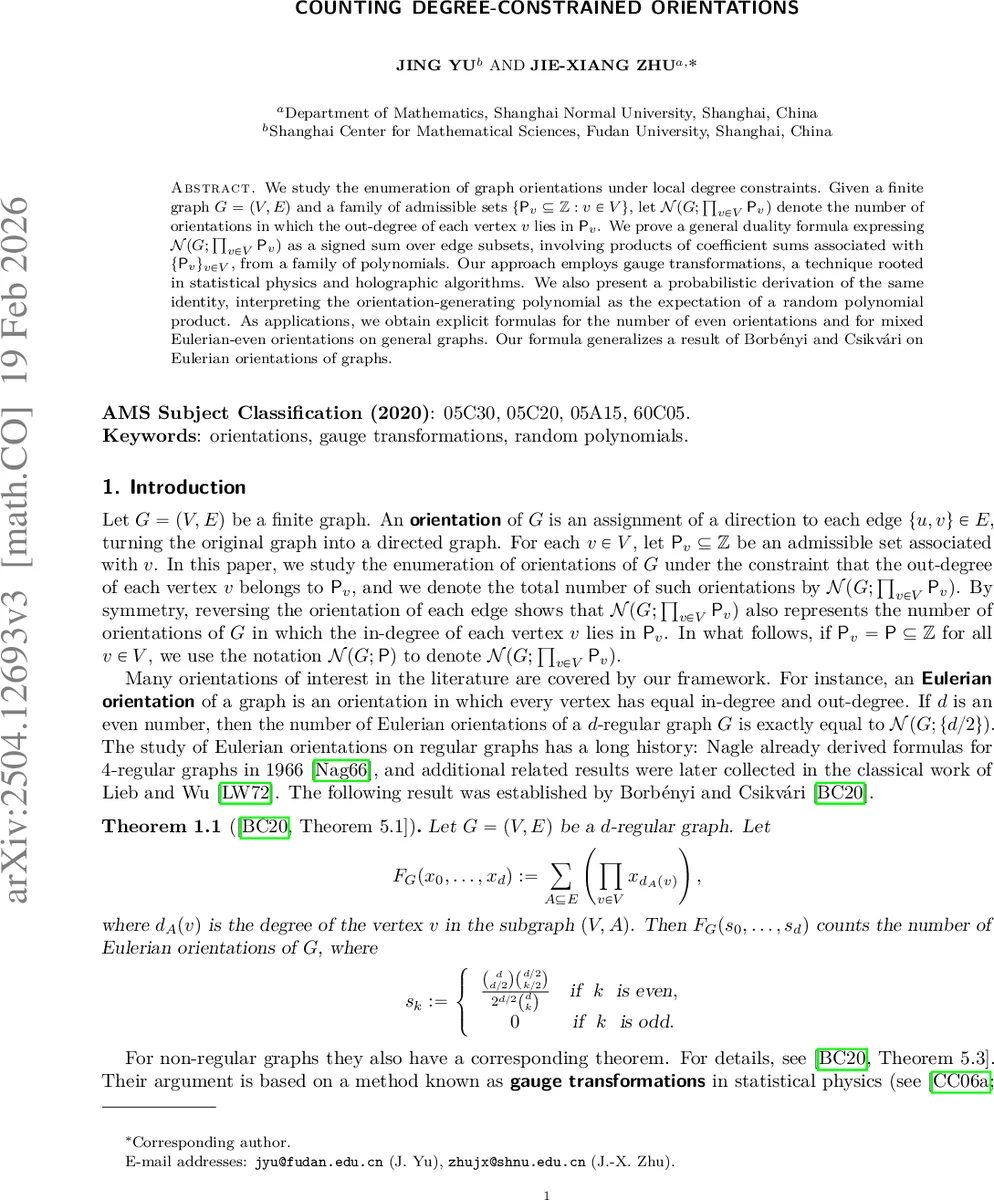
We study the enumeration of graph orientations under local degree constraints. Given a finite graph $G = (V, E)$ and a family of admissible sets ${\mathsf P_v \subseteq \mathbb{Z} : v \in V}$, let $\mathcal N (G; \prod_{v \in V} \mathsf P_v)$ denote the number of orientations in which the out-degree of each vertex $v$ lies in $P_v$. We prove a general duality formula expressing $\mathcal N(G; \prod_{v \in V} \mathsf P_v)$ as a signed sum over edge subsets, involving products of coefficient sums associated with ${\mathsf P_v}_{v \in V}$, from a family of polynomials. Our approach employs gauge transformations, a technique rooted in statistical physics and holographic algorithms. We also present a probabilistic derivation of the same identity, interpreting the orientation-generating polynomial as the expectation of a random polynomial product. As applications, we obtain explicit formulas for the number of even orientations and for mixed Eulerian-even orientations on general graphs. Our formula generalizes a result of Borbényi and Csikvári on Eulerian orientations of graphs.
💡 Research Summary
The paper addresses the problem of counting orientations of a finite graph G=(V,E) under local out‑degree constraints. For each vertex v a prescribed admissible set P_v⊂ℤ is given, and N(G;{P_v}) denotes the number of orientations in which the out‑degree of v belongs to P_v. While special cases such as Eulerian orientations (out‑degree = indegree) or even orientations (out‑degree even) have been studied before, the authors develop a unified framework that works for arbitrary families {P_v}.
The core of the work is a duality theorem (Theorem 2.3) that rewrites the orientation count as a signed sum over all edge subsets F⊆E. The authors first encode the orientation problem as a normal factor graph: each vertex carries a local function that is 1 exactly when the incident edges realize an out‑degree belonging to P_v, and each edge is equipped with two 2×2 matrices G_{uv} and G_{vu}. By choosing these matrices so that G_{uv}·G_{vu}=I (the identity), a gauge transformation leaves the partition function unchanged (Proposition 2.2). After the transformation, the contribution of a vertex depends only on the degree d_F(v) of v in the subgraph induced by F, and the out‑degree constraint is captured by a linear functional C that extracts the sum of coefficients of a polynomial whose exponents lie in P_v. The resulting identity is
N(G;{P_v}) = Σ_{F⊆E} (–1)^{|F|} 2^{|E|–|F|} ∏_{v∈V} C( (1+z)^{d_F(v)} – z^{d_F(v)} ; P_v ).
Here C(q;S) means “sum of coefficients of q(z) whose exponent belongs to S”. This formula converts a sum over exponentially many orientations into a sum over exponentially many edge subsets, but the latter is often more tractable because the vertex contributions factorize.
A second, independent proof is given via a probabilistic viewpoint. Define the graph polynomial H_G(z)=∏{uv∈E}(z_u+z_v). For each edge introduce an independent Bernoulli variable ε_e∈{0,1} with probability ½. The expectation of the random product ∏{uv∈E}(ε_u z_u+ε_v z_v) equals H_G(z). Applying the coefficient‑extraction functional C to H_G(z) yields exactly N(G;{P_v}), reproducing the duality formula. This approach highlights that the orientation‑generating polynomial can be seen as the expectation of a product of simple random univariate polynomials. The authors further generalize this idea (Theorem 3.7) by allowing arbitrary independent complex‑valued random variables ε_e and \tilde ε_e, provided they satisfy certain moment conditions; this leads to a broader family of identities that encompass N‑colorings of edges.
The duality theorem is then applied to several concrete counting problems:
-
N‑divisible orientations – orientations where each out‑degree is a multiple of N (N≥2). By choosing N‑th roots of unity ω_N^j as the “weights” in the functional C, the authors obtain a formula (4.4) that expresses the number of N‑divisible orientations as a weighted sum over N‑colorings of the edge set. For N=2 (even orientations) on a connected graph the formula collapses to the simple closed form 2^{|E|−|V|+1}, recovering a known result but now derived from the general framework.
-
Eulerian‑even orientations – orientations that are simultaneously Eulerian (out‑degree = indegree) and even. By intersecting the corresponding admissible sets, the duality theorem yields an explicit expression involving products of binomial coefficients and powers of 2.
-
Mixed constraints – any combination of local constraints can be handled by plugging the appropriate sets P_v into the general formula.
The paper’s contributions are threefold. First, it provides a universal duality identity that translates degree‑constrained orientation counts into edge‑subset sums, thereby unifying many previously isolated results. Second, it showcases the power of gauge transformations—originating from statistical physics and holographic algorithms—to manipulate combinatorial partition functions while preserving their values. Third, it offers a probabilistic reinterpretation that not only supplies an alternative proof but also suggests flexible extensions (different distributions, continuous weights) that are difficult to achieve via gauge transformations alone.
Overall, the work bridges combinatorial enumeration, statistical‑mechanical techniques, and probabilistic polynomial analysis, delivering new tools for tackling a broad class of counting problems on graphs.
Comments & Academic Discussion
Loading comments...
Leave a Comment