Self-reinforcing cascades: A spreading model for beliefs or products of varying intensity or quality
Models of how things spread often assume that transmission mechanisms are fixed over time. However, social contagions–the spread of ideas, beliefs, innovations–can lose or gain in momentum as they spread: ideas can get reinforced, beliefs strengthened, products refined. We study the impacts of such self-reinforcement mechanisms in cascade dynamics. We use different mathematical modeling techniques to capture the recursive, yet changing nature of the process. We find a critical regime with a range of power-law cascade size distributions with non-universal scaling exponents. This regime clashes with classic models, where criticality requires fine tuning at a precise critical point. Self-reinforced cascades produce critical-like behavior over a wide range of parameters, which may help explain the ubiquity of power-law distributions in empirical social data.
💡 Research Summary
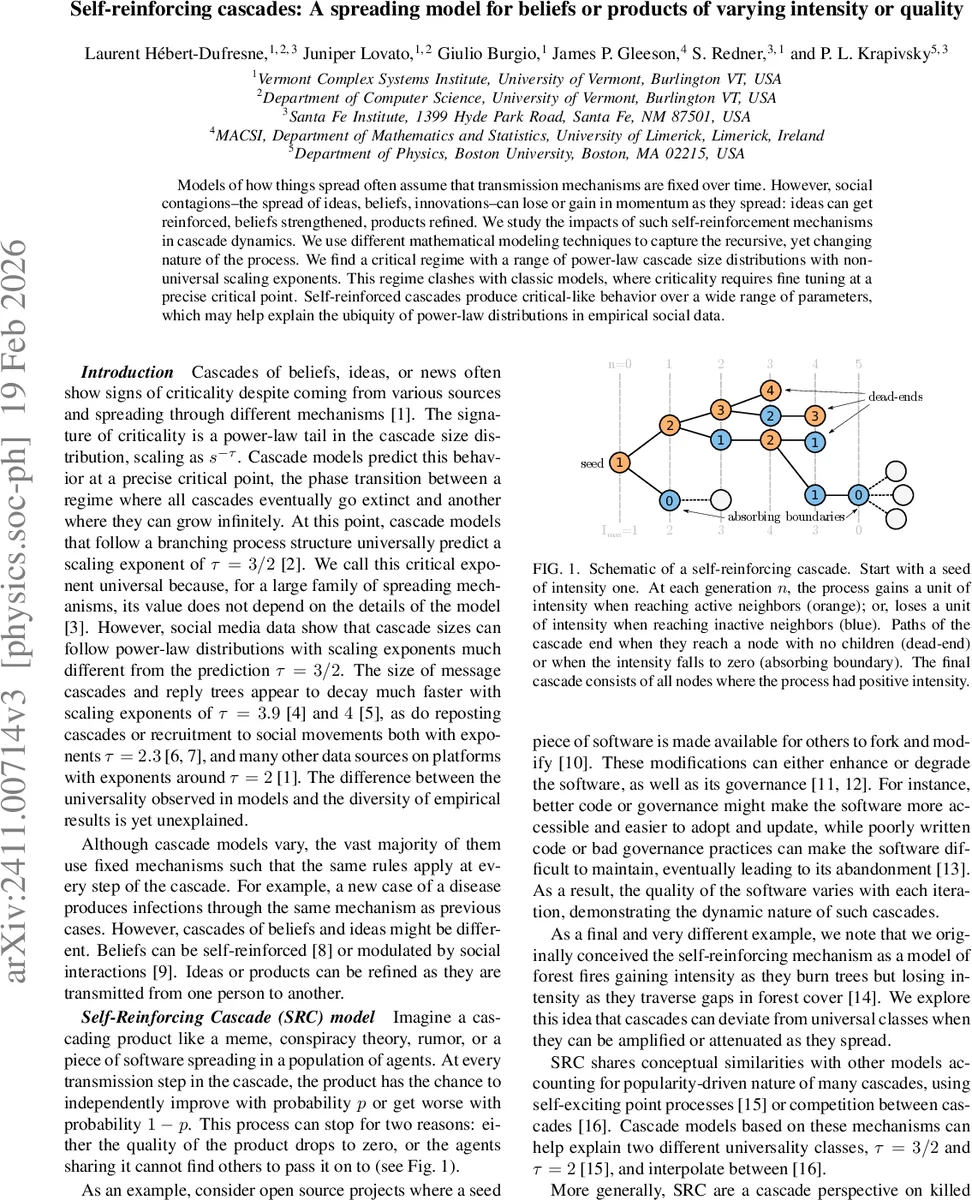
The paper introduces a novel spreading model called the Self‑Reinforcing Cascade (SRC) that captures the dynamic nature of many social contagions, such as ideas, beliefs, memes, or software projects, whose “intensity” or “quality” can evolve as they propagate. Traditional cascade models assume a fixed transmission rule: each infected node attempts to infect its neighbors with the same probability at every step. In contrast, the SRC model allows the transmission strength to change at each step: when a node contacts a receptive neighbor the cascade intensity increases by one unit with probability p, while contacting a non‑receptive neighbor decreases the intensity by one unit with probability 1‑p. The process stops either when the intensity reaches zero (an absorbing boundary) or when a node has no further children (a dead‑end).
Mathematically the authors place the process on a generic branching structure described by a probability‑generating function (PGF) G(x) for the number of children per node. They define H_k(x) as the PGF of the cascade size generated by a node that starts with intensity k. By conditioning on whether each child is receptive or not, they obtain a second‑order recursive relation:
H_k(x) = x G
Comments & Academic Discussion
Loading comments...
Leave a Comment