Existence and regularity for perturbed Stokes system with critical drift
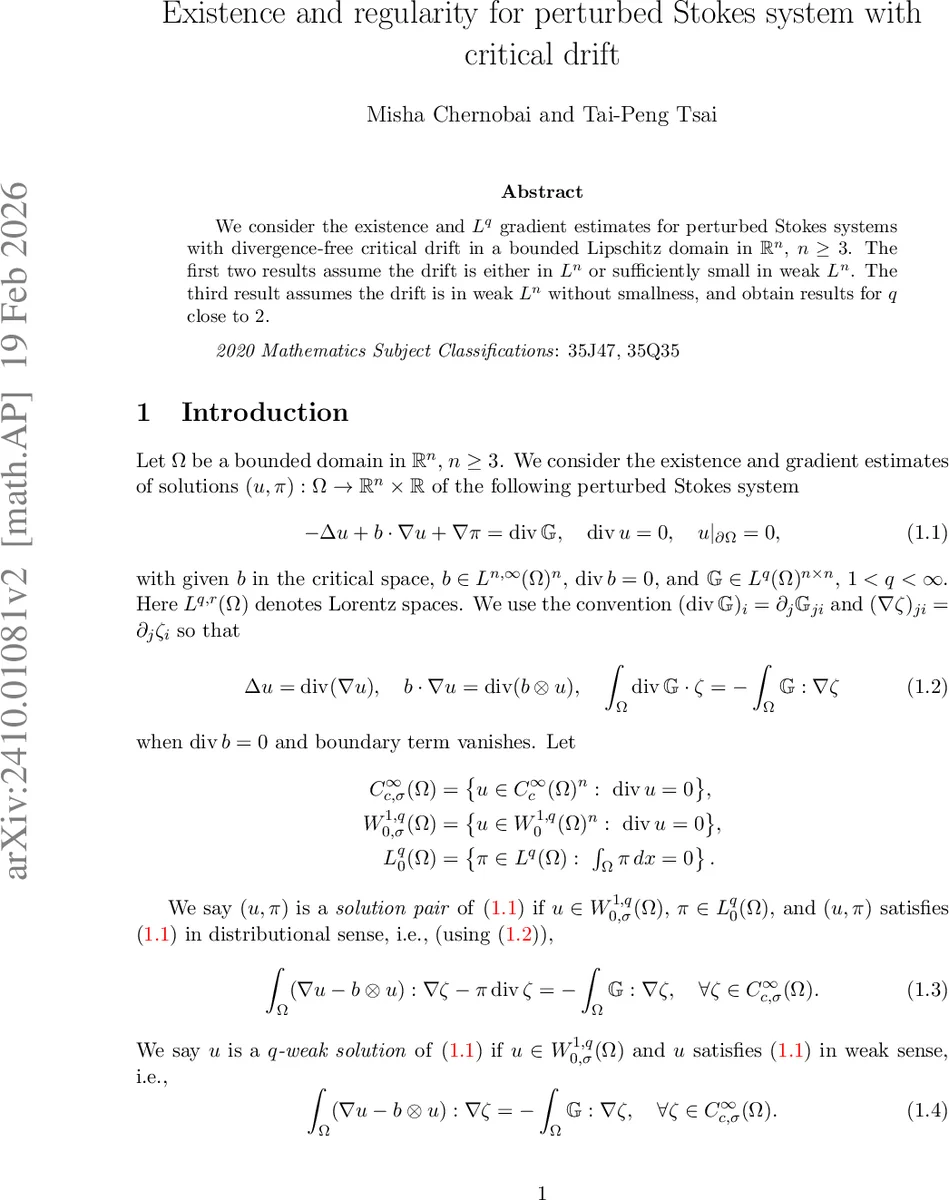
We consider the existence and $L^q$ gradient estimates for perturbed Stokes systems with divergence-free critical drift in a bounded Lipschitz domain in $\mathbb{R}^n$, $n \ge 3$. The first two results assume the drift is either in $L^n$ or sufficiently small in weak $L^n$. The third result assumes the drift is in weak $L^n$ without smallness, and obtain results for $q$ close to 2.
💡 Research Summary
The paper studies the stationary perturbed Stokes system in a bounded Lipschitz domain Ω⊂ℝⁿ (n≥3) with a divergence‑free drift term b that belongs to the critical space Lⁿ,∞(Ω)ⁿ. The system is
−Δu + b·∇u + ∇π = div G, div u = 0, u|_{∂Ω}=0,
where G∈L^q(Ω)^{n×n} and 1<q<∞. The authors investigate three regimes for the drift:
-
Small drift in Lⁿ (Proposition 1.3). If b∈Lⁿ(Ω)ⁿ and div b=0, then for any q the system admits a unique pair (u,π) with u∈W^{1,q}0,σ(Ω) and π∈L^q_0(Ω) satisfying the estimate
‖u‖{W^{1,q}} + ‖π‖{L^q} ≤ C‖G‖{L^q}.
The proof relies on the standard estimate of the lower‑order term b·∇u in W^{−1,q} (Lemma 2.3) and the pressure reconstruction Lemma 2.6. The Lipschitz constant of Ω must be sufficiently small to guarantee the L^q‑regularity of the unperturbed Stokes operator (Theorem 2.7). -
Small drift in the weak space Lⁿ,∞ (Theorem 1.4). When b∈Lⁿ,∞(Ω)ⁿ with ‖b‖_{Lⁿ,∞}≤ε(q,Ω), the same existence and estimate hold. Lemma 2.4 provides the required W^{−1,q} bound for b·∇u in terms of the weak‑norm, and a perturbation argument yields the result.
-
General drift without smallness (Theorem 1.5). This is the most novel contribution. Assuming only div b=0, b∈Lⁿ,∞(Ω)ⁿ and a Lipschitz constant L<½, the authors prove that there exists a number p₀>2, depending on Ω and ‖b‖_{Lⁿ,∞}, such that for every q∈(p₀′,p₀) the perturbed Stokes system admits a unique solution with the same estimate as above. The proof follows a Gehring‑type reverse Hölder scheme:
- A Caccioppoli inequality is derived by testing with f(|u|)u ζ, where f is a Lipschitz cut‑off and ζ a smooth spatial cut‑off. The divergence‑free condition eliminates the troublesome b·∇u term after integration by parts.
- The pressure term, which cannot be absorbed as in scalar equations, is handled via Wolf’s local pressure projection. Section 4 establishes uniform L²‑bounds for this projection using an explicit Bogovskiĭ map.
- Combining the Caccioppoli estimate with Lorentz‑space Hölder and Sobolev embeddings (Lemmas 2.1, 2.2) yields a reverse Hölder inequality for |∇u|². Iterating this inequality raises integrability from L² to any q in the interval (p₀′,p₀).
- Finally, the pressure is recovered from the divergence of the stress tensor using Lemma 2.6, giving the desired L^q‑bound for π.
The result shows that even when the drift is large in the critical norm, one still obtains higher integrability of the gradient, albeit only for exponents close to 2. The restriction L<½ is technical and stems from the need for uniform control of the local pressure projection on Lipschitz subdomains.
The paper also contains a scalar counterpart (Proposition 1.6). For the scalar equations −Δu+∇·(ub)=div F and −Δv−b·∇v=div G with b∈Lⁿ,∞ and div b≥0, the same p₀>2 exists, providing W^{1,q}‑estimates for q up to p₀ (or down to p₀′). This extends Kwon’s work on reverse Hölder inequalities to the case of divergence‑free drifts without requiring b to belong to L^{n/2,∞}.
The structure of the paper is as follows: Section 2 collects Lorentz‑space inequalities, drift estimates, and the classical L^q‑theory for the unperturbed Stokes system. Section 3 proves the a priori estimates for the small‑drift cases (Proposition 1.3, Theorem 1.4). Section 4 develops the uniform L²‑bounds for Wolf’s pressure projection using an explicit Bogovskiĭ map. Sections 5 and 6 contain the reverse Hölder argument and the proof of Theorem 1.5. Section 7 treats the scalar equations and proves Proposition 1.6.
Overall, the work advances the regularity theory for Stokes‑type systems with critical drifts. By introducing Wolf’s local pressure projection into the Gehring‑Kwon framework, the authors overcome the main obstacle that prevented the pressure term from being treated by standard De Giorgi–Moser techniques. This opens the door to further investigations of Navier–Stokes equations with critical, possibly large, divergence‑free drifts, and suggests that similar pressure‑projection ideas could be useful in other coupled PDE systems where pressure or Lagrange multiplier fields appear.
Comments & Academic Discussion
Loading comments...
Leave a Comment