How Bursty is Star Formation at z>5?
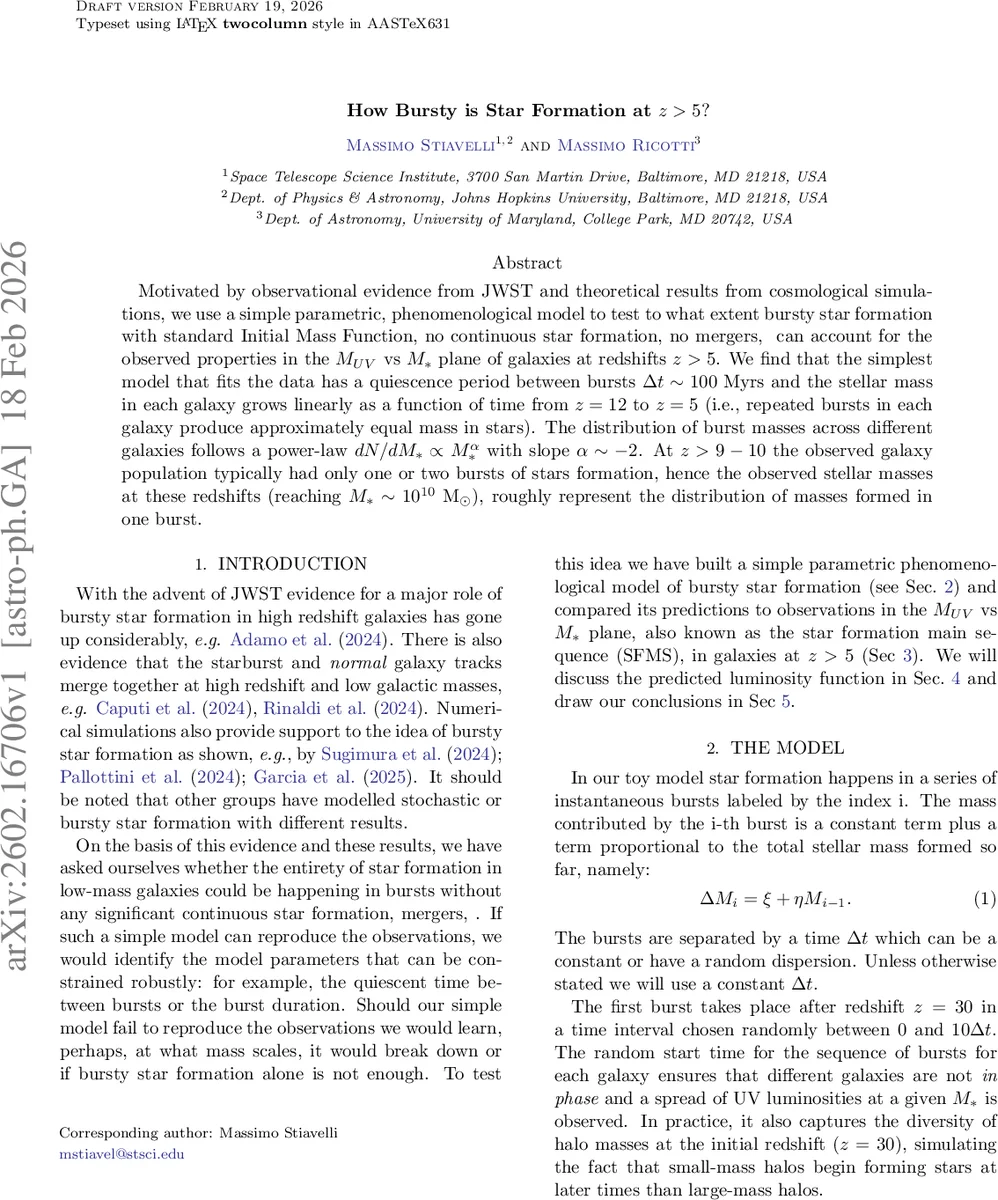
Motivated by observational evidence from JWST and theoretical results from cosmological simulations, we use a simple parametric, phenomenological model to test to what extent bursty star formation with standard Initial Mass Function, no continuous star formation, no mergers, \mr{and no dust} can account for the observed properties in the $M_{UV}$ vs $M_$ plane of galaxies at redshifts $z>5$. We find that the simplest model that fits the data has a quiescence period between bursts $Δt \sim 100$~Myrs and the stellar mass in each galaxy grows linearly as a function of time from $z=12$ to $z=5$ (i.e., repeated bursts in each galaxy produce approximately equal mass in stars). The distribution of burst masses across different galaxies follows a power-law $dN/dM_ \propto M_^α$ with slope $α\sim -2$. At $z>9-10$ the observed galaxy population typically had only one or two bursts of stars formation, hence the observed stellar masses at these redshifts (reaching $M_ \sim 10^{10}$~M$_\odot$), roughly represent the distribution of masses formed in one burst.
💡 Research Summary
The authors investigate whether a highly simplified, burst‑only model of star formation can reproduce the observed UV‑luminosity versus stellar‑mass (M_UV–M_*) distribution of galaxies at redshifts z > 5, as revealed by JWST. Their model deliberately excludes continuous star formation, galaxy mergers, and dust attenuation, assuming a standard Salpeter IMF and low metallicity (Z = 0.002). Star formation proceeds in discrete, instantaneous bursts indexed by i, with the stellar mass added in each burst given by ΔM_i = ξ + η M_{i‑1}. Here ξ represents the mass formed in the first burst (or the intrinsic burst strength), while η controls how the burst mass scales with the already‑assembled stellar mass. Bursts are separated by a fixed interval Δt, which they initially treat as a constant but also explore random variations. The first burst for each galaxy occurs at a random time between redshift 30 and 10 Δt later, mimicking the spread in halo formation times.
The authors generate synthetic galaxy populations by evolving each model galaxy from z = 12 down to z = 5, sampling 21 equally spaced redshift snapshots. At each snapshot they compute the total stellar mass and the rest‑frame 1500 Å UV luminosity using STARBURST99, weighting each past burst by its age‑dependent luminosity. An observational cut of m_AB ≤ 30 is applied to emulate JWST detection limits.
A series of “minimal” models with constant ξ, η, and Δt are first examined. These produce vertical lines in the M_UV–M_* plane; the vertical extent is set by Δt (larger Δt yields greater UV dimming between bursts) and the horizontal position by the number of bursts (i.e., redshift). Constant‑ξ models cannot span the full observed mass range without over‑producing extremely bright UV sources, especially when η > 0 (exponential mass growth). Conversely, linear growth (η = 0) requires larger ξ to reach high masses, but then risks bright‑UV excesses.
To resolve these tensions the authors introduce stochasticity. They allow ξ to follow a power‑law distribution dN/dξ ∝ ξ^{α_ξ} with α_ξ = −1 or −2, and optionally let η also vary. The most successful configuration (their “Model 19”) adopts η = 0 (linear mass growth), Δt = 100 Myr, and a ξ distribution with α_ξ = −2 spanning 10⁶–10¹⁰ M_⊙. This model reproduces the observed scatter and median trends of the Morishita et al. (2024) sample across all redshift bins (z ≈ 5–12). The power‑law slope of ξ directly maps onto the faint‑end slope of the UV luminosity function (LF); with α_ξ = −2 the LF slope α_LF ≈ −2, matching observations. The LF exhibits a broken power‑law shape: a bright‑end steepening caused not by an intrinsic halo mass cutoff but by the “duty cycle” of bursts—galaxies spend only a short time at peak UV luminosity, so bright objects are under‑represented relative to the underlying ξ distribution. Adjusting Δt shifts the break magnitude, confirming that the inter‑burst spacing controls this feature.
Key conclusions are:
- A simple burst‑only framework with constant 100 Myr spacing and linear stellar‑mass growth can explain the M_UV–M_* distribution at z > 5.
- The initial burst masses must follow a steep power‑law (α ≈ −2) to match both the mass distribution and the LF.
- The observed stellar masses at z > 10 (up to ~10¹⁰ M_⊙) likely reflect the distribution of first‑burst masses rather than cumulative growth.
- The model’s success suggests that the dominant driver of high‑z UV properties may be the timing and strength of discrete star‑forming episodes, rather than continuous star formation or merger‑driven growth.
However, the study has notable limitations. Ignoring dust may overestimate UV luminosities, especially for more massive, metal‑enriched systems. The assumption of a universal Δt and η = 0 neglects possible dependence on halo mass, environment, or feedback processes. The requirement that a single burst can produce up to 10¹⁰ M_⊙ of stars is physically extreme; real galaxies likely assemble such mass through multiple, overlapping episodes, regulated by gas inflow and feedback. Moreover, the model does not incorporate the underlying dark‑matter halo mass function, which could affect the predicted number densities.
Overall, the paper demonstrates that a minimal phenomenological model, calibrated with only three parameters (Δt, ξ distribution, η), can capture the bulk of JWST high‑z galaxy observations. It provides a useful baseline for more sophisticated simulations and highlights the importance of burst timing and stochasticity in shaping the early galaxy population. Future work should integrate dust attenuation, continuous star formation, and realistic halo growth histories to test the robustness of these conclusions.
Comments & Academic Discussion
Loading comments...
Leave a Comment