A New Lower Bound for the Diagonal Poset Ramsey Numbers
Given two finite posets $\mathcal P$ and $\mathcal Q$, their Ramsey number, denoted by $R(\mathcal P,\mathcal Q)$, is defined to be the smallest integer $N$ such that any blue/red colouring of the vertices of the hypercube $Q_N$ has either a blue ind…
Authors: Maria-Romina Ivan, Bernardus Wessels
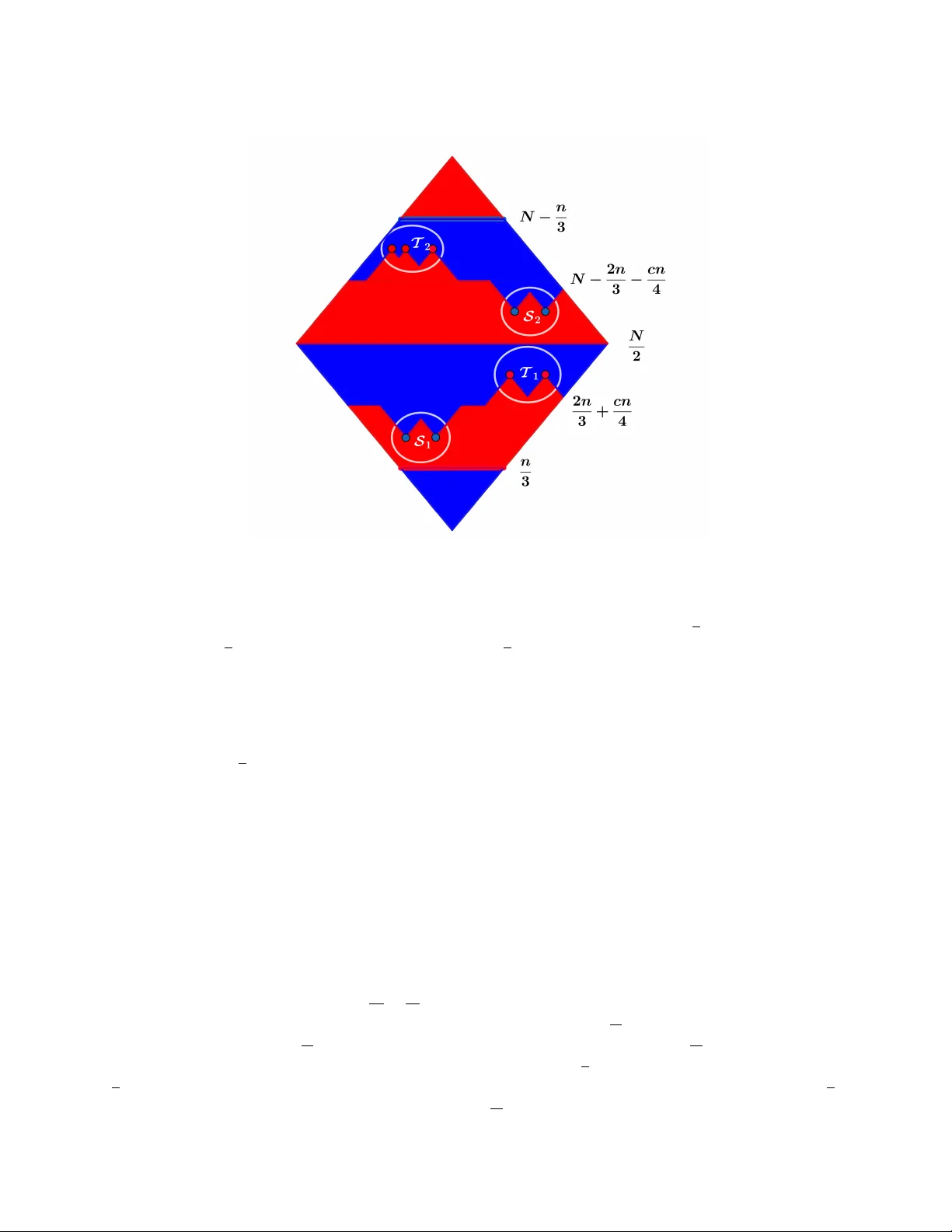
A NEW LO WER BOUND F OR THE DIA GONAL POSET RAMSEY NUMBERS MARIA-R OMINA IV AN AND BERNARDUS A. WESSELS Abstract Giv en tw o finite p osets P and Q , their Ramsey num b er, denoted by R ( P , Q ) , is defined to b e the smallest in teger N suc h that any blue/red colouring of the vertices of the hypercub e Q N has either a blue induced copy of P , or a red induced copy of Q . Axeno vich and W alzer show ed that, for fixed P , R ( P , Q n ) grows linearly with n . Ho wev er, for the diagonal question, we do not even come close to knowing the order of growth of R ( Q n , Q n ) . The current upp er b ound is R ( Q n , Q n ) ≤ n 2 − (1 − o (1)) n log n , due to Axenovic h and Winter. What ab out lo wer bounds? It is trivial to see that 2 n ≤ R ( Q n , Q n ) , but surprisingly , even an incremen tal improv ement required significant work. Recently , an elegant probabilistic argument of Winter gav e that, for large enough n , R ( Q n , Q n ) ≥ 2 . 02 n . In this pap er we sho w that R ( Q n , Q n ) ≥ 2 . 7 n + k , where k is a constant. Our current tec hniques might in principle show that in fact, for every ϵ > 0 , for large enough n , R ( Q n , Q n ) ≥ (3 − ϵ ) n . Our metho ds exploit careful mo difications of lay ered-colourings, for a large num b er of la yers. These mo difications are stronger than previous argumen ts as they are more constructive, rather than purely probabilistic. 1 In tro duction Giv en t wo finite p osets, P and Q , w e denote b y R ( P , Q ) the minimum integer N suc h that any blue/red copy of the h yp ercub e Q N con tains either a blue induced copy of P , or a red induced copy of Q . R ( P , Q ) is known as the R amsey numb er of p osets P and Q . Since any finite p oset can b e embedded in a hypercub e, one of the most natural questions is: what is R ( Q m , Q n ) ? When m is fixed and n grows, these are known as the off-diagonal Ramsey n umbers for p osets, and R ( Q n , Q n ) is known as the diagonal Ramsey n umbers for p osets. These notions were first studied by Axenovic h and W alzer in 2017 [1]. They also established the first b ounds, namely that for any p ositiv e integers m, n we hav e n + m ≤ R ( Q m , Q n ) ≤ mn + m + n. This already sho ws that the off-diagonal Ramsey num b ers ha ve linear growth. How ever, it places R ( Q n , Q n ) betw een 2 n and n 2 + 2 n , and there is m uch desire to close the gap b etw een these b ounds. The most recen t upp er bound is due to Axenovic h and Winter [2] who show ed that R ( Q n , Q n ) ≤ n 2 − 1 − 2 √ log n n log n . On the other hand, the low er bound is notoriously more elusive. While 2 n is trivially ac hiev ed b y colouring the sets of Q 2 n − 1 blue if the size is at most n − 1 , and red otherwise (there is no 1 2 MARIA-R OMINA IV AN AND BERNARDUS A. WESSELS mono c hromatic chain on length n + 1 , let alone an entire Q n ), any little improv ement to ok time, clev er optics and new tec hniques. First, Co x and Stolee impro ved the upp er b ound to 2 n + 1 for n ≥ 13 and 3 ≤ n ≤ 8 [4]. Their colouring still w as blue up to a certain lev el, and red after a certain level, except that in-b etw een they managed to add one extra level using probabilistic metho ds. Their b ound was later achiev ed b y Bohman and Peng for all n ≥ 3 , this time by an explicit colouring [3]. Moreo ver, Grósz, Methuku and Thompkins show ed that, in fact, for any p ositiv e integers n, m , R ( Q m , Q n ) ≥ m + n + 1 , whic h is surprisingly still the b est low er b ound for the off-diagonal case [5]. Recen tly , using clever probabilistic metho ds, Winter [6] ac hieved the b est low er b ound y et for diagonal Ramsey n umbers for p osets, namely that for large enough n , R ( Q n , Q n ) ≥ 2 . 02 n. In this pap er we show the following. Theorem 1. F or n lar ge enough, ther e exists a c onstant k such that R ( Q n , Q n ) > 2 . 7 n + k . Our blueprin t for this result can, in principle, give a lo wer b ound of (3 − ϵ ) n for every fixed ϵ > 0 and n large enough. W e explore the absolute limitations of this metho d at the end of the pap er. Before explaining the strategy , we introduce some standard terminology . F or a natural num b er n , we define [ n ] = { 1 , 2 , . . . , n } . The n -dimensional hyp er cub e , denoted by Q n , is the poset consisting of all subsets of [ n ] ordered by inclusion. An embedding of a p oset P into a p oset Q is an injective map ϕ : P → Q that preserves the p oset structure – that is, x ≤ P y if and only if ϕ ( x ) ≤ Q ϕ ( y ) . F or 0 ≤ i ≤ N , we refer to the collection of subsets of [ N ] of size i , denoted by [ N ] ( i ) , as the i th level of Q N . A colouring of Q N is called layer e d if sets of the same size hav e the same colour. The n umber of lay ers is the num b er of colour transitions, plus one, when going from the empty set to the full set. A layer is a maximal collection of mono c hromatic levels of Q N . Our pro of is inspired by Winter’s pro of in which a 4 -lay ered colouring is mo dified with the help of t wo families of sets, called pivots . Our strategy is to start with a large n umber of lay ers, pair them up, and inside each pair mo dify the colouring according to t wo families of piv ots tailored for said pair. The pivots (and their parameters) are designed to force a mono chromatic embedding to ‘skip’ a certain num b er of levels. If one manages to force a mono c hromatic embedding to skip more than n + 1 levels in total, there is, of course, no mono chromatic Q n . In Winter’s pro of, the existence of pivots relies exclusively on probabilistic metho ds. Our pro of is more constructive in the sense that we pinp oin t exactly one type of families of pivots. This giv es more control and, in consequen tly , tighter b ounds. It turns out that starting with 602 lay ers is enough to achiev e the claimed 2 . 7 n b ound. Moreov er, for an arbitrary n umber of initial la yers, we pinp oin t the exact restrictions that need to b e satisfied in order for the pro of to go through, whic h suggest that the more lay ers, the b etter the b ound, although not exceeding 3 n . The plan of the pap er is as follo ws. In Section 2, to illustrate our metho dology without o verly complex parameters, we establish a weak er lo wer b ound of (2 + 1 / 3) n , assuming the existence of piv ot sets, for a 6-la yered initial colouring. In Section 3, the most technical part of the pap er, w e rigorously prov e the existence of the necessary pivot sets (Lemma 4 and Lemma 5). Finally , in Section 4, we present the pro of of our main result, for which the parameters were found using a n umerical optimiser (see App endix), as well as establish the absolute technical limitations of this t yp e of pro of strategy . 2 A lo w er b ound of (2 + 1 3 ) n In this section, we sho w the follo wing. A NEW LO WER BOUND F OR THE DIAGONAL POSET RAMSEY NUMBERS 3 Theorem 2. F or sufficiently lar ge n , R ( Q n , Q n ) > 7 3 n − 413 3 . The pro of is hea vily based on the existence of certain sets of ‘piv ots’ . W e first state the lemmas that ensure their existence and use them to ac hieve the desired lo wer b ound. In the next section, w e provide full pro ofs of these lemmas. W e also use the follo wing result ab out embeddings of Q n (Theorem 9 in [1]). Since the pro of is short, we include it here to o. Lemma 3 (Axenovic h-W alzer [1]) . L et Z b e a set such that | Z | > n , and let Q = Q ( Z ) , the hyp er cub e with gr ound set Z . If ther e exists an emb e dding ϕ : Q n → Q , then ther e exist a subset X ⊂ Z such that | X | = n , and an emb e dding ϕ ′ : Q ( X ) → Q , with the same image as ϕ , such that ϕ ′ ( S ) ∩ X = S for al l S ⊆ X . Pr o of. W e start b y lo oking at the image of the singletons under the original embedding, namely ϕ ( { i } ) for all i ∈ [ n ] . Assume that there exist i ∈ [ n ] such that ϕ ( { i } ) ⊆ [ A ⊆ ([ n ] \{ i } ) ϕ ( A ) . Since ϕ is an em b edding, we then get ϕ ( { i } ) ⊆ ϕ ([ n ] \ { i } ) , a contradiction. Therefore, for every i ∈ [ n ] there exists a ( i ) ∈ ϕ ( { i } ) \ S A ⊆ ([ n ] \{ i } ) ϕ ( A ) . W e further notice that if i = j ϕ ( { j } ) and S A ⊆ ([ n ] \{ i } ) ϕ ( A ) are disjoint as { j } ⊆ [ n ] \ { i } . As suc h, a ( i ) = a ( j ) if i = j . Let X = { a ( i ) : i ∈ [ n ] } , whic h is in bijection with [ n ] . Giv en A ⊆ X , let ˆ A = { a − 1 ( x ) : x ∈ A } . W e therefore define ϕ ′ : Q ( X ) → Q as follo ws ϕ ′ ( A ) = ϕ ( ˆ A ) . It is clear that ϕ ′ is an em b edding with the same image at ϕ . Moreo ver, let x = a ( i ) ∈ X for some i ∈ [ n ] , and A ⊆ X . If x = a ( i ) ∈ A , then i ∈ ˆ A , which implies that ϕ ( { i } ) ⊆ ϕ ( ˆ A ) , thus x = a ( i ) ∈ ϕ ( ˆ A ) = ϕ ′ ( A ) . Con v ersely , if x = a ( i ) ∈ ϕ ′ ( A ) = ϕ ( ˆ A ) , whic h by construction of a implies that i ∈ ˆ A , th us a ( i ) = x ∈ A . Therefore, for any A ⊆ X we hav e that ϕ ′ ( A ) ∩ X = A. Assume that n is a m ultiple of 60, and let c = 1 3 and N = (2 + c ) n . In order to achiev e the claimed results, it is enough to provide a colouring of Q N without a mono c hromatic copy of Q n , for ev ery n multiple of 60 . This is b ecause if 60 k ≤ n ′ ≤ 60 k + 59 , then R ( Q n ′ , Q n ′ ) ≥ R ( Q 60 k , Q 60 k ) > (2 + c )60 k ≥ (2 + c )( n ′ − 59) = (2 + c ) n ′ − 59(2 + c ) . No w let s = 2 n 3 and t = 2 n 3 + cn 2 + hn , where h = 0 . 05 . Notice that since n is assumed to b e a m ultiple of 60, all these quan tities are natural n umbers. Lemma 4. F or lar ge enough n , divisible by 60, ther e exist sets S 1 ⊆ [ N ] ( s ) and T 1 ⊆ [ N ] ( t ) with no S ∈ S 1 and T ∈ T 1 such that S ⊆ T , and the fol lowing pr op erties: 1. F or any P , X ⊆ [ N ] with | P | = n 3 , | X | = n and P ∩ X = ∅ , ther e exists S ∈ S 1 such that: (a) P ∩ X ⊆ S ∩ X (b) S \ X ⊆ P \ X (c) | S ∩ X | ≤ n 3 . 2. F or any P , X ⊆ [ N ] with | P | = N 2 = n + cn 2 , | X | = n , and | P ∩ X | = 2 n 3 , ther e exists some T ∈ T 1 such that: (a) T ∩ X ⊆ P ∩ X (b) P \ X ⊆ T \ X 4 MARIA-R OMINA IV AN AND BERNARDUS A. WESSELS (c) | T ∩ X | ≥ n 3 . By taking complemen ts, w e also get the following. Lemma 5. F or lar ge enough n , ther e exist sets S 2 ⊆ [ N ] ( N − t ) and T 2 ⊆ [ N ] ( N − s ) with no S ∈ S 2 and T ∈ T 2 such that S ⊆ T , and the fol lowing pr op erties: 1. F or any P , X ⊆ [ N ] with | P | = N 2 = n + cn 2 and | X | = n , and | P ∩ X | = n 3 , ther e exists S ∈ S 2 such that: (a) P ∩ X ⊆ S ∩ X (b) S \ X ⊆ P \ X (c) | S ∩ X | ≤ 2 n 3 . 2. F or any P , X ⊆ [ N ] with | P | = N − n 3 , | X | = n , and X ⊆ P , ther e exists T ∈ T 2 such that: (a) T ∩ X ⊆ P ∩ X (b) P \ X ⊆ T \ X (c) | T ∩ X | ≥ 2 n 3 . These tw o lemmas are enough to no w construct a red-blue colouring of Q N without a mono c hro- matic cop y of Q n . Pr o of of The or em 2. Recall that N = (2 + 1 3 ) n , c = 1 3 , and n is a m ultiple of 60, large enough such that Lemma 4 and Lemma 5 apply . As mentioned ab o v e, all fractions b elo w are in fact p ositive in tegers. Therefore, by Lemma 4 and Lemma 5, w e hav e 4 families of elemen ts, S 1 , T 1 , S 2 , T 2 lying on the s -lev el, t -level, ( N − s ) -lev el and ( N − t ) -level of Q N , resp ectiv ely . W e will call a set in any of these families a pivot . W e are going to use their existence to mo dify a lay ered colouring of Q N dep ending on certain up-sets and down-sets corresp onding to these piv ots. More precisely , we now colour Q N as follo ws. Let A ∈ Q N . • If | A | < n 3 , w e colour A blue . • If n 3 ≤ | A | ≤ 2 n 3 + cn 4 , w e colour A blue if there exists S ∈ S 1 suc h that S ⊆ A , and red otherwise. • If 2 n 3 + cn 4 < | A | ≤ N / 2 , we colour A red if there exists T ∈ T 1 suc h that A ⊆ T , and blue otherwise. • If N / 2 < | A | ≤ N − 2 n 3 − cn 4 , we colour A blue if there exists S ∈ S 2 suc h that S ⊆ A , and red otherwise. • If N − 2 n 3 − cn 4 < | A | ≤ N − n 3 , we colour A red if there exists T ∈ T 2 suc h that A ⊆ T , and blue otherwise. • If N − n 3 < | A | , w e colour A red . This colouring is illustrated in the picture b elo w. A NEW LO WER BOUND F OR THE DIAGONAL POSET RAMSEY NUMBERS 5 Supp ose no w that there exists an embedding ϕ : Q n → Q N suc h that its image is red. By Lemma 3, there exists X ⊆ [ N ] and an em b edding ϕ ′ : Q ( X ) → Q N suc h that | X | = n , ϕ ′ ( S ) ∩ X = S for all S ⊆ X , and the image of ϕ is precisely the image of ϕ ′ . Therefore ϕ ′ ( S ) is red for all S ⊆ X . In particular, ϕ ′ ( ∅ ) is red. Since in our colouring all sets of size less than n 3 are blue, w e m ust ha ve | ϕ ′ ( ∅ ) | ≥ n 3 . Let P 1 ⊆ ϕ ′ ( ∅ ) such that | P 1 | = n 3 . W e notice that P 1 ∩ X ⊆ ϕ ′ ( ∅ ) ∩ X = ∅ . Therefore, b y Lemma 4, part 1, there exists a pivot S 1 ∈ S 1 suc h that: 1. P 1 ∩ X ⊆ S 1 ∩ X 2. S 1 \ X ⊆ P 1 \ X 3. | S 1 ∩ X | ≤ n 3 . W e no w ha ve that S 1 = ( S 1 ∩ X ) ∪ ( S 1 \ X ) . By the em b edding property we hav e that S 1 ∩ X = ϕ ′ ( S 1 ∩ X ) ∩ X . Com bining this with the second property of b eing a piv ot, we hav e that S 1 ⊆ ( ϕ ′ ( S 1 ∩ X ) ∩ X ) ∪ ( P 1 \ X ) . Next, since P 1 ⊆ ϕ ′ ( ∅ ) , w e of course hav e that ( ϕ ′ ( S 1 ∩ X ) ∩ X ) ∪ ( P 1 \ X ) ⊆ ( ϕ ′ ( S 1 ∩ X ) ∩ X ) ∪ ( ϕ ′ ( ∅ ) \ X ) . Moreov er, since ϕ ′ is a hypercub e em b edding, we ha ve that ϕ ′ ( ∅ ) ⊆ ϕ ′ ( S 1 ∩ X ) . Putting ev erything together, we get S 1 ⊆ ( ϕ ′ ( S 1 ∩ X ) ∩ X ) ∪ ( ϕ ′ ( S 1 ∩ X ) \ X ) = ϕ ′ ( S 1 ∩ X ) . In particular, this implies that S 1 ∩ X = ∅ . Since S 1 ∈ S 1 is a piv ot, we coloured it and ev erything ab o v e it of size at most 2 n 3 + cn 4 blue. Moreov er, since no element of S 1 is a subset of an y elemen t of T 1 , we also hav e that all sets ab ov e S 1 of size less than N 2 are blue. Therefore we m ust ha ve that | ϕ ′ ( S 1 ∩ X ) | ≥ N 2 . As b efore, let P 2 ⊆ ϕ ′ ( S 1 ∩ X ) such that | P 2 | = N 2 . W e now see that P 2 ∩ X ⊆ ϕ ′ ( S 1 ∩ X ) ∩ X = S 1 ∩ X , thus | P 2 ∩ X | ≤ | S 1 ∩ X | ≤ n 3 . W e wan t P 2 ∩ X to hav e exactly n 3 elemen ts, so define P ′ 2 b y adding arbitrary elements from X \ P 2 to P 2 suc h that | P ′ 2 ∩ X | = n 3 , and remo ving elemen ts from P 2 \ X so that | P ′ 2 | = N 2 . Therefore, by Lemma 5, part 1, there exists a piv ot S 2 ∈ S 2 suc h that: 6 MARIA-R OMINA IV AN AND BERNARDUS A. WESSELS 1. P 2 ∩ X ⊆ P ′ 2 ∩ X ⊆ S 2 ∩ X 2. S 2 \ X ⊆ P ′ 2 \ X ⊆ P 2 \ X 3. | S 2 ∩ X | ≤ 2 n 3 . F ollowing the same blueprint as ab o ve, we similarly get that S 2 ⊆ ϕ ′ ( S 2 ∩ X ) . As b efore, since S 2 ∈ S 2 is a pivot, ev erything ab o ve it of size at least N − n 3 is blue. Therefore, as ϕ ′ ( S 2 ∩ X ) is red, we must hav e that | ϕ ′ ( S 2 ∩ X ) | > N − n 3 . On the other hand, we hav e that | S 2 ∩ X | ≤ 2 n 3 , which implies that | X \ S 2 | ≥ n 3 . Finally , since ϕ ′ ( S 2 ∩ X ) ∩ ( X \ S 2 ) = ∅ , we hav e that | ϕ ′ ( S 2 ∩ X ) | ≤ N − | X \ S 2 | ≤ N − n 3 , a contradiction. Therefore there exists no red embedding. By the symmetry of the colouring and of the conditions of Lemma 4 and Lemma 5 (under taking complemen ts), there also do es not exist a blue embedding. The argument will start with lo oking at the top of the em b edding, and taking a superset of it of size N − n 3 . W e then go do wn the la yers, using the families of pivots T 1 and T 2 , in the same wa y we wen t up the lay ers for the red em b edding, using the families of pivots S 1 and S 2 . Even tually w e will find some A ∈ Q N suc h that n 3 ≤ | A | < n 3 , whic h gives the desired con tradiction, and finishes the pro of. 3 Existence of piv ot sets In this section we prov e in full Lemma 4 and Lemma 5. W e first fo cus on Lemma 4 and then, b y taking complemen ts, we establish Lemma 5. T o refresh the reader’s memory , w e restate them. Lemma 4. F or lar ge enough n , divisible by 60, ther e exist sets S 1 ⊆ [ N ] ( s ) and T 1 ⊆ [ N ] ( t ) with no S ∈ S 1 and T ∈ T 1 such that S ⊆ T , and the fol lowing pr op erties: 1. F or any P , X ⊆ [ N ] with | P | = n 3 , | X | = n and P ∩ X = ∅ , ther e exists S ∈ S 1 such that: (a) P ∩ X ⊆ S ∩ X (b) S \ X ⊆ P \ X (c) | S ∩ X | ≤ n 3 . 2. F or any P , X ⊆ [ N ] with | P | = N 2 = n + cn 2 , | X | = n , and | P ∩ X | = 2 n 3 , ther e exists some T ∈ T 1 such that: (a) T ∩ X ⊆ P ∩ X (b) P \ X ⊆ T \ X (c) | T ∩ X | ≥ n 3 . Pr o of of L emma 4. W e recall that c = 1 3 , h = 0 . 05 n , s = 2 n 3 , and t = 2 n 3 + cn 2 + hn , and since n is divisible b y 60 , s, t, cn 2 , hn ∈ N . Let us start with S ′ = [ N ] ( s ) . W e take T 1 to b e a family constructed b y adding each set of size t , independently , with probability p = (0 . 525) n . W e will no w modify S ′ so that together with T 1 , all conditions in the statement are satisfied. In order to do this, for an y pair of sets that satisfies either condition of the lemma, we lo ok at the family of all candidate sets from S ′ . W e call these families c ones . A NEW LO WER BOUND F OR THE DIAGONAL POSET RAMSEY NUMBERS 7 More precisely , given P , X ⊆ [ N ] such that | P | = n 3 , | X | = n , and P ∩ X = ∅ , we define the s -c one of P and X as follows: K s ( P , X ) = S ⊆ [ N ] : | S | = s, S \ X ⊆ P \ X, | S ∩ X | ≤ n 3 . Similarly , for any P , X ⊆ [ N ] such that | P | = N 2 = n + cn 2 , | X | = n , and | P ∩ X | = 2 n 3 , w e define the t -c one of P and X as follows: K t ( P , X ) = T ⊆ [ N ] : | T | = t, T ∩ X ⊆ P ∩ X, P \ X ⊆ T \ X , | T ∩ X | ≥ n 3 . F or readability purp oses, from now on w e will write K s to mean a cone K s ( P , X ) for some sets P and X suc h that | P | = n 3 , | X | = n , and P ∩ X = ∅ . Similarly , we adopt the same shorthand notation for t -cones, namely K t . The pro of has three building blocks. First, we show that all s -cones K s are large, and that with high probabilit y , all intersections K t ∩ T are large. Next, we wan t to fo cus on the property that no elemen t of S 1 can b e a subset of an y element of T 1 . Therefore w e sa y that cone K s is b ad if for all S ∈ K s there is some T ∈ T 1 suc h that S ⊆ T . W e then show that for an y cone, P [ K s is bad ] ≤ (0 . 9997) n (1 . 0002) n . Finally , we find that with high probability there are no bad cones, which allo ws us to build legal families S 1 and T 1 , as claimed. Before delving into the pro of, we establish a useful estimate for the choose function whic h w e will use throughout. W e start with the following inequalities. Let n b e a p ositiv e integer. Then √ 2 π n n +0 . 5 e − n ≤ n ! ≤ en n +0 . 5 e − n . This can b e prov en relativ ely quic kly b y analysing the sequence a n = n ! e − n n n +0 . 5 . By looking at log( a n /a n +1 ) , one easily finds that the sequence is decreasing. Since a 1 = e and, b y Stirling’s form ula, lim n →∞ a n = √ 2 π , w e indeed get √ 2 π ≤ n ! e − n n n +0 . 5 ≤ e , as claimed. Next, using the ab o ve inequalities, w e ha ve that, giv en positive constants d < C and a natural n umber n such that dn, C n ∈ N , O (1) 1 √ n C C d d ( C − d ) C − d ! n ≤ C n dn ! = ( C n )! ( dn )!( C n − dn )! ≤ O (1) 1 √ n C C d d ( C − d ) C − d ! n . In particular, this means that for any ϵ > 0 , and large enough n , w e ha ve that: C C d d ( C − d ) C − d − ϵ ! n < C n dn ! < C C d d ( C − d ) C − d + ϵ ! n . In what follo ws w e will assume that n is large enough, thus apply the ab o v e inequalities by rounding the numerical v alues either up or down, dep ending on whether we w ant an upp er or low er b ound. Claim A. F or every c one K s , |K s | > (1 . 8898) n , and with high pr ob ability |K t ∩ T | > (1 . 006) n for every c one K t . 8 MARIA-R OMINA IV AN AND BERNARDUS A. WESSELS Pr o of. Let K s b e an s -cone with the asso ciated sets P, X . W e w ant to coun t the size of the cone. W e are looking for sets S of size 2 n 3 suc h that S \ X ⊆ P \ X and | S ∩ X | ≤ n 3 . Therefore selecting exactly n 3 elemen ts of X , and taking the union with P gives us a set in the cone. More precisely S : S = P ∪ S ′ , S ′ ⊂ X, | S ′ | = n 3 ⊆ K s ( P , X ) . Therefore we hav e that |K s | ≥ n n/ 3 . By the ab o ve inequalit y , applied with d = 1 3 , C = 1 , we get that for an y ϵ > 0 , for large enough n , |K s | ≥ 1 (1 / 3) 1 / 3 (2 / 3) 2 / 3 − ϵ n . Since 1 (1 / 3) 1 / 3 (2 / 3) 2 / 3 = 3 3 √ 4 = 1 . 88988 · · · > 1 . 8898 , we indeed get that for large enough n , all s -cones hav e size at least (1 . 8898) n . Next, let K t b e a t -cone with asso ciated sets R and Y . W e recall that this means that | R | = N 2 = n + cn 2 , | Y | = n , and | R ∩ Y | = 2 n 3 . Also t = 2 n 3 + cn 2 + hn . Again, based on these prop erties, we will pinp oin t a large num b er of sets that must b e in the cone. Indeed, consider sets of size t formed b y taking the union of R \ Y (which has size n 3 + cn 2 ) with n 3 elemen ts from R ∩ Y (which is p ossible as | R ∩ Y | = 2 n 3 ), plus at least hn other elemen ts from [ N ] \ ( R ∪ Y ) . T o ensure that this is p ossible, we must hav e that | [ N ] \ ( R ∪ Y ) | ≥ t − n 3 − | R \ Y | . This is true as | [ N ] \ ( R ∪ Y ) | = N − | R | − | Y | + | Y ∩ R | = (2 + c ) n − n + cn 2 − n + 2 n 3 = 2 n 3 + cn 2 = t − hn . Clearly t − hn is greater than t − n 3 − | R \ Y | . Therefore we hav e that T = ( R \ Y ) ∪ S ′ ∪ S ′′ : | T | = t, | S ′ | = n 3 , S ′ ⊂ R ∩ Y , S ′′ ⊆ [ N ] \ ( R ∪ Y ) ⊆ K t ( R, Y ) . Based on this we ha ve a lo wer b ound for K t , namely that |K t | ≥ 2 n/ 3 n/ 3 ! 2 n/ 3 + cn/ 2 hn ! . Therefore, applying our inequalit y for the c ho ose function, w e get that for an y ϵ > 0 , and n large enough |K t | ≥ (2 / 3) 2 / 3 (1 / 3) 1 / 3 (1 / 3) 1 / 3 − ϵ ! n (2 / 3 + 1 / 6) 2 / 3+1 / 6 0 . 05 0 . 05 (2 / 3 + 1 / 6 − 0 . 05) 2 / 3+1 / 6 − 0 . 05 − ϵ ! n . Since (2 / 3) 2 / 3 (1 / 3) 1 / 3 (1 / 3) 1 / 3 (2 / 3+1 / 6) 2 / 3+1 / 6 0 . 05 0 . 05 (2 / 3+1 / 6 − 0 . 05) 2 / 3+1 / 6 − 0 . 05 = 1 . 917913 · · · > 1 . 9179 , we hav e that for large enough n an y t -cone has size at least (1 . 9179) n . This implies that, for large enough n , we hav e E [ |K t ∩ T | ] = |K t | p > (1 . 9179 n )(0 . 525 n ) > (1 . 0068) n > 2(1 . 006 n ) . T o finish the claim, we are left to show that the expected num b er of t -cones whose in tersection with T is at most (1 . 006) n go es to zero as n go es to infinit y . T o do this, we will mak e use of the m ultiplicative Chernoff ’s inequalit y which states that for a binomial random v ariable X and a real n umber 0 < a < 1 , the following is true: P [ X ≤ (1 − a ) E [ X ]] ≤ exp − E [ X ] a 2 2 ! . A NEW LO WER BOUND F OR THE DIAGONAL POSET RAMSEY NUMBERS 9 W e take a to b e 1 2 and the random v ariable |K t ∩ T | . Th us, we get: P [ |K t ∩ T | ≤ (1 . 006) n ] ≤ P |K t ∩ T | ≤ 1 − 1 2 E [ |K t ∩ T | ] ≤ exp − E [ |K t ∩ T | ] 8 ≤ exp − (1 . 006) n 4 . Denote by X t the random v ariable equal to the num b er of t -cones K t suc h that |K t ∩ T | ≤ (1 . 006) n . W e therefore hav e that E [ X t ] = X K t P [ |K t ∩ T | ≤ (1 . 006) n ] ≤ X X ⊆ [ N ] , | X | = n X P ⊆ [ N ] , | P | = n + cn/ 2 , | P ∩ X | =2 n/ 3 exp − (1 . 006) n 4 ≤ 2 2 N exp − (1 . 006) n 4 = 2 4 n +2 cn exp − (1 . 006) n 4 → 0 as n → ∞ . Therefore, with high probabilit y , X t = 0 , i.e. for almost all t -cones we hav e that |K t ∩ T | > (1 . 006) n , whic h finishes the pro of of the claim. This sho ws that, with high probability , our family T has non-empty in tersection with ev ery t -cone K t , therefore satisfying the second condition of Lemma 4. Recall that an s -cone K s is said to b e bad if for all S ∈ K s there exists some T ∈ T suc h that S ⊆ T . W e are now going to estimate the probabilit y that an y given s -cone is bad. Claim B. F or any c one K s , P [ K s is b ad ] ≤ (0 . 9997) n (1 . 0002) n . Pr o of. Let K s = K s ( P , X ) b e an s -cone. In particular, this means that | P | = n 3 , | X | = n , and P ∩ X = ∅ . Instead of lo oking at the en tire cone, w e will ev aluate P [ K ′ s is bad ] for a suitable subfamily K ′ s ⊆ K s . The construction of the family K ′ s will b e in such a wa y that the ev ents ∃ T ∈T [ S ⊆ T ] are pairwise independent for all S ∈ K ′ s . A clean w ay to ensure this is to sa y that no tw o elements of K ′ s ‘see’ the same set in the t -level of Q N . Therefore, we define the t -neighb ourho o d of S , N t ( S ) = { T ⊆ [ N ] : | T | = t, S ⊆ T } . W e now aim to pic k K ′ s in suc h a wa y that the neighbourho o ds N t ( S ) are pairwise disjoint for S ∈ K ′ s . Our construction is iterative. W e start with some S 1 ∈ K s . Then, we delete all the sets in K s whose t -neigh b ourho od ov erlaps with the t -neigh b ourho od of S 1 , and then rep eat. W e now estimate how large the final family , K ′ s , is. The t -neighbourho o ds of tw o sets ov erlap if and only if their union h as size at most t . Let A, B ∈ K s suc h that | A ∪ B | ≥ t . Then, since | A ∪ B | = | A | + | B | − | A ∩ B | = 2 s − | A ∩ B | , w e get that 2 s − t = 2 n 3 − cn 2 − hn ≥ | A ∩ B | . W e first compute how many sets of K s w e hav e remo ved in step 1, in other words, ho w many sets there are in K s suc h that their intersection with S 1 has size at least 2 n 3 − cn 2 − hn . Recall that K s = K s ( P , X ) , th us any set in K s is comprised of P , union a subset of X of size n 3 . Therefore w e coun t ho w man y subsets of size n 3 of X ha ve in tersection of size at least n 3 − cn 2 − hn with S 1 \ P . 10 MARIA-R OMINA IV AN AND BERNARDUS A. WESSELS These will b e all the subsets of X w e get b y remo ving i ≤ cn 2 + hn elements from S 1 ∩ X = S 1 \ P , and adding i from the part of X disjoint from S 1 , which has size 2 n 3 . Therefore, we remov e exactly cn/ 2+ hn X i =0 n/ 3 i ! 2 n/ 3 i ! ≤ cn 2 + hn max n/ 3 i ! 2 n/ 3 i ! : 0 ≤ i ≤ cn/ 2 + hn sets . T o determine the maximum of the pro duct n/ 3 i 2 n/ 3 i for 0 ≤ i ≤ cn/ 2 + hn , w e will sho w that the quan tity increases with i . T o do that, w e analyse the follo wing ratio, for i ≥ 1 : n/ 3 i 2 n/ 3 i n/ 3 i − 1 2 n/ 3 i − 1 = ( n/ 3 + 1 − i )(2 n/ 3 + 1 − i ) i 2 . The fraction is at least 1 if and only if 2 n 2 9 + 1 + n ≥ i (2 + n ) . Therefore, if i ≤ 2 n 9 , the ratio is at least 1, hence the quantit y is increasing, as claimed. Therefore, since c/ 2 + h = 1 / 6 + 0 . 05 < 2 / 9 , w e remov ed at most cn 2 + hn n/ 3 cn/ 2 + hn ! 2 n/ 3 cn/ 2 + hn ! sets. Next, b y our inequalities for this t yp e of binomial coefficients, giv en ϵ > 0 , for large enough n w e hav e that cn 2 + hn n/ 3 cn/ 2+ hn 2 n/ 3 cn/ 2+ hn is at most (1 / 6 + 0 . 05) n (1 / 3) 1 / 3 (2 / 3) 2 / 3 (1 / 6 + 0 . 05) 2(1 / 6+0 . 05) (1 / 6 − 0 . 05) 1 / 6 − 0 . 05 (1 / 2 − 0 . 05) 1 / 2 − 0 . 05 + ϵ ! n . Since (1 / 3) 1 / 3 (2 / 3) 2 / 3 (1 / 6+0 . 05) 2(1 / 6+0 . 05) (1 / 6 − 0 . 05) 1 / 6 − 0 . 05 (1 / 2 − 0 . 05) 1 / 2 − 0 . 05 = 1 . 88929 . . . , w e get that for large n w e remo ve at most (1 . 8893) n sets. Therefore, at each step of this pro cess, we delete at most (1 . 8893) n elemen ts of K s , which gives us that, for large enough n , we hav e |K ′ s | ≥ |K s | (1 . 8894) n ≥ (1 . 8898) n (1 . 8893) n ≥ (1 . 0002) n . Finally , we upp er b ound the probability that the s -cone K s is bad. W e first hav e that, for ϵ > 0 small enough, and for n large enough, the size of a t -neigh b ourho o d of any S ∈ K s , | N t ( S ) | , is N − s t − s ! = 4 n 3 + cn cn 2 + hn ! ≤ (4 / 3 + 1 / 3) 4 / 3+1 / 3 (1 / 6 + 0 . 05) 1 / 6+0 . 05 (4 / 3 + 1 / 6 − 0 . 05) 4 / 3+1 / 6 − 0 . 05 + ϵ ! n ≤ (1 . 9041) n . Recall that, b y constructions, the sets N t ( S ) for S ∈ K ′ s are disjoin t. W e therefore get that P [ K s is bad ] ≤ P [ K ′ s is bad ] = Y S ∈K ′ s P [ N t ( S ) ∩ T = ∅ ] . After a union-b ound we get that, for a giv en S ∈ K ′ s , P [ N t ( S ) ∩ T = ∅ ] ≤ X T ∈ N t ( S ) P [ T ∈ T ] = p | N t ( S ) | . Putting ev erything together w e hav e P [ K s is bad ] ≤ Y S ∈K ′ s | N t ( S ) | p ≤ Y S ∈K ′ s (1 . 9041) n (0 . 525) n ≤ (0 . 9997) n |K ′ s | . T ogether with the fact that |K ′ s | ≥ (1 . 0002) n , we hav e that P [ K s is bad ] ≤ (0 . 9997) n (1 . 0002) n → 0 as n → ∞ , which finishes the claim. A NEW LO WER BOUND F OR THE DIAGONAL POSET RAMSEY NUMBERS 11 Claim C. With high pr ob ability ther e ar e no b ad c ones. Pr o of. Let X bad b e the random v ariable coun ting the num b er of bad s -cones, K s . By Claim B, we can upp er b ound its exp ectation as follows: E [ X bad ] = X K s P [ K s is bad ] ≤ X X ⊆ [ N ] | X | = n X P ⊆ [ N ] | P | = n/ 3 , P ∩ X = ∅ P [ K s ( P , X ) is bad ] ≤ 2 2 N (0 . 9997) n (1 . 0002) n ≤ 2 4 n +2 cn (0 . 9997) n (1 . 0002) n . Finally , by Mark ov’s inequality , we hav e that P [ X bad ≥ 1] ≤ E [ X ] ≤ 2 4 n +2 cn (0 . 9997) n (1 . 0002) n → 0 as n → ∞ . In other w ords, with high probability , X bad = 0 , as claimed. Finally , we hav e that by Claim A and Claim C, with high probabilit y , the family T do es not generate any bad s -cones K s , and for every t -cone K t the intersection T ∩ K t is non-empty . Since n is taken to b e large enough, this implies that there m ust exist a family T with the ab o ve prop erties. Let that be T 1 . Next, b y construction, for every cone s -cone K s , there exists some S ∈ K s suc h that N t ( S ) ∩ T 1 = ∅ . Let S 1 b e the collection of all suc h S for all s -cones K s . Thus, for all S ∈ S 1 and T ∈ T 1 , S ⊆ T , and • for all K s there exists some S ∈ K s ∩ S 1 , corresp onding to the first part of Lemma 4, • for all K t there exists some T ∈ K t ∩ T 1 , corresp onding to the second part of Lemma 4, whic h finishes the pro of. W e no w mo ve on to Lemma 5, which follows from Lemma 4 b y taking complemen ts. F or completeness, w e restate it b elo w, and c heck all the conditions. Lemma 5. F or lar ge enough n , ther e exist sets S 2 ⊆ [ N ] ( N − t ) and T 2 ⊆ [ N ] ( N − s ) with no S ∈ S 2 and T ∈ T 2 such that S ⊆ T , and the fol lowing pr op erties: 1. F or any P , X ⊆ [ N ] with | P | = N 2 = n + cn 2 and | X | = n , and | P ∩ X | = n 3 , ther e exists S ∈ S 2 such that: (a) P ∩ X ⊆ S ∩ X (b) S \ X ⊆ P \ X (c) | S ∩ X | ≤ 2 n 3 . 2. F or any P , X ⊆ [ N ] with | P | = N − n 3 , | X | = n , and X ⊆ P , ther e exists T ∈ T 2 such that: (a) T ∩ X ⊆ P ∩ X (b) P \ X ⊆ T \ X (c) | T ∩ X | ≥ 2 n 3 . Pr o of of L emma 5. Let S 1 ⊆ [ N ] ( s ) and T 1 ⊆ [ N ] ( t ) b e the sets that satisfy Lemma 4. W e will sho w that S 2 = { [ N ] \ T : T ∈ T 1 } and T 2 = { [ N ] \ S : S ∈ S 1 } satisfy the conditions of Lemma 5. W e need to c heck three prop erties. First, there exist no S ∈ S 2 , T ∈ T 2 suc h that S ⊆ T . Indeed, if S ⊆ T for some S ∈ S 2 , T ∈ T 2 , then [ N ] \ T ⊆ [ N ] \ S . Ho wev er, [ N ] \ T ∈ S 1 and [ N ] \ S ∈ T 1 , a con tradiction. Next, we show that given P , X ⊆ [ N ] suc h that | P | = N 2 = n + cn 2 , | X | = n , and | P ∩ X | = n 3 , there exists S ∈ S 2 suc h that P ∩ X ⊆ S ∩ X , S \ X ⊆ P \ X , and | S ∩ X | ≤ 2 n 3 . 12 MARIA-R OMINA IV AN AND BERNARDUS A. WESSELS Let Q = [ N ] \ P , thus | Q | = N 2 . Moreov er, since Q ∩ X = X \ P and | P ∩ X | = n 3 , we also ha ve that | Q ∩ X | = 2 n 3 . Therefore, b y the second part of Lemma 4, there exists T ∈ T 1 suc h that T ∩ X ⊆ Q ∩ X , Q \ X ⊆ T \ X , and | T ∩ X | ≥ n 3 . Set S = [ N ] \ T ∈ S 2 . First, we hav e that P ∩ X = X \ Q ⊆ X \ T = S ∩ X . Next, S \ X = ([ N ] \ T ) \ X = ([ N ] \ X ) \ ( T \ X ) ⊆ ([ N ] \ X ) \ ( Q \ X ) = ([ N ] \ Q ) \ X = P \ X . Finally , since | T ∩ X | ≥ n 3 , we clearly ha ve that | S ∩ X | ≤ 2 n 3 . Th us, all conditions of the first part of Lemma 5 are satisfied. F or the second part, w e pro ceed similarly . Let P , X ⊆ [ N ] such that | P | = N − n 3 , | X | = n and X ⊆ P . Then w e sho w there exists T ∈ T 2 suc h that P \ X ⊆ T \ X , and | T ∩ X | ≥ 2 n 3 . Let Q = [ N ] \ P , th us | Q | = n 3 . Moreo v er, since X ⊆ P , w e also ha ve that Q ∩ X = ∅ . By the first part of Lemma 4, there exists S ∈ S 1 suc h that S \ X ⊆ Q \ X , and | S ∩ X | ≤ n 3 . Set T = [ N ] \ S ∈ T 2 . Since | S ∩ X | ≤ n 3 , w e of course ha ve that | T ∩ X | ≥ 2 n 3 . Lastly , P \ X = ([ N ] \ Q ) \ X = ([ N ] \ X ) \ ( Q \ X ) ⊆ ([ N ] \ X ) \ ( S \ X ) = ([ N ] \ S ) \ X = T \ X . Th us the conditions of the second part of Lemma 5 are also satisfied, whic h finishes the pro of. 4 Pro of of the main result In this section we sho w that R ( Q n , Q n ) ≥ 2 . 7 n + k for some constan t k . All ideas of the pro of hav e already b een presen ted in great detail in the proof of Theorem 2 – we will increase the n umber of la yers of the initial colouring, and for eac h pair of consecutiv e la yers, we mo dify the colouring with piv ot sets, just as ab ov e. As suc h, w e presen t the outline of the proof, as well as the Python code used to find the v arious n umerical v alues. W e first analyse the ab o v e pro of and the k ey facts that made all computations go through. The construction starts with a 6-la yered colouring. Recall that this means sets of same size receiv e the same colour, and the n umber of colour transitions, while going upw ards (or down wards) in the hypercub e, plus one, is the num b er of la yers of the colouring. If one wishes to keep the same starting p oin t (the first and last la yer), the only other quan tities that could b e v aried are c and h . Therefore, we view the pro of as an optimisation problem: w e hav e non-negativ e v ariables c, h and w e wish to maximise c , while ensuring all steps of the pro of remain v alid. It is clear that, as long as Lemma 4 remains true for our new c and h , the rest of the pro of follo ws in the exact same wa y . Going through the pro of of Lemma 4 carefully , we identify the exact constrain ts on c and h that m ust b e preserv ed. W e first lo ok where the c hoice of the probability p = q n , where q is a constant b etw een 0 and 1, has pla yed a role. W e see that in Claim A w e needed |K t | q > 1 , and in Claim B we needed 1 > | N t | q , for all t -neighbourho o ds. Therefore, suc h c hoice of p is p ossible if and only if |K t | > | N t | . Using the b ound w e deriv ed in the pro ofs of these claims, we can translate this into a condition c and h m ust satisfy , namely 2 n/ 3 n/ 3 ! 2 n/ 3 + cn/ 2 hn ! > 4 n 3 + cn cn 2 + hn ! . W e refer to this as the pr ob ability c onstr aint . The other, non-probabilistic constrain t app ears in Claim B, during the construction of K ′ s . Recall that at eac h step we discarded the sets that had large in tersection with at least one of the sets already chosen. W e require that the n umber of elements we remov e is exp onen tially smaller than |K s | ≥ n n/ 3 . W e established that, as long as c/ 2 + h < 2 9 , the n umber of elements we remov e A NEW LO WER BOUND F OR THE DIAGONAL POSET RAMSEY NUMBERS 13 is at most cn 2 + hn n/ 3 cn/ 2 + hn ! 2 n/ 3 cn/ 2 + hn ! . A quic k c hec k sho ws that, for fixed i ≤ 2 9 , ( in ) n/ 3 in 2 n/ 3 in is exponentially smaller than n n/ 3 . Therefore, the restriction c/ 2 + h < 2 9 guaran tees the v alidity of this part of the pro of. W e refer to this as the interse ction c onstr aint . The in tersection constraint gives a direct upp er b ound for this metho d, namely c < 4 9 . It also means that increasing h comes at the cost of c . On the other hand, the probability constraint is where we can use h to increase c . This is b ecause increasing h slightly ab o ve zero increases the left hand side more than the righ t hand side, thus allo wing for larger c , while still not violating the probabilit y constrain t. Nevertheless, this approach is someho w optimised, and cannot result in an upp er b ound of more than (2 + 4 9 ) n , as already explained. Ho wev er, another approach is to increase the num b er of lay ers of the colouring w e are starting with, and then we get a m uch better b ound. Below we explain in detail the general strategy and limitations, as w ell as the following v erified result, for whic h the parameters hav e b een found using the co de presented in the App endix. Theorem 1. F or n lar ge enough, ther e exists a c onstant k such that R ( Q n , Q n ) > 2 . 7 n + k . Outline of the pr o of. Let N = (2 + c ) n , n big enough and also such that all the quantities in volving a m ultiple of n are p ositiv e integers. The pro of starts with a la yered colouring of Q N , with 4 L + 2 la yers. The mo dification of this colouring is symmetric in the upp er half of the h yp ercub e, therefore w e fo cus on the 2 L + 1 la yers b elo w N / 2 . Let all sets of size less than b 0 n b e blue, for some b 0 > 0 to b e chosen later. W e now group the rest of the lay ers in to L consecutive pairs. F or each pair of lay ers we hav e an equiv alent of Lemma 4 that will allo w us to mo dify the colouring in these tw o lay ers as b efore. Ev ery pair of la yers will hav e the following parameters: a v alue of c i indicating how many levels of the h yp ercub e we are forced to skip in that region, and an h i , r i and b i , the equiv alent of h , n/ 3 and n/ 3 in the pro of of Lemma 4. More precisely , let b 0 n = l 1 n < l 2 n < · · · < l L +1 n = N / 2 b e the levels of the h yp ercub e ab o ve the blue sets. F or every 1 ≤ i ≤ L , we find t wo families of sets S i and T i with the same properties as in Lemma 4, except s is replaced b y s i n = ( l i + r i ) n , t is replaced b y t i n = ( l i + r i + c i + h i ) n . Moreo ver, in part 1, ‘ P ∩ X = ∅ ’ is replaced b y | P ∩ X | = P i − 1 k =1 r k n , ‘ | P | = n/ 3 ’ is replaced by | P | = l i n , and ‘ | S ∩ X | ≤ n/ 3 ’ is replaced b y | S ∩ X | ≤ P i k =1 r k n . Similarly , in part 2, ‘ | P | = N / 2 ’ is replaced by | P | = l i +1 n , ‘ | P ∩ X | = 2 n/ 3 ’ is replaced by | P ∩ X | = n − P L k =1 r k n − P L k = i +1 b k n , and ‘ | T ∩ X | ≥ n/ 3 ’ is replaced b y | T ∩ X | ≥ n − P L k =1 r k n − P L k = i b k n . Moreov er, l i +1 − l i = b i + c i + r i . This is illustrated b elow. 14 MARIA-R OMINA IV AN AND BERNARDUS A. WESSELS Our total v alue for c will then b e c = 2 P L i =1 c i . In each pair of la y ers, the parameters r i and b i tell us how m uch a mono c hromatic embedding is allo wed to tra vel in that region. This is captured in Lemma 4 by the intersection condition with X , the ground set of the embedding. Similarly here, for the S i family , corresp onding to working with a red em b edding, we start with P such that | P | = l i n and | P ∩ X | = P i − 1 k =1 r k n , and obtain S ∈ S i suc h that | S ∩ X | ≤ P i k =1 r k n , thus w e tra vel at most r i n lev els. Similarly , for the T i family , corresp onding to w orking with a blue embedding, w e start with P such that | P | = l i +1 n and | P ∩ X | = n − P L k =1 r k n − P L k = i +1 b k n , and obtain T ∈ T i suc h that | T ∩ X | ≥ n − P L k =1 r k n − P L k = i b k n , so again we hav e a trav el of at most b i n levels. The other trav el parameter is the starting level, either from the top or the b ottom, namely b 0 n . Noting that a blue trav el in a la yer b ecomes a red tra vel in the complement la yer (abov e N / 2 ), we m ust ensure that the em b edding cannot trav el all the w ay to n , thus we need b 0 + L X i =1 r i + L X i =0 b i ≤ 1 . The same w ay as in the pro of of Theorem 2, we satisfy this condition b y simply taking b 0 = r i = b i = 1 2 L +1 for all 1 ≤ i ≤ n . Note that this is consisten t with l L +1 n = P L i =0 b i n + P L i =1 c i n + P L i =1 r i n = (1 + c 2 ) n . W e no w mov e on to the in tersection and probability constrain ts, and how they change with more la yers, particularly in this setup. By design, we will hav e an instance of each of these constrain ts for eac h pair of la yers. F or the intersection constraint , we initially had that n/ 3 ( c/ 2+ h ) n 2 n/ 3 ( c/ 2+ h ) n gro ws slow er than |K s | ≥ n n/ 3 . That was to ensure that, whilst making the t -neighbourho o ds disjoint, we do not remo ve to o many elements for the s -cone. In this setup, b et w een l i n and l i +1 n an s i n -cone will ha ve the form { P ∪ P ′ : | P ′ | = r i n, P ′ ⊆ X \ P } . Based on this we get |K s i n | ≥ (1 − P i − 1 k =1 r k ) n r i n . W e wan t to eliminate sets that ha ve union at most t i n . Fix S ∈ K s i n . W e w ant to delete all sets S ′ ∈ K s i n suc h that | S ∪ S ′ | ≤ t i n , or equiv alen tly | S ∩ S ′ | ≥ l i n + r i n − ( c i + h i ) n . As b efore, the elemen ts of an s i n -cone are of the form: P union a subset of X \ P of size r i n . Th us, we coun t the num b er of subsets of X \ P of size r i n that ha ve intersection of size at least r i n − ( c i + h i ) n with another given subset of size r i n . Since | X \ P | = n − ( P i − 1 k =1 r k ) n , we remov e at most P ( c i + h i ) n k =1 r i n k (1 − P i k =1 r k ) n k elemen ts. Similar computations as b efore sho w that the maximal binomial co efficien t is when k = r i − r 2 i 1 − P i − 1 k =1 r k n. Therefore w e need c i + h i ≤ r i − r 2 i 1 − P i − 1 k =1 r k , and r i n ( c i + h i ) n ! (1 − P i k =1 r k ) n ( c i + h i ) n ! << (1 − P i − 1 k =1 r k ) n r i n ! . F or the probabilit y constraint , w e once again wan t that the size of a t i n -cone, |K t i n | is strictly greater than the size of a t i n -neigh b ourho od of set of size s i n , | N t i n | = N − s i n ( t i − s i ) n = N − s i n c i n + h i n . Before w e low er b ound the size of a t i n -cone, w e introduce the following notation: for ev ery 1 ≤ i ≤ L w e define B i = P i − 1 k =0 b k . Recall that w e are working under the assumption that P L k =0 b k + P L k =1 r k = 1 . Therefore, the conditions for the family T i start with P suc h that | P | = l i +1 n and | P ∩ X | = B i +1 n , and obtain T ∈ T i suc h that | T ∩ X | ≥ B i n . As before, by lo oking at sets of the form ( P \ X ) ∪ S ′ ∪ S ′′ and of size t i n , where S ′ ⊆ P ∩ X , | S ′ | = B i n , and S ′′ ⊂ [ N ] \ ( P ∪ X ) , w e get A NEW LO WER BOUND F OR THE DIAGONAL POSET RAMSEY NUMBERS 15 that a t i n -cone has size at least B i +1 n B i n N − l i +1 n − n + B i +1 n h i n , hence our probability constrain t is B i +1 n B i n ! N − l i +1 n − n + B i +1 n h i n ! > N − s i n c i n + h i n ! . The constrain ts deriv ed ab o ve hav e been implemented in the co de presen ted in the Appendix, whic h is a numerical optimiser for the v alue of c . It w as also used to find the several numerical v alues present in the proofs of Theorem 2 and Lemma 4. The largest v alue of c we calculated is 0 . 7 with L = 150 , which indeed gives that R ( Q n , Q n ) > 2 . 7 n + k for some constant k , and sufficiently large n . W e end this section with the observ ation that, under all the constraints presen ted ab o ve, one cannot hop e to find c ≥ 1 . Recall that we ha ve taken r i = 1 2 L +1 for all 1 ≤ i ≤ L , and, from the in tersection constraint, we require c i + h i ≤ r i − r 2 i 1 − P i − 1 k =1 r k . Summing all these inequalities we get L X i =1 ( c i + h i ) ≤ L X i =1 r i − r 2 i 1 − P i − 1 k =1 r k ! . Since c = 2 P L i =1 c i and r i = 1 2 L +1 for all 1 ≤ i ≤ L , we hav e that c 2 + L X i =1 h i ≤ L 2 L + 1 − L X i =1 1 (2 L +1) 2 1 − i − 1 2 L +1 ≤ L 2 L + 1 − L 1 (2 L +1) 2 1 − 0 = 2 L 2 (2 L + 1) 2 . Multiplying b oth sides by 2 w e get that c + 2 P L i =1 h i ≤ 2 L 2 L +1 2 , and so c < 1 . F urthermore, as L → ∞ the right hand side go es to 1, suggesting that the more lay ers we work with, the b etter the b ound, with c p oten tially ac hieving all v alues in the interv al [0 , 1) . How ever, we need a b etter understanding of the probability constrain ts, and whether the sum of the h i v ariables can b e made arbitrarily close to zero as L increases, in order to pro ve this. 5 Limitations and future directions As explained ab o ve, it is not en tirely clear, although it is believ able, that the sum P L i =1 h i can b e legally made to go to 0, as the num b er of la yers, thus L , go es to infinit y . Nev ertheless, in the pro of of Theorem 1, w e made a con venien t, y et p oten tially very restrictiv e c hoice. Namely , w e to ok all b i and r i to be equal to 1 L +1 . It is therefore natural to ask whether a differen t choice could lead to a b etter b ound, one that could ev en p oten tially give c > 1 . One clue that this a ven ue could b e fruitful comes from noting that the in tersection constraints b ound c i in terms of r i , and not in terms of b i . Therefore, increasing the r i v alues might make enough ro om and allow c to go ab o ve 1. How ever, since P L i =0 b i + P L i =1 r i ≤ 1 , increasing the r i immediately implies decreasing the b i , so there is a delicate balance to b e kept at all times in order for the structure of the pro of to hold. A t this stage we b eliev e that some numerical w ork should indicate whether this approac h migh t indeed yield b etter b ounds or whether the other constraints are still too strong to allow for c ≥ 1 . W e do ho wev er strongly believe the following. Conjecture 6. L et ϵ > 0 . Then ther e exists L and a c onstant a such that the ab ove typ e of c olouring ( 2 L p airs of layers mo difie d by 2 families of pivots) gives, for lar ge enough n , R ( Q n , Q n ) ≥ (3 − ϵ ) n + a. 16 MARIA-R OMINA IV AN AND BERNARDUS A. WESSELS One could ask if c hanging the s tructure of the colouring ever so sligh tly migh t b e b eneficial. In our pro of w e hav e shifted the t i n levels up b y an extra h i n term, in contrast with the s i n levels. What if we also shift the s i n levels do wn by a similar term? Surprisingly , this makes all our b ounds tigh ter, thus giving worse results for c . Finally , how suitable is this t yp e of colouring if w e change the question to the off-diagonal v ersion, R ( Q m , Q n ) ? This immediately comes with a lot of broken symmetry , which we heavily relied on while low er b ounding R ( Q n , Q n ) . F or example, w e would need a flexible, yet sturdy enough wa y of estimating binomials of the form An + B m pn + q m . If one such general estimate is found, the envisioned lo wer b ound will b e of the form (1 + c 2 )( m + n ) . A different wa y of keeping all the binomials in terms of only one of m or n is to change the colouring sligh tly . F or example, in Q N , colour the middle n − m levels blue, and the rest of them using our ‘pivotal’ colouring tec hniques. This approac h is tailored, if successful, to give a b ound of the form R ( Q m , Q n ) ≥ (1 + c ) m + n . Our feeling is that breaking symmetries is here an incon venience, and not a true h urdle. Nev- ertheless, as with the diagonal case, we exp ect the same limitation, namely that c < 1 . References [1] Maria Axenovic h and Stefan W alzer, Bo ole an L attic es: R amsey Pr op erties and Emb e ddings , Order 34 (2017-07-01), no. 2, 287–298. [2] Maria Axeno vich and Christian Win ter, Diagonal p oset Ramsey numb ers , Discrete Mathematics 349 (2026). [3] T om Bohman and F ei P eng, A Construction for Bo ole an Cub e Ramsey Numb ers , Order 40 (2023), no. 2, 327–333. [4] Christopher Cox and Derric k Stolee, R amsey Numb ers for Partial ly-Or der e d Sets , Order 35 (2018), no. 3, 557–579. [5] Dániel Grósz, Abhishek Methuku, and Casey T ompkins, R amsey Numb ers of Bo ole an Lattic es , Bulletin of the London Mathematical So ciety 55 (2023), no. 2, 914–932. [6] Christian Win ter, Er dős-Hajnal Pr oblems for Posets , Order 42 (2025), 509–527. Maria-Romina Iv an, Dep ar tment of Pure Ma thema tics and Ma thema tical St a tistics, Centre for Ma the- ma tical Sciences, Wilberforce Ro ad, Cambridge, CB3 0WB, UK. Email address: mri25@dpmms.cam.ac.uk Bernardus A. W essels, School of Ma thema tics, Georgia Institute of Technology, A tlant a, GA 30332, USA. Email address: bwessels3@gatech.edu A NEW LO WER BOUND F OR THE DIAGONAL POSET RAMSEY NUMBERS 17 App endix – Python co de to optimise c for large L In this app endix we explain the Python co de used to optimise the parameters that give us Theorem 1. The parameters w e optimise ov er are a c i v alue and a h i v alue for each la yer. The co de sets up the relev ant constraints for these parameters as discussed in the pro of outline of Theorem 1, and then calls a function from SciPy to maximise the total v alue of c = 2 P L i =1 c i . In our pro of, c i and h i are all co efficien ts of n . Other relev ant quan tities in the pro of can all b e represen ted as some base v alue raised to the p ow er of n , thus we only fo cus on the base v alue for these. Moreo ver, by the symmetry of the construction under complemen ts, we only need to do the calculations for the b ottom half of the h yp ercub e. The first part of the co de is our setup. W e hav e the required imp orts, and define a function whic h p erforms the follo wing estimate: C n dn ! ≈ C C d d ( C − d ) C − d ! n . 1 f r o m s c i p y . o p t i m i z e i m p o r t m i n i m i z e 2 f r o m m a t h i m p o r t l o g 3 i m p o r t n u m p y a s n p 4 f r o m c o l l e c t i o n s i m p o r t n a m e d t u p l e 5 6 # S m a l l e p s i l o n t o a p p r o x i m a t e s t r i c t i n e q u a l i t y 7 e p s i l o n = 1 e - 6 8 9 # L o g e v e r y t h i n g t o a v o i d f l o a t i n g p o i n t p r e c i s i o n i s s u e s 10 d e f c h o o s e _ b a s e _ l o g ( C , d ) : 11 i f d < = 0 o r d > = C : 12 r e t u r n 0 13 r e t u r n ( C * l o g ( C ) ) - ( d * l o g ( d ) ) - ( ( C - d ) * l o g ( C - d ) ) F or each lay er, we need to kno w the v alues corresp onding to other la yers to b e able to calculate the relev an t quan tities. This includes the bottom level, the top lev el, and the equiv alents of levels s i n and t i n . W e predefine these v alues, excluding the contributions from the c i and h i parameters. There is also other data w e can predefine. Recall that the pro of works by only allo wing an em b edding to gain at most a certain num b er of levels in each la yer, so that it runs out leve ls at the end. W e m ust therefore track h o w many lev els w e ha ve allow ed a red embedding to gain in the lo wer lay ers, ho w many levels we allow ed in the upp er lay ers, and how many it is allow ed to gain in this lay er. In principle, these are also parameters which can b e optimised o ver, but we fixed these to ha ve a total of n lev els, divided equally o ver all lay ers. 14 # b o t t o m = b o t t o m l e v e l o f t h e l a y e r a s f r a c o f n , d o e s n ’ t i n c l u d e c o n t r i b u t i o n s f r o m c 15 # t o p = t o p l e v e l o f l a y e r a s f r a c o f n , d o e s n ’ t i n c l u d e c o n t r i b u t i o n s f r o m c 16 # r e d _ l e v e l = w h a t f r a c o f n h a v e w e a l r e a d y c l i m b e d i n p r e v i o u s l a y e r s f o r r e d a t t h e b o t t o m 17 # r e d _ c l i m b = w h a t f r a c o f n a r e w e a l l o w e d t o c l i m b i n t h e r e d p a r t f o r t h i s l a y e r 18 # b l u e _ l e v e l = w h a t f r a c o f n h a v e w e a l r e a d y c l i m b e d i n p r e v i o u s l a y e r s f o r b l u e a t t h e t o p 19 # b l u e _ c l i m b = w h a t f r a c o f n a r e w e a l l o w e d t o c l i m b i n t h e b l u e p a r t f o r t h i s l a y e r 18 MARIA-R OMINA IV AN AND BERNARDUS A. WESSELS 20 L a y e r = n a m e d t u p l e ( " L a y e r " , [ " i n d e x " , " b o t t o m " , " t o p " , " r e d _ l e v e l " , " r e d _ c l i m b " , " b l u e _ l e v e l " , " b l u e _ c l i m b " , " n u m _ l a y e r s " ] ) 21 22 d e f m a k e _ l a y e r s ( n u m _ l a y e r s ) : 23 d e n o m = n u m _ l a y e r s * 2 + 1 24 l a y e r s = [ ] 25 f o r i i n r a n g e ( n u m _ l a y e r s ) : # l o o p s f r o m b o t t o m o f p o s e t t o m i d d l e 26 l a y e r s . a p p e n d ( L a y e r ( 27 i , # i n d e x 28 ( 1 + 2 * i ) / d e n o m , # b o t t o m 29 ( 3 + 2 * i ) / d e n o m , # t o p 30 i / d e n o m , # r e d _ l e v e l 31 1 / d e n o m , # r e d _ c l i m b 32 ( 2 + i ) / d e n o m , # b l u e _ l e v e l 33 1 / d e n o m , # b l u e _ c l i m b 34 n u m _ l a y e r s 35 ) ) 36 r e t u r n l a y e r s 37 38 # t o p = b o t t o m + r e d _ c l i m b + b l u e _ c l i m b 39 # = r e d _ l e v e l + b l u e _ l e v e l + r e d _ c l i m b 40 # b o t t o m = r e d _ l e v e l + b l u e _ l e v e l - b l u e _ c l i m b Using the predefined constants and our parameters, w e define how to calculate v arious quan tities used in the pro of. 41 # D e f i n e N 42 d e f v a r _ N ( v a r s , l a y e r : L a y e r ) : 43 c = v a r s [ : l a y e r . n u m _ l a y e r s ] 44 r e t u r n 2 + 2 * s u m ( c ) 45 46 # D e f i n e s 47 d e f v a r _ s ( v a r s , l a y e r : L a y e r ) : 48 c = v a r s [ : l a y e r . n u m _ l a y e r s ] 49 r e t u r n l a y e r . b o t t o m + s u m ( c [ : l a y e r . i n d e x ] ) + l a y e r . r e d _ c l i m b 50 51 # D e f i n e t 52 d e f v a r _ t ( v a r s , l a y e r : L a y e r ) : 53 c = v a r s [ : l a y e r . n u m _ l a y e r s ] 54 h = v a r s [ l a y e r . n u m _ l a y e r s : ] 55 r e t u r n v a r _ s ( v a r s , l a y e r ) + c [ l a y e r . i n d e x ] + h [ l a y e r . i n d e x ] 56 57 # D e f i n e t h e t o p l e v e l o f a l a y e r i n c l u d i n g c o n t r i b u t i o n s f r o m c 58 d e f v a r _ t o p ( v a r s , l a y e r : L a y e r ) : 59 c = v a r s [ : l a y e r . n u m _ l a y e r s ] 60 r e t u r n l a y e r . t o p + s u m ( c [ : l a y e r . i n d e x + 1 ] ) 61 62 # C a l c u l a t e K _ s 63 d e f K s _ l o g ( v a r s , l a y e r : L a y e r ) : 64 r e t u r n c h o o s e _ b a s e _ l o g ( 1 - l a y e r . r e d _ l e v e l , l a y e r . r e d _ c l i m b ) 65 66 # C a l c u l a t e K _ t 67 d e f K t _ l o g ( v a r s , l a y e r : L a y e r ) : 68 c = v a r s [ : l a y e r . n u m _ l a y e r s ] A NEW LO WER BOUND F OR THE DIAGONAL POSET RAMSEY NUMBERS 19 69 h = v a r s [ l a y e r . n u m _ l a y e r s : ] 70 r e t u r n c h o o s e _ b a s e _ l o g ( l a y e r . b l u e _ l e v e l , l a y e r . b l u e _ c l i m b ) + c h o o s e _ b a s e _ l o g ( v a r _ N ( v a r s , l a y e r ) - l a y e r . t o p - s u m ( c [ : l a y e r . i n d e x + 1 ] ) + l a y e r . b l u e _ l e v e l - 1 , h [ l a y e r . i n d e x ] ) 71 72 # C a l c u l a t e t - n e i g h b o u r h o o d o f a n s - s e t 73 d e f N t _ l o g ( v a r s , l a y e r : L a y e r ) : 74 r e t u r n c h o o s e _ b a s e _ l o g ( v a r _ N ( v a r s , l a y e r ) - v a r _ s ( v a r s , l a y e r ) , v a r _ t ( v a r s , l a y e r ) - v a r _ s ( v a r s , l a y e r ) ) 75 76 # C a l c u l a t e h o w m a n y s e t s i n K _ s h a v e u n i o n o f s i z e a t m o s t t w i t h a s p e c i f i e d s e t . 77 d e f N s e c t _ l o g ( v a r s , l a y e r : L a y e r ) : 78 c = v a r s [ : l a y e r . n u m _ l a y e r s ] 79 h = v a r s [ l a y e r . n u m _ l a y e r s : ] 80 v a l = h [ l a y e r . i n d e x ] + c [ l a y e r . i n d e x ] 81 r e t u r n c h o o s e _ b a s e _ l o g ( l a y e r . r e d _ c l i m b , v a l ) + c h o o s e _ b a s e _ l o g ( 1 - l a y e r . r e d _ l e v e l - l a y e r . r e d _ c l i m b , v a l ) W e w ant to define the constrain ts w e require these quan tities to sta y within. These corresp ond to those discussed in the pro of outline of Theorem 1: the intersection constraint and the probability constrain t. 82 # W e n e e d l e v e l t t o b e i n s i d e t h e l a y e r , s o t < = t o p - > t o p - t > = 0 83 # T h i s c o n s t r a i n t s h o u l d b e c o v e r e d b y t h e N s e c t _ m a x _ c o n s t r a i n t , s o 84 # w e d o n ’ t i n c l u d e i t i n t h e o p t i m i s a t i o n , b u t w e c a n c h e c k i t a f t e r w a r d s 85 d e f t _ l e s s T h a n _ T o p _ c o n s t r a i n t ( v a r s , l a y e r : L a y e r ) : 86 c = v a r s [ : l a y e r . n u m _ l a y e r s ] 87 r e t u r n l a y e r . t o p + s u m ( c [ : l a y e r . i n d e x + 1 ] ) - v a r _ t ( v a r s , l a y e r ) - e p s i l o n 88 89 # I - C o n s t r a i n t : T h i s c o m e s f r o m f i n d i n g a l a r g e s u b s e t o f K _ s ( P , X ) w i t h o n l a r g e i n t e r s e c t i o n s 90 # h + c < = R C - R C ^ 2 / ( 1 - R L ) - > R C - R C ^ 2 / ( 1 - R L ) - ( h + c ) > = 0 91 d e f N s e c t _ m a x _ c o n s t r a i n t ( v a r s , l a y e r : L a y e r ) : 92 c = v a r s [ : l a y e r . n u m _ l a y e r s ] 93 h = v a r s [ l a y e r . n u m _ l a y e r s : ] 94 r e t u r n l a y e r . r e d _ c l i m b - ( l a y e r . r e d _ c l i m b * * 2 ) / ( 1 - l a y e r . r e d _ l e v e l ) - ( h [ l a y e r . i n d e x ] + c [ l a y e r . i n d e x ] ) - e p s i l o n 95 96 # p - c o n s t r a i n t : T h i s c o m b i n e s t h e c o n s t r a i n t s t h a t 1 < = p t * K t a n d p t * N t < = 1 , 97 # w h i c h i s e q u i v a l e n t t o K t / N t > = 1 - > K t - N t > = 0 98 d e f r o o m _ f o r _ p t _ c o n s t r a i n t ( v a r s , l a y e r : L a y e r ) : 99 r e t u r n K t _ l o g ( v a r s , l a y e r ) - N t _ l o g ( v a r s , l a y e r ) - e p s i l o n 100 101 # C o n s t r a i n t : 1 < = K ’ - > K ’ - 1 > = 0 102 # T h i s c o n s t r a i n t s h o u l d b e c o v e r e d b y t h e N s e c t _ m a x _ c o n s t r a i n t , s o 103 # w e d o n ’ t i n c l u d e i t i n t h e o p t i m i s a t i o n , b u t w e c a n c h e c k i t a f t e r w a r d s 104 d e f K _ b a d _ s u b f a m i l y _ c o n s t r a i n t ( v a r s , l a y e r : L a y e r ) : 105 r e t u r n ( K s _ l o g ( v a r s , l a y e r ) - N s e c t _ l o g ( v a r s , l a y e r ) ) - e p s i l o n 106 107 # C o n s t r a i n t : N - t o p - n + b l u e _ l e v e l > = h t - > N - t o p - n + b l u e _ l e v e l - h t > = 0 20 MARIA-R OMINA IV AN AND BERNARDUS A. WESSELS 108 # W e n e e d t h i s t o l o w e r b o u n d K _ t i n C a s e A , o t h e r w i s e w e c a n n o t t a k e t h e e x t r a h n e l e m e n t s 109 d e f r o o m _ f o r _ h _ c o n s t r a i n t ( v a r s , l a y e r : L a y e r ) : 110 h = v a r s [ l a y e r . n u m _ l a y e r s : ] 111 r e t u r n v a r _ N ( v a r s , l a y e r ) - v a r _ t o p ( v a r s , l a y e r ) - 1 + l a y e r . b l u e _ l e v e l - h [ l a y e r . i n d e x ] - e p s i l o n 112 113 # S o m e e x t r a c o n s t r a i n t s w h i c h I c o n j e c t u r e a r e g o o d b a s e d o n o p t i m a l v a l u e s s e e n b e f o r e 114 # W e d o n o t n e e d t o c h e c k t h a t t h e s e h o l d , b u t h o p e f u l l y t h e y h e l p t h e o p t i m i s e r 115 116 # c _ i s h o u l d b e i n c r e a s i n g 117 d e f c _ i n c r e a s i n g _ c o n s t r a i n t ( v a r s , i , n u m _ l a y e r s ) : 118 c = v a r s [ : n u m _ l a y e r s ] 119 r e t u r n c [ i + 1 ] - c [ i ] 120 121 # h _ i s h o u l d b e d e c r e a s i n g 122 d e f h _ d e c r e a s i n g _ c o n s t r a i n t ( v a r s , i , n u m _ l a y e r s ) : 123 h = v a r s [ n u m _ l a y e r s : ] 124 r e t u r n h [ i ] - h [ i + 1 ] 125 \ e n d { m i n t e d } 126 127 F i n a l l y , w e s e t u p o u r o b j e c t i v e f u n c t i o n ( t o m a x i m i s e $ \ s u m _ i c _ i $ ) a n d r u n t h e o p t i m i s e r i n a l o o p w h i l e e n s u r i n g a l l c o n s t r a i n t s h o l d . 128 129 \ b e g i n { l s t l i s t i n g } [ f i r s t n u m b e r = 1 1 9 ] 130 # O b j e c t i v e f u n c t i o n : m a x i m i s e c ( e q u i v a l e n t t o m i n i m i s i n g - c ) 131 d e f o b j e c t i v e ( v a r s , n u m _ l a y e r s ) : 132 c = v a r s [ : n u m _ l a y e r s ] 133 r e t u r n - s u m ( c ) # N e g a t e s i n c e w e m i n i m i s e i n s c i p y 134 135 d e f o p t i m i s e F o r N L a y e r s ( n u m _ l a y e r s ) : 136 l a y e r s = m a k e _ l a y e r s ( n u m _ l a y e r s ) 137 138 # I n i t i a l g u e s s 139 s t a r t i n g _ p o i n t = [ 0 . 0 0 1 ] * n u m _ l a y e r s # c 140 s t a r t i n g _ p o i n t + = [ 0 . 0 0 0 1 ] * n u m _ l a y e r s # h 141 142 # B o u n d s 143 b o u n d s = [ ( 0 , 2 ) ] * n u m _ l a y e r s # c 144 b o u n d s + = [ ( 0 , 1 ) ] * n u m _ l a y e r s # h 145 146 # C o n s t r a i n t s 147 c o n s t r a i n t s = [ { ’ t y p e ’ : ’ i n e q ’ , ’ f u n ’ : r o o m _ f o r _ p t _ c o n s t r a i n t , ’ a r g s ’ : ( l a y e r , ) } f o r l a y e r i n l a y e r s ] 148 c o n s t r a i n t s + = [ { ’ t y p e ’ : ’ i n e q ’ , ’ f u n ’ : N s e c t _ m a x _ c o n s t r a i n t , ’ a r g s ’ : ( l a y e r , ) } f o r l a y e r i n l a y e r s ] 149 c o n s t r a i n t s + = [ { ’ t y p e ’ : ’ i n e q ’ , ’ f u n ’ : r o o m _ f o r _ h _ c o n s t r a i n t , ’ a r g s ’ : ( l a y e r , ) } f o r l a y e r i n l a y e r s ] 150 c o n s t r a i n t s + = [ { ’ t y p e ’ : ’ i n e q ’ , ’ f u n ’ : c _ i n c r e a s i n g _ c o n s t r a i n t , ’ a r g s ’ : ( i , n u m _ l a y e r s , ) } f o r i i n r a n g e ( n u m _ l a y e r s - 1 ) ] 151 c o n s t r a i n t s + = [ { ’ t y p e ’ : ’ i n e q ’ , ’ f u n ’ : h _ d e c r e a s i n g _ c o n s t r a i n t , ’ a r g s ’ : ( i , n u m _ l a y e r s , ) } f o r i i n r a n g e ( n u m _ l a y e r s - 1 ) ] A NEW LO WER BOUND F OR THE DIAGONAL POSET RAMSEY NUMBERS 21 152 153 g u e s s = s t a r t i n g _ p o i n t 154 b e s t = 0 155 b e s t _ v a r s = N o n e 156 157 f o r _ i n r a n g e ( 3 ) : # R u n m u l t i p l e t i m e s i n c a s e i t f a i l s s o m e o f t h e c o n s t r a i n t s 158 r e s u l t = m i n i m i z e ( 159 o b j e c t i v e , 160 g u e s s , 161 a r g s = ( n u m _ l a y e r s , ) , 162 b o u n d s = b o u n d s , 163 c o n s t r a i n t s = c o n s t r a i n t s , 164 m e t h o d = " t r u s t - c o n s t r " , 165 h e s s = l a m b d a x , _ : n p . z e r o s ( ( l e n ( x ) , l e n ( x ) ) ) , 166 t o l = 1 e - 9 167 ) 168 169 # N e g a t e t o g e t m a x i m u m c , d o u b l e f o r r e f l e c t i o n a c r o s s m i d d l e l a y e r u s i n g c o m p l e m e n t s 170 m a x _ c = - r e s u l t . f u n * 2 171 o p t i m a l _ v a r s = r e s u l t . x 172 173 # M a k e s u r e t h e v a l u e s w e g o t f r o m t h e o p t i m i s e r a c t u a l l y s a t i s f y t h e c o n s t r a i n t s 174 t e s t = T r u e 175 f o r i i n r a n g e ( n u m _ l a y e r s ) : 176 l a y e r = l a y e r s [ i ] 177 178 g o o d = ( r o o m _ f o r _ p t _ c o n s t r a i n t ( o p t i m a l _ v a r s , l a y e r ) > 0 ) 179 t e s t = t e s t a n d g o o d 180 i f n o t g o o d : 181 p r i n t ( " L a y e r " , i , " : " , " r o o m _ f o r _ p t _ c o n s t r a i n t : " , r o o m _ f o r _ p t _ c o n s t r a i n t ( o p t i m a l _ v a r s , l a y e r ) ) 182 183 g o o d = ( K _ b a d _ s u b f a m i l y _ c o n s t r a i n t ( o p t i m a l _ v a r s , l a y e r ) > - e p s i l o n ) 184 t e s t = t e s t a n d g o o d 185 i f n o t g o o d : 186 p r i n t ( " L a y e r " , i , " : " , " K _ b a d _ s u b f a m i l y : " , K _ b a d _ s u b f a m i l y _ c o n s t r a i n t ( o p t i m a l _ v a r s , l a y e r ) ) 187 188 g o o d = ( N s e c t _ m a x _ c o n s t r a i n t ( o p t i m a l _ v a r s , l a y e r ) > 0 ) 189 t e s t = t e s t a n d g o o d 190 i f n o t g o o d : 191 p r i n t ( " L a y e r " , i , " : " , " N s e c t _ m a x : " , N s e c t _ m a x _ c o n s t r a i n t ( o p t i m a l _ v a r s , l a y e r ) ) 192 193 g o o d = ( t _ l e s s T h a n _ T o p _ c o n s t r a i n t ( o p t i m a l _ v a r s , l a y e r ) > - e p s i l o n ) 194 t e s t = t e s t a n d g o o d 195 i f n o t g o o d : 196 p r i n t ( " L a y e r " , i , " : " , " t _ l e s s T h a n _ T o p _ c o n s t r a i n t : " , t _ l e s s T h a n _ T o p _ c o n s t r a i n t ( o p t i m a l _ v a r s , l a y e r ) ) 22 MARIA-R OMINA IV AN AND BERNARDUS A. WESSELS 197 198 g o o d = ( r o o m _ f o r _ h _ c o n s t r a i n t ( o p t i m a l _ v a r s , l a y e r ) > 0 ) 199 t e s t = t e s t a n d g o o d 200 i f n o t g o o d a n d d e b u g : 201 p r i n t ( " L a y e r " , i , " : " , " r o o m _ f o r _ h _ c o n s t r a i n t : " , r o o m _ f o r _ h _ c o n s t r a i n t ( o p t i m a l _ v a r s , l a y e r ) ) 202 203 i f t e s t : 204 p r i n t ( " A l l c o n s t r a i n t s g o o d " ) 205 p r i n t ( m a x _ c ) 206 p r i n t ( o p t i m a l _ v a r s ) 207 i f m a x _ c > b e s t : 208 b e s t = m a x _ c 209 b e s t _ v a r s = o p t i m a l _ v a r s 210 e l s e : 211 p r i n t ( " S o m e c o n s t r a i n t s o f f " ) 212 213 g u e s s = o p t i m a l _ v a r s # S t a r t t h e n e x t r u n o f t h e o p t i m i s e r f r o m t h e p r e v i o u s r e s u l t 214 215 r e t u r n b e s t , b e s t _ v a r s 216 217 b e s t , b e s t _ v a r s = o p t i m i s e F o r N L a y e r s ( 1 5 0 ) 218 219 p r i n t ( " # # # # # # # # # # # # # # # # # # # # # # # # # # # # # # # # # # # # # # # # # # # # # " ) 220 p r i n t ( " B e s t : " , b e s t ) 221 p r i n t ( " B e s t p a r a m e t e r s : " , b e s t _ v a r s ) R unning this co de with L = 150 giv es c > 0 . 7 , which is exactly Theorem 1. This corresp onds to 602 total lay ers (300 pairs of la yers).
Original Paper
Loading high-quality paper...
Comments & Academic Discussion
Loading comments...
Leave a Comment