A zero-one law for improvements to Dirichlet's theorem in arbitrary dimension
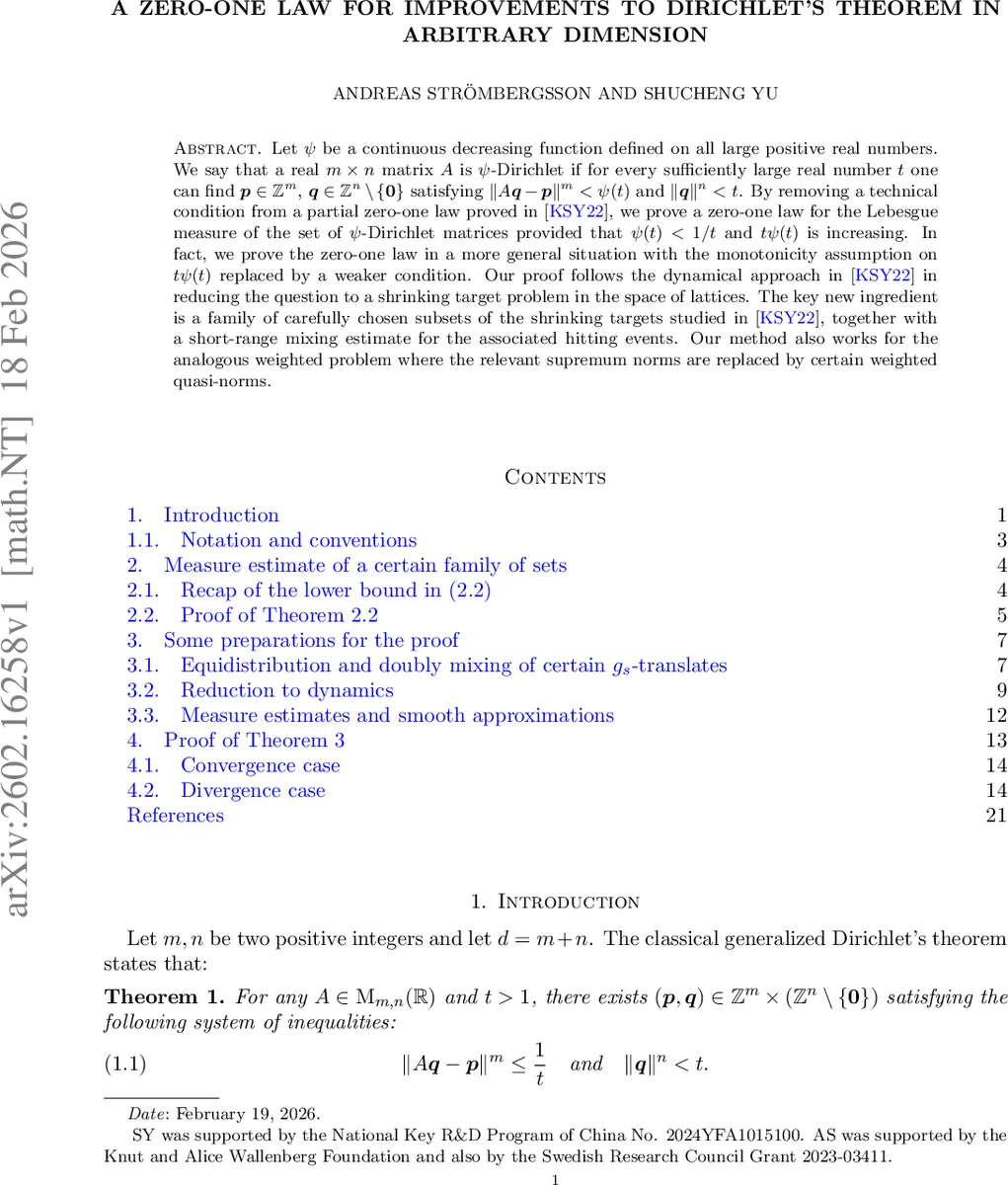
Let $ψ$ be a continuous decreasing function defined on all large positive real numbers. We say that a real $m\times n$ matrix $A$ is $ψ$-Dirichlet if for every sufficiently large real number $t$ one can find $\mathbf{p} \in \mathbb{Z}^m$, $\mathbf{q} \in \mathbb{Z}^n\setminus{\mathbf{0}}$ satisfying $|A\mathbf{q}-\mathbf{p}|^m< ψ(t)$ and $|\mathbf{q}|^n<t$. By removing a technical condition from a partial zero-one law proved by Kleinbock-Strömbergsson-Yu, we prove a zero-one law for the Lebesgue measure of the set of $ψ$-Dirichlet matrices provided that $ψ(t)<1/t$ and $tψ(t)$ is increasing. In fact, we prove the zero-one law in a more general situation with the monotonicity assumption on $tψ(t)$ replaced by a weaker condition. Our proof follows the dynamical approach of Kleinbock-Strömbergsson-Yu in reducing the question to a shrinking target problem in the space of lattices. The key new ingredient is a family of carefully chosen subsets of the shrinking targets studied by Kleinbock-Strömbergsson-Yu, together with a short-range mixing estimate for the associated hitting events. Our method also works for the analogous weighted problem where the relevant supremum norms are replaced by certain weighted quasi-norms.
💡 Research Summary
The paper studies uniform Diophantine approximation in arbitrary dimensions by investigating matrices that improve upon Dirichlet’s classical theorem. For a continuous decreasing function ψ defined on large real numbers, a real m×n matrix A is called ψ‑Dirichlet if for every sufficiently large t there exist integer vectors p∈ℤ^m and q∈ℤ^n{0} such that ‖Aq−p‖^m < ψ(t) and ‖q‖^n < t. The central question is to determine the Lebesgue measure of the set DI_{α,β}(ψ) of ψ‑Dirichlet matrices (or its weighted version with quasi‑norms defined by weight vectors α,β).
Earlier work by Kleinbock, Strömbergsson, and Yu (KSY, 2022) proved a partial zero‑one law under three hypotheses: (i) ψ(t) < 1/t, (ii) the product tψ(t) is monotone increasing, and (iii) a technical condition (1.8) concerning lim inf of certain partial products. The present paper removes the technical condition (1.8) and replaces the monotonicity requirement with a much weaker “quasi‑decreasing” condition (1.9). Consequently, the authors obtain a full zero‑one law for a substantially larger class of approximation functions.
The proof follows the dynamical systems approach pioneered in KSY. Using Dani’s correspondence, each matrix A is associated with a unimodular lattice Λ_A in X_d = SL_d(ℝ)/SL_d(ℤ), where d = m+n. The one‑parameter diagonal flow g_s = diag(e^{α₁s},…,e^{α_ms},e^{-β₁s},…,e^{-β_ns}) acts on X_d. The ψ‑Dirichlet condition translates into a shrinking‑target problem: for a sequence of radii r_k = ψ(k), one asks whether the orbit Λ_A·g_{log k} hits the target set Δ_{
Comments & Academic Discussion
Loading comments...
Leave a Comment