Tunable Ferroelectric Acoustic Resonators in Monolithic Thin-Film Barium Titanate
The increasing development of wireless communication bands has motivated the development of compact, low-loss, and frequency adjustable RF filtering technologies. Acoustic resonators are the ideal solution to these requirements, and tunable implement…
Authors: *제공된 텍스트에 저자 정보가 명시되어 있지 않습니다.*
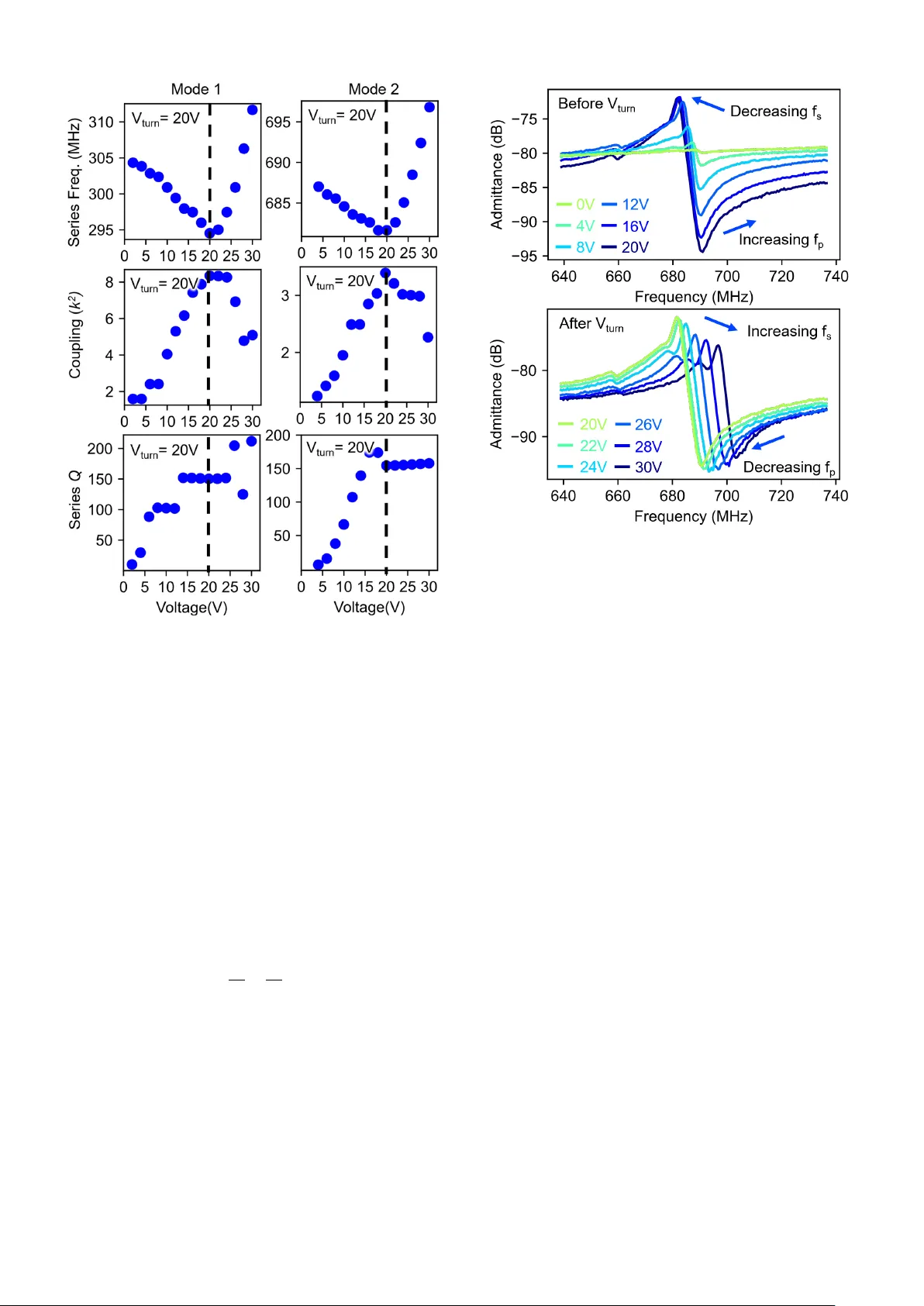
T unable Ferroelectric Acoustic Resonators in Monolithic Thin-Film Barium T itanate Ian Anderson ∗ , Agham Posadas ‡ , Alexander A. Demk ov † , and Ruochen Lu ∗ ∗ Department of Electrical and Computer Engineering, The Univ ersity of T exas at Austin, Austin, TX, USA † Department of Physics, The Uni versity of T exas at Austin, Austin, TX, USA ‡ La Luce Cristallina, Inc., Austin, TX, USA ianderson@utexas.edu Abstract —The increasing de velopment of wir eless commu- nication bands has motivated the de velopment of compact, low-loss, and frequency adjustable RF filtering technologies. Acoustic resonators are the ideal solution to these requir ements, and tunable implementations offer a path to ward reconfigurable front ends. In this work, we in vestigate epitaxial barium titanate (BTO) grown on silicon as a platform for tunable acoustic resonators operating in the sub-GHz regime. W e demonstrate lateral excitation of symmetric lamb (S0) modes in X-cut BTO membranes, in contrast to prior thickness-defined ferroelectric resonators. Devices are designed using finite-element simula- tions and fabricated with laterally patterned electrodes that enable overtone coupling to multiple resonant modes. Under applied DC bias, ferroelectric domains align, allowing electrical excitation, frequency tuning, and quality-factor enhancement of acoustic modes. Resonances near 300 MHz and 700 MHz ex- hibit electromechanical coupling up to 8% and bias-dependent frequency tuning, with a distinct transition in behavior near 20 V . These results highlight monolithic BTO on silicon as a promising material system for laterally excited, tunable acoustic resonators for reconfigurable RF applications. Index T erms —Acoustic Resonators, Barium Titanate, Ferro- electrics, Lamb Modes, T unable Devices I . I N T RO D U C T I O N Modern wireless communications and technology hav e progressiv ely shifted tow ard smaller, more clustered fre- quency bands with higher data rates [1]. W ith each additional communication band comes the addition of more Radio Fre- quency (RF) components to accommodate these bands and selectiv ely select one signal from hundreds. Acoustic filters, with small size and low insertion loss, are ideal candidates for these tasks, as one can fit far more acoustic filters into cellular devices than electromagnetic (EM) versions [2], [3]. Current acoustic technology assigns one filter per fre- quency band to select the appropriate information. Thin film piezoelectric materials commonly used include aluminum nitride (AlN), scandium aluminum nitride (ScAlN), Lithium Niobate (LN), and Lithium T antalate (L T) [4]–[6]. Howe v er , an alternative to using one filter per band is to use a single tunable filter across multiple frequency bands. T echnologies for tunable integrated resonators/filters include phase change materials [7], ferromagnetics [8], or MEMS v aractors and switches [9], [10]. Ferroelectrics offer an alternati ve route to integration, requiring only a DC bias in addition to the AC signal for tuning. These materials use a tuning of electrome- Fig. 1. Device optical image showing dimensions and electrode layout. chanical coupling ( k 2 ), or change in ef fectiv e stiffness to change resonance frequency , and thus change filter frequency or turn off the filter altogether [11]. The most commonly used ferroelectric material in the acoustic domain is ScAlN, but is limited by only changing frequenc y with changes in effecti ve stiffness, and the de vice cannot be turned on and of f [12], [13]. Barium Titanate (BTO), alongside its lower Curie temperature counterpart Barium Strontium T itanate (BST), is an excellent candidate for tunable filters. Compared to ScAlN, the tunability is far greater through the increase of coupling with DC bias. BTO also offers several other advantages, including epitaxial gro wth on silicon (Si), control of orientation via growth conditions, and integration with other device types, such as electro-optic modulators [14]– [16]. Howe ver , prior BT O/BST resonators typically rely on thickness-defined frequencies and often require bottom elec- trodes, which limits monolithic integration and makes multi- frequency-on-chip difficult without changing film thickness or adding additional process complexity . The following work focuses on Epitaxial BTO on Si as a material for tunable acoustic resonators. Previous demonstra- tions of BTO hav e focused on film bulk acoustic resonators (FB ARs) for acoustic devices, utilizing thickness electrical- field profiles to excite acoustic modes [17]–[19]. Here, we demonstrate lateral excitation of symmetric Lamb modes in Fig. 2. COMSOL admittance simulation shows S0 overtones and their stress profiles. X-Cut BTO in the sub-GHz range. I I . D E S I G N A N D S I M U L A T I O N Simulations were performed in COMSOL Multiphysics to determine optimal electrode configurations for coupling to the following mode profiles. Simulations are performed with 125 nm of BTO and 75 nm of gold for electrodes. Due to high film stress, release conditions were limited to isotropic etching of approximately 10 µ m of silicon laterally to limit the out-of-plane deflection of said devices, as can be seen by the gradient of color in the blue released region. A total lateral size of 7.75 µ m was chosen, with an electrode size of 1.25 µ m and an aperture of 50 µ m. Devices utilize the e 11 coefficient to excite fundamental symmetric lamb modes (S0). Due to the lateral spacing between the electrodes and the etch windows, the device functions as an overtone resonator and couples to multiple modes rather than a single mode [20]. The admittance plot of the device is shown in Fig. 2, which depicts the different modes we are coupling into, with progressiv ely higher-order stress nodes. I I I . M E A S U R E M E N T A N D A N A L Y S I S For this study , intrinsic silicon wafers (R ≈ 10000 Ω - cm) with 2” diameter were used as substrates. Before BTO deposition, a 5 nm-thick SrTiO 3 (STO) buf fer layer was deposited on the clean Si surface by molecular beam epitaxy and subsequently transferred under vacuum to a sputtering system. The BTO layer was deposited by off-axis RF mag- netron sputtering at a substrate temperature of 700°C and was grown to a thickness of 120 nm. Epitaxial growth was confirmed using reflection high-energy electron diffraction (RHEED) and X-ray dif fraction (XRD) in Fig. 3. The 120-nm BTO films on bulk Si sho wed an out-of-place lattice constant of 4.036 ˚ A. Devices were measured using a V ector Network Analyzer (VN A) with an applied DC bias between ports 1 and 2 Fig. 3. XRD 2 θ scan measurements showing peak slightly lower than 45 degrees, with inset of RHEED pattern. Fig. 4. (a) 0V versus 20V DC Bias wide admittance measurement (b) zoom of mode at 300 MHz showing k 2 and Q , and (c) same zoom of mode at 700 MHz. [21]. When the stack is grown, unit cells have spontaneous polarizations that can point in one of four directions for a- axis BTO, termed ferroelectric domains [22]. For this reason, generally , electromechanical coupling cancels out, and no modes can be seen for unbiased measurements. Howe ver , when a DC bias is overlaid with our A C signal, these unit cells align, a net piezoelectric coef ficient is realized, and acoustic modes can be excited with nonzero coupling. Fig. 4 shows examples of our de vice measured under 0 V and 20 V DC bias, indicating that our modes exist only under external bias. Here, we present our previously simulated modes with electromechanical coupling of 8 % and 3 % , and quality factor (Q) of 150 for each. The different modes arise from the gap between electrodes and release windows, causing overtone coupling. Fig. 5. Mode 1 at 300 MHz and mode 2 at 700 MHz behaviors versus applied DC bias showing electromechanical coupling, series quality factor, and series resonance frequency . T o demonstrate device tunability , Fig. 5 shows device performance metrics for the two modes as a function of the applied DC bias. In both modes at 300 MHz and 700 MHz, similar trends are observed. As you apply larger and larger DC bias, the series resonance frequency is tuned through the change in electromechanical coupling, which only shifts the series resonance frequency [23]. For this reason, the resonance frequency drops in a seemingly linear fashion. Along with the drop in resonance frequency , we observe an increase in the coupling between the modes and in the series quality factor ( Q ) (where we focus on series values, as they hav e lower impedance). Quality factors are determined using 3-dB bandwidths, and coupling is determined using Eq. 1 as: k 2 = π 2 8 · ( f 2 p f 2 s − 1) (1) These trends continue until approximately 20 V , at which point we observe a dramatic change in behavior in the opposite direction for each resonance and v alue. The series resonance frequency turns up at a much larger rate, and the electromechanical coupling seems to drop significantly . Because this DC Bias is necessary for de vice excitation, Fig. 6. (a) Admittance plots before V turn showing increasing figures of merit, and (b) after V turn showing reverse behavior . increasing the number of electrodes will cancel the stress pro- file and yield zero coupling; therefore, only a two-electrode configuration is possible for the current electrode duty cycle. Fig. 6 shows admittance plots for the 700 MHz mode before and after the voltage turning point. It is evident that the modes become more prominent belo w 20 V as the v oltage increases. Subsequently , after 20 V , modes appear to decrease in prominence, with much larger changes in performance for a giv en voltage change. It is evident that the parallel resonance frequency changes substantially after this turning voltage. Before this point, the series resonance changes much more than the parallel resonance due to the increasing k 2 , while changes in ef fective stif fness only slightly alter reso- nance frequencies [24]. Above 20 V , both series and parallel resonance frequencies change dramatically . It is thought that, giv en the sudden onset, this change is due to electrostriction, though it could also originate from general material or electrode breakdown, giv en the drop in coupling [25], [26]. It can also be seen that the capacitance v aries markedly with the applied voltage, with lower capacitance at higher voltages. This is consistent with the expected decrease in permittivity , which also alters the resonance characteristics. W e compare our results with those from ferroelectric acoustic resonators reported in the literature. Compared with other ferroelectric resonators, we exhibit comparable fre- quency , coupling, and frequency tunability , which we define as the percentage change in frequency as in Ref. [18]. Our T ABLE I S T A T E - O F - T H E - A RT F E R RO E LE C T R IC R E S ON A T O RS Ref. Material Excitation f (GHz) Q k 2 T uning On-chip multi- f [11] STO Lateral 2.1 2400 0.02% 0.7% Y [12] ScAlN Thickness 2.9 210 18.1% 1.1% N [17] BST Thickness 2.1 100 8.6% N/A N [18] BTO Thickness 1.65 160 2% 1.8% N [27] BST Thickness 0.75 99 0.1% N/A N Here BTO Lateral 0.7 150 3% 1.1% Y devices are also the only ones that are both monolithic, and have lithographically defined frequency setting without requiring bottom electrodes. This enables the fabrication of multiple devices at different frequencies without altering the film thickness. I V . C O N C L U S I O N Here, we demonstrate high-quality monolithic BTO acous- tic resonators via lateral e xcitation of Lamb modes in released devices. De vices exhibit good tunability and acoustic perfor- mance up to 20 V , with sev eral overmodes corresponding to S0-mode resonances. Compared with prior BTO works, we demonstrate competitiv e Q , coupling, and tunability without bottom electrodes. Future work will focus on larger devices with lower impedance and thicker films for higher Q . A C K N O W L E D G M E N T This work was supported by the N ASA Space T echnology Graduate Research Opportunity (NSTGRO), National Sci- ence Foundation (NSF) under CAREER A ward No. 2339731, and the Of fice of Nav al Research (Grant No. N00014-24- 1–2063). R E F E R E N C E S [1] H. Attar , H. Issa, J. Ababneh, M. Abbasi, A. A. A. Solyman, M. Khos- ravi, and R. Said Agieb, “5G System Overview for Ongoing Smart Applications: Structure, Requirements, and Specifications, ” Computa- tional Intelligence and Neur oscience , vol. 2022, pp. 1–11, Oct. 2022. [2] A. Hagelauer, R. Ruby , S. Inoue, V . Plessky , K.-Y . Hashimoto, R. Nak- agawa, J. V erdu, P . D. Paco, A. Mortazawi, G. Piazza, Z. Schaffer , E. T .-T . Y en, T . Forster , and A. T ag, “From Microwa ve Acoustic Filters to Millimeter-W av e Operation and New Applications, ” IEEE Journal of Micr owaves , vol. 3, no. 1, pp. 484–508, Jan. 2023. [3] K. Jackson, S. Newton, B. Moslehi, M. Tur , C. Cutler, J. Goodman, and H. Shaw , “Optical Fiber Delay-Line Signal Processing, ” IEEE T ransactions on Micr owave Theory and T echniques , vol. 33, no. 3, pp. 193–210, Mar . 1985. [4] F . Qian, J. Zheng, J. Xu, and Y . Y ang, “Heterogeneous Interface- Enhanced Thin-Film SA W Devices Using Lithium Niobate on Si, ” IEEE Micr owave and W ireless T echnology Letters , vol. 35, no. 1, pp. 123–126, Jan. 2025. [5] M. Rinaldi, C. Zuniga, Chengjie Zuo, and G. Piazza, “Super-high- frequency two-port AlN contour-mode resonators for RF applications, ” IEEE T ransactions on Ultrasonics, F err oelectrics and F r equency Con- tr ol , vol. 57, no. 1, pp. 38–45, Jan. 2010. [6] R. Lu and S. Gong, “RF acoustic microsystems based on suspended lithium niobate thin films: advances and outlook, ” Journal of Microme- chanics and Micr oengineering , vol. 31, no. 11, p. 114001, Nov . 2021. [7] G. Hummel, Y . Hui, and M. Rinaldi, “Reconfigurable Piezoelectric MEMS Resonator Using Phase Change Material Programmable V ias, ” Journal of Microelectr omechanical Systems , v ol. 24, no. 6, pp. 2145– 2151, Dec. 2015. [8] C. Devitt, S. Tiwari, B. Ziv asatienraj, and S. A. Bhave, “Spin-wa ve band-pass filters for 6G communication, ” Natur e , Feb . 2026. [9] A. Konno, H. Hirano, M. Inaba, K.-y . Hashimoto, M. Esashi, and S. T anaka, “T unable Surface Acoustic W ave Filter Using Integrated Micro-Electro-Mechanical-System Based V aractors Made of Electro- plated Gold, ” J apanese Journal of Applied Physics , vol. 52, no. 7S, p. 07HD13, Jul. 2013. [10] C. D. Nordquist, R. H. Olsson, S. M. Scott, D. W . Branch, T . Pluym, and V . Y arberry , “On/Off micro-electromechanical switching of AlN piezoelectric resonators, ” in 2013 IEEE MTT-S International Mi- cr owave Symposium Digest (MTT) . Seattle, W A, USA: IEEE, Jun. 2013, pp. 1–4. [11] S. Alzuaga, W . Daniau, R. Salut, T . Baron, S. Ballandras, and E. De- fay , “T unable and high quality factor SrTiO 3 surface acoustic wa ve resonator , ” Applied Physics Letters , vol. 105, no. 6, p. 062901, Aug. 2014. [12] J. W ang, M. Park, S. Mertin, T . Pensala, F . A yazi, and A. Ansari, “ A Film Bulk Acoustic Resonator Based on Ferroelectric Aluminum Scandium Nitride Films, ” Journal of Microelectr omechanical Systems , vol. 29, no. 5, pp. 741–747, Oct. 2020. [13] S. Fichtner, N. W olff, F . Lofink, L. Kienle, and B. W agner, “AlScN: A III-V semiconductor based ferroelectric, ” Journal of Applied Physics , vol. 125, no. 11, p. 114103, Mar . 2019. [14] H. Kim, S. Mathews, J. T ischler , A. B. Posadas, A. A. Demkov , and A. Piqu ´ e, “Crystal domain orientation control of epitaxial BaT iO3 films integrated on silicon for large electro-optic response, ” Applied Physics Letters , vol. 127, no. 5, p. 051102, Aug. 2025. [15] Z. Dong, A. Raju, A. B. Posadas, M. Reynaud, A. A. Demkov , and D. M. W asserman, “Monolithic Barium T itanate Modulators on Silicon-on-Insulator Substrates, ” ACS Photonics , vol. 10, no. 12, pp. 4367–4376, Dec. 2023. [16] I. Kim, T . Paoletta, and A. A. Demkov , “Nature of electro-optic response in tetragonal BaT iO 3 , ” Physical Revie w B , vol. 108, no. 11, p. 115201, Sep. 2023. [17] M. Z. K oohi, S. Lee, and A. Mortazawi, “High Q m ×k t 2 intrinsically switchable BST thin film bulk acoustic resonators, ” in 2017 IEEE MTT-S International Microwave Symposium (IMS) . Honololu, HI, USA: IEEE, Jun. 2017, pp. 296–299. [18] V . Lee, S. A. Sis, J. D. Phillips, and A. Mortazawi, “Intrinsically Switchable Ferroelectric Contour Mode Resonators, ” IEEE Tr ansac- tions on Microwave Theory and T echniques , vol. 61, no. 8, pp. 2806– 2813, Aug. 2013. [19] S. S. K ongbrailatpam, R. Akhil T S, R. James K C, and G. Pillai, “Switchable and tuneable high-performance acoustic modes in the L- X band using ferroelectric thin film on sapphire, ” Micr osystems & Nanoengineering , v ol. 11, no. 1, p. 217, Nov . 2025. [20] D. Lee, S. Jahanbani, J. Kramer, R. Lu, and K. Lai, “Nanoscale imaging of super-high-frequency microelectromechanical resonators with femtometer sensitivity , ” Natur e Communications , vol. 14, no. 1, p. 1188, Mar . 2023. [21] J. Nordlander, F . Eltes, M. Reynaud, J. N ¨ urnberg, G. De Luca, D. Caimi, A. A. Demko v , S. Abel, M. Fiebig, J. Fompeyrine, and M. Trassin, “Ferroelectric domain architecture and poling of BaT iO 3 on Si, ” Physical Review Materials , vol. 4, no. 3, p. 034406, Mar. 2020. [22] A. T . V asudevan and S. K. Selvaraja, “Domain effects on the electro- optic properties of thin-film barium titanate, ” Optical Materials Ex- pr ess , v ol. 13, no. 4, p. 956, Apr . 2023. [23] E. Defa ¨ y, N. B. Hassine, P . Emery , G. Parat, J. Abergel, and A. Dev os, “T unability of Alluminum Nitride Acoustic Resonators: A Phenomeno- logical Approach, ” IEEE T ransactions on Ultrasonics, F erroelectrics, and F r equency Control , vol. 58, no. 12, pp. 2516–2520, Dec. 2011. [24] J. F . Rosenbaum, Bulk acoustic wave theory and de vices , ser . The Artech House acoustics library . Boston: Artech House, 1988. [25] I. B. V endik, P . A. T uralchuk, O. G. V endik, and J. Berge, “Modeling tunable bulk acoustic resonators based on induced piezoelectric effect in BaTiO 3 and Ba 0.25 Sr 0.75 T iO 3 films, ” Journal of Applied Physics , vol. 103, no. 1, p. 014107, Jan. 2008. [26] R. Lanz, “Piezoelectric thin films for bulk acoustic wav e resonator applications : from processing to microwa ve filters, ” Ph.D. dissertation, Lausanne, EPFL, 2004. [27] S. A. Sis, S. Lee, V . Lee, and A. Mortazawi, “ An Intrinsically Switchable, Monolithic BA W Filter Using Ferroelectric BST, ” IEEE Micr owave and Wir eless Components Letters , vol. 26, no. 1, pp. 25–27, Jan. 2016.
Original Paper
Loading high-quality paper...
Comments & Academic Discussion
Loading comments...
Leave a Comment