On the number of $k$-full integers between three successive $k$-th powers
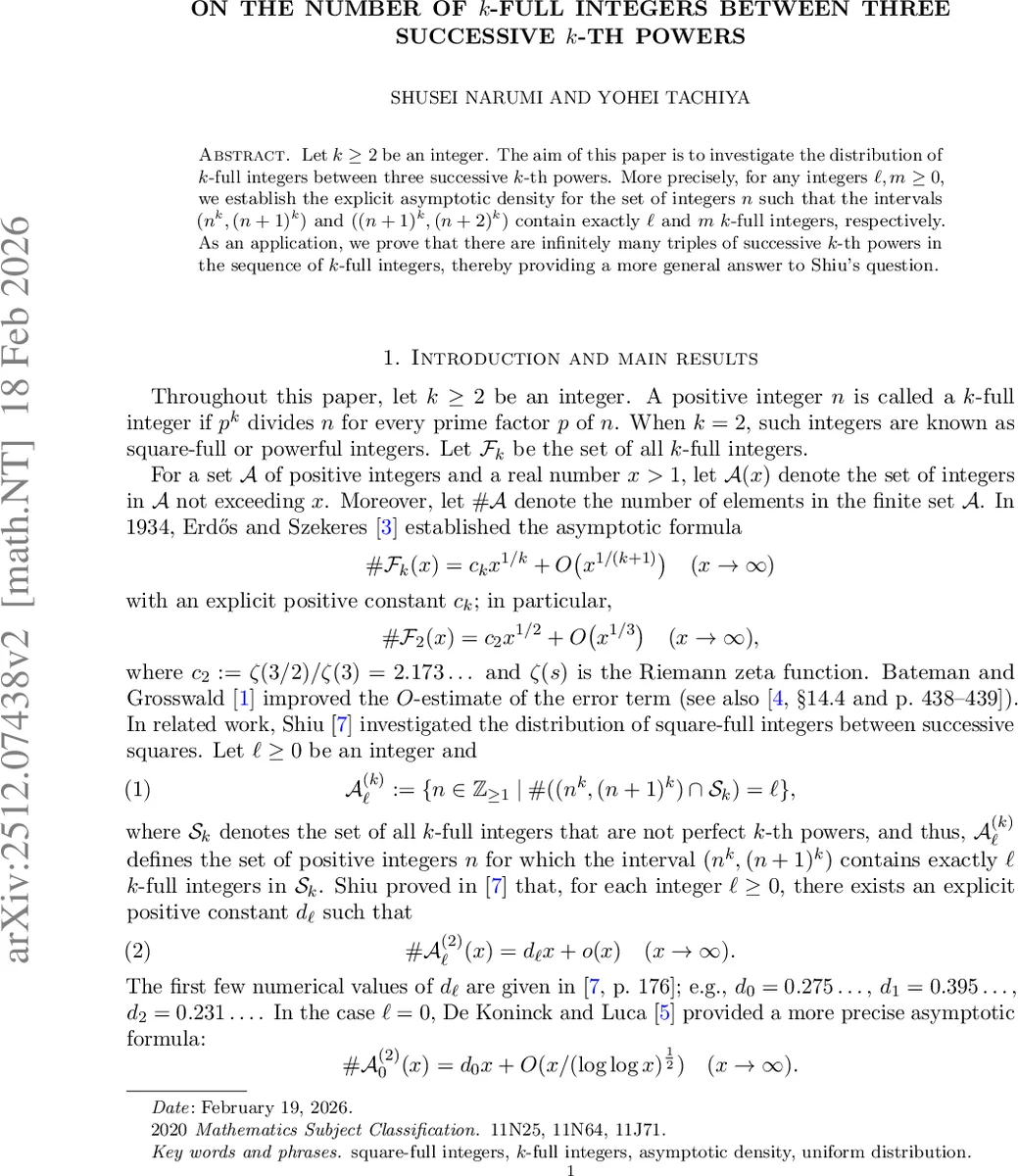
Let $k\geq2$ be an integer. The aim of this paper is to investigate the distribution of $k$-full integers between three successive $k$-th powers. More precisely, for any integers $\ell,m\ge0$, we establish the explicit asymptotic density for the set of integers $n$ such that the intervals $(n^k, (n+1)^k)$ and $((n+1)^k, (n+2)^k)$ contain exactly $\ell$ and $m$ $k$-full integers, respectively. As an application, we prove that there are infinitely many triples of successive $k$-th powers in the sequence of $k$-full integers, thereby providing a more general answer to Shiu’s question.
💡 Research Summary
The paper investigates the distribution of k‑full integers—positive integers n for which p^k divides n for every prime divisor p—between three successive k‑th powers. For any integers ℓ, m ≥ 0, the authors determine the exact asymptotic density of the set
A(k)_{ℓ,m} = { n ≥ 1 | the interval (n^k,(n+1)^k) contains exactly ℓ k‑full integers and the interval ((n+1)^k,(n+2)^k) contains exactly m k‑full integers }.
The main results are two theorems.
Theorem 1 deals with a more refined situation. Let I, J ⊂ Λ_k be finite, disjoint subsets of a certain real set Λ_k (defined in (5) as products of prime powers). Define B(k){I,J} as the set of n for which the first interval contains precisely the k‑full integers associated with I, the second interval contains those associated with J, and no other k‑full integers appear in the combined interval (n^k,(n+2)^k). The theorem proves that B(k){I,J} has a positive asymptotic density given explicitly by
d(B(k){I,J}) = ∏{λ∈I∪J} 1/λ · ∏{λ∉I∪J}(1 − 2/λ).
The product converges because ∑{λ∈Λ_k}1/λ < ∞. Remarkably, the density depends only on the union I∪J, not on the individual sets, yielding the symmetry d(B(k){I,J}) = d(B(k){J,I}).
Corollary 1 is the special case I=J=∅. It shows that there is a positive proportion C_k = ∏_{λ∈Λ_k}(1 − 2/λ) of integers n for which the whole interval (n^k,(n+2)^k) contains no k‑full integer except the perfect k‑th power (n+1)^k. For k=2 this gives the explicit sequence {3, 6, 12, 23, …}. Consequently, there are infinitely many triples of consecutive perfect k‑th powers appearing in the sequence of k‑full integers, answering Shiu’s question in a stronger form.
Theorem 2 lifts the restriction to specific subsets I, J. For any ℓ, m ≥ 0, the density of A(k){ℓ,m} is obtained by summing the densities from Theorem 1 over all disjoint I, J with |I|=ℓ, |J|=m:
d(A(k){ℓ,m}) = Σ_{I,J⊂Λ_k, |I|=ℓ, |J|=m, I∩J=∅} d(B(k){I,J}).
From this, the generating function follows:
∑{ℓ,m≥0} d(A(k){ℓ,m}) z^ℓ w^m = ∏{λ∈Λ_k} (1 + z + w − 2/λ).
Setting w=0 recovers the earlier result of Xiong and Zaharescu for a single interval, while setting z=w=0 gives the constant C_k of Corollary 1.
The proofs rely on a unique representation of a k‑full integer as n = a^k λ^k, where λ∈Λ_k. Lemma 2 establishes that the numbers 1, λ_1^{−1},…,λ_t^{−1} are linearly independent over ℚ for distinct λ_i, which enables the application of the multidimensional equidistribution theorem (Lemma 1). Lemma 3 translates the presence of a λ‑type k‑full integer in a given interval into a simple condition on the fractional part {n/λ}. Combining these lemmas yields Lemma 4, the core counting statement for sets of the form B(k)_{I,J}.
A notable methodological point is that the authors avoid the use of discrepancy estimates such as the Koksma–Hlawka or Erdős–Turán–Koksma inequalities, which were essential in earlier works (e.g., De Koninck–Luca, Xiong–Zaharescu). Instead, the equidistribution result alone suffices to obtain the asymptotic densities, simplifying the analytic framework.
The paper also provides explicit numerical values for d(A(k){ℓ,m}) when k=2 and k=3, illustrating the distribution’s shape and identifying the pairs (ℓ,m) with maximal density (e.g., d(A(2){1,1})≈0.158, d(A(2)_{0,2})≈0.079).
In summary, the authors give a complete, explicit description of how k‑full integers populate the two consecutive gaps between three successive k‑th powers, prove that every possible pair (ℓ,m) occurs with positive density, and deduce the existence of infinitely many triples of consecutive perfect k‑th powers within the k‑full integer sequence. This work generalizes Shiu’s original question from squares to arbitrary k‑full integers and provides a clean, equidistribution‑based proof technique that may be useful for related problems in arithmetic combinatorics and analytic number theory.
Comments & Academic Discussion
Loading comments...
Leave a Comment