A refined variant of Hartley convolution: algebraic structures, spectral radius and related issues
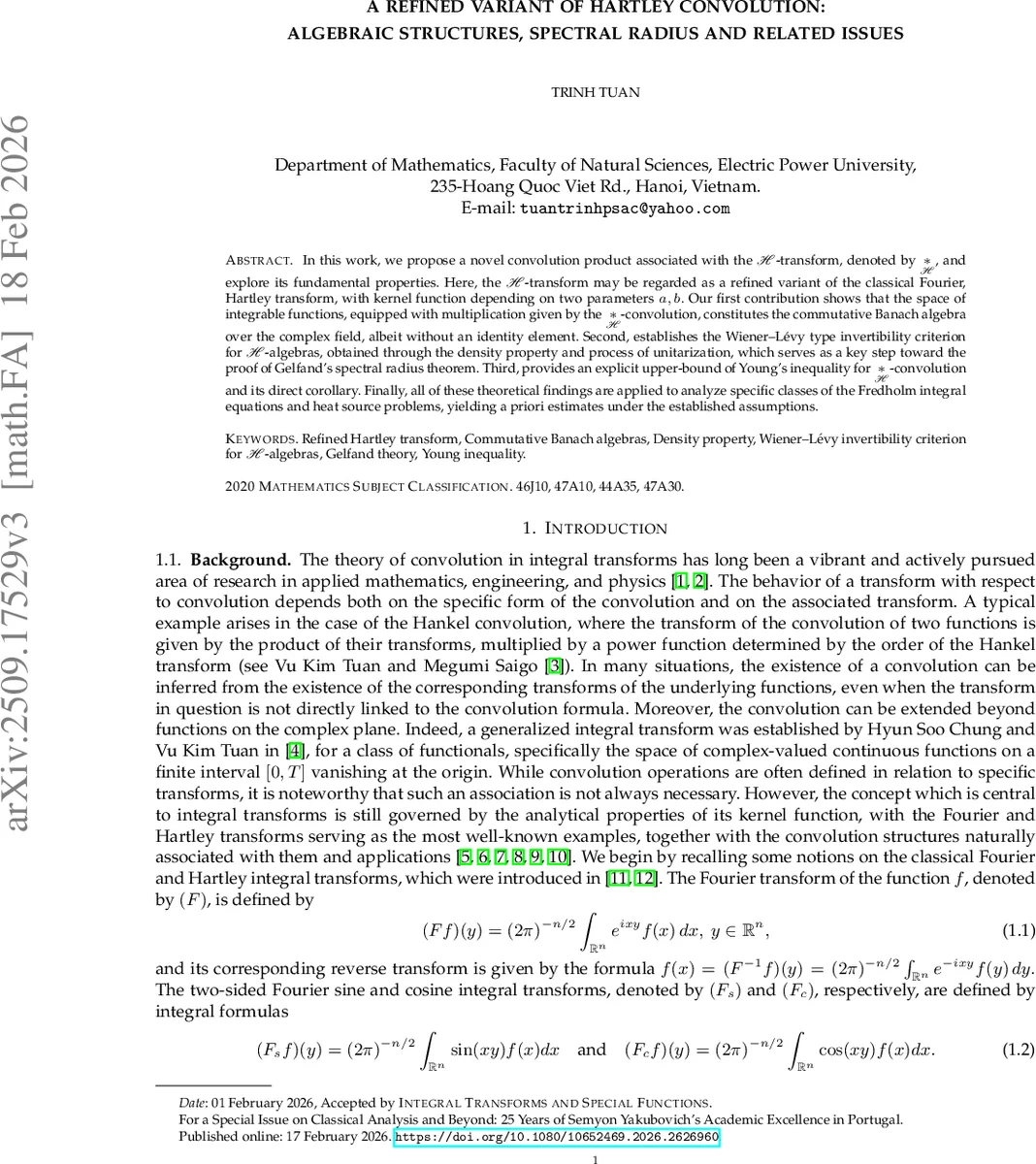
In this work, we propose a novel convolution product associated with the $\mathscr{H}$-transform, denoted by $\underset{\mathscr{H}}{\ast}$, and explore its fundamental properties. Here, the $\mathscr{H}$-transform may be regarded as a refined variant of the classical Fourier, Hartley transform, with kernel function depending on two parameters $a,b$. Our first contribution shows that the space of integrable functions, equipped with multiplication given by the $\underset{\mathscr{H}}{\ast}$-convolution, constitutes the commutative Banach algebra over the complex field, albeit without an identity element. Second, establishes the Wiener–Lévy type invertibility criterion for $\mathscr{H}$-algebras, obtained through the density property and process of unitarization, which serves as a key step toward the proof of Gelfand’s spectral radius theorem. Third, provides an explicit upper-bound of Young’s inequality for $\underset{\mathscr{H}}{\ast}$-convolution and its direct corollary. Finally, all of these theoretical findings are applied to analyze specific classes of the Fredholm integral equations and heat source problems, yielding a priori estimates under the established assumptions.
💡 Research Summary
The paper introduces a new convolution operation associated with a two‑parameter family of integral transforms that the author calls the refined Hartley or $\mathscr H$‑transform. The transform is defined for real parameters $a,b\neq0$ by
\
Comments & Academic Discussion
Loading comments...
Leave a Comment