Odd relaxation in three-dimensional Fermi liquids
Recent theoretical works predict a hierarchy of long-lived, non-hydrodynamic modes in two-dimensional Fermi liquids arising from the feature$-$supposedly unique to two dimensions$-$that relaxation by head-on scattering is not efficient in the presence of Pauli blocking. This leads to a parity-based separation of scattering rates, with odd-parity modes relaxing much more slowly than even-parity ones. In this work, we establish that a similar effect exists in isotropic three-dimensional (3D) Fermi liquids, even though relaxation does not proceed solely by head-on scattering. We show that while the relaxation rates of even and odd modes in 3D share the same leading-order $\sim T^2$ low-temperature scaling typical of Fermi liquids, their magnitudes differ, with odd-parity modes relaxing more slowly than even ones for a broad class of interactions. We find a relative difference between odd-parity and even-parity relaxation rates as large as $40%$ just by Pauli blocking alone, with a strong additional dependence on the scattering potential, such that the odd-even staggering is further enhanced by interactions that favor large-angle scattering. We identify signatures of these odd-parity relaxation rates in the static transverse conductivity as well as the transverse collective mode structure. Our results establish the unexpected existence of a tomographic like regime in higher-dimensional Fermi liquids and suggest experimental probes via transport measurements.
💡 Research Summary
The paper investigates whether the parity‑based separation of relaxation rates, previously identified in two‑dimensional (2D) Fermi liquids, also occurs in three‑dimensional (3D) isotropic Fermi liquids. In 2D, Pauli blocking forces low‑temperature electron–electron collisions to be “head‑on,” which efficiently relaxes even‑parity (symmetric) deformations of the quasiparticle distribution while odd‑parity (antisymmetric) deformations relax only through subleading processes. This yields a dramatic hierarchy of long‑lived non‑hydrodynamic modes, often referred to as a “tomographic” regime.
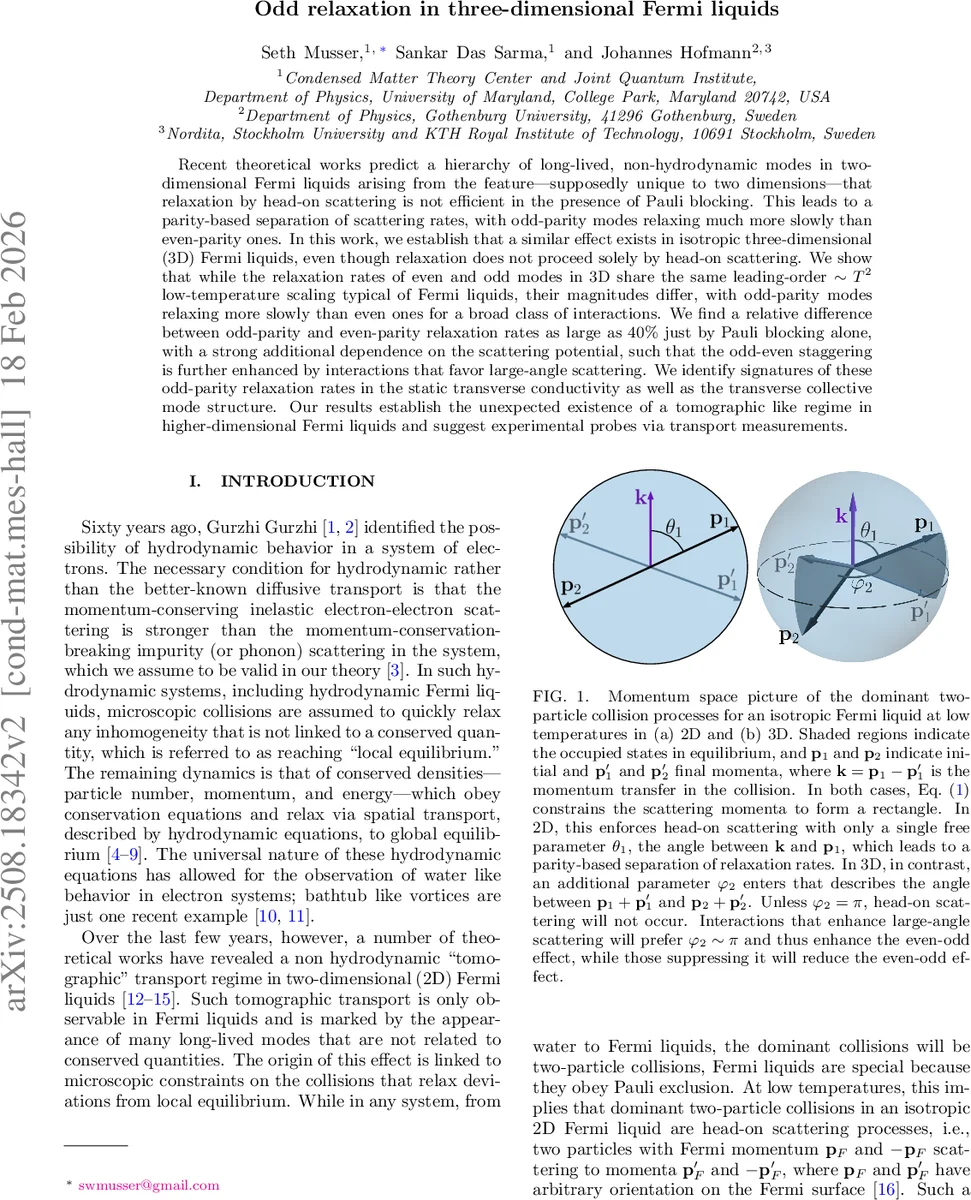
In 3D the geometry of momentum conservation does not enforce head‑on scattering; an extra azimuthal angle φ₂ allows generic scattering configurations. Consequently, the conventional argument predicts no parity‑based distinction: both even and odd modes should decay with the same leading‑order T² scaling typical of Fermi‑liquid quasiparticle scattering. The authors challenge this expectation by explicitly diagonalizing the full electron‑electron collision integral in a spherical‑harmonic basis.
They parametrize small deviations from equilibrium as δf = (−∂f₀/∂ε)ψ, expand ψ in spherical harmonics Yₗᵐ(θ,φ) and radial functions uₙ(p), and focus on the low‑temperature limit where the radial dependence can be taken as constant (rigid shift of the Fermi surface). The decay rate of each angular mode l (independent of m) is found to be
γₗ = (π/6) (T²/ℏT_F) N_f Iₗ,
where N_f counts spin/valley flavors and Iₗ is a dimensionless coefficient that depends on the interaction potential. For a momentum‑independent (screened) interaction, Iₗ can be evaluated analytically:
Iₗ = (2l)/(2l+1) for even l, Iₗ = (2l − 2)/(2l+1) for odd l.
Thus, even‑parity modes (even l) decay faster than odd‑parity modes (odd l). The difference is maximal for the lowest non‑trivial odd mode (l = 3), where γ₃ is only about 60 % of γ₂, corresponding to a relative gap of ≈40 %. The authors emphasize that this gap arises already from pure Pauli blocking; the interaction’s angular dependence can further enhance it. Interactions that favor large‑angle scattering (e.g., potentials that increase with momentum transfer) increase the weight of configurations with φ₂ ≈ π, effectively reinforcing the even‑odd disparity. Conversely, forward‑scattering‑dominated potentials reduce the effect.
The paper also verifies that γ₀ = γ₁ = 0, reflecting conservation of particle number (l = 0) and total momentum (l = 1). At large l the coefficients Iₗ approach unity, so the parity effect diminishes, but low‑l modes dominate transport at experimentally accessible temperatures, making the effect observable.
To connect theory with experiment, the authors analyze the transverse conductivity σ⊥(ω,q). In the static, finite‑q limit the conductivity contains a “tomographic” parameter that is directly proportional to the slowest odd‑parity decay rate. Consequently, the width of the low‑frequency peak in σ⊥ is set by γ_odd, providing a measurable signature. Moreover, the dispersion and damping of transverse collective modes (e.g., shear‑like plasmons) are likewise governed by the odd‑parity relaxation rate. Thus, precise measurements of σ⊥(q) or of the attenuation of transverse collective excitations in ultra‑clean 3D metals (where impurity and phonon scattering are negligible) can reveal the predicted even‑odd staggering.
The authors discuss practical considerations: 3D metals have Fermi temperatures of order 10⁴ K, so even a modest fraction of T_F corresponds to experimentally accessible temperatures (tens of kelvin). The absolute difference between even and odd rates therefore becomes sizable, and the temperature window where electron‑electron scattering dominates is broader than in 2D systems. They suggest candidate materials with strong screening (yielding an approximately constant interaction) and, where possible, engineered interactions that enhance large‑angle scattering (e.g., via lattice‑induced anisotropies or multi‑band effects).
In conclusion, the work overturns the prevailing belief that parity‑based long‑lived modes are exclusive to 2D Fermi liquids. By demonstrating a robust even‑odd disparity in 3D, it opens a new avenue for exploring non‑hydrodynamic transport phenomena in bulk metals. Future directions include extending the analysis to anisotropic Fermi surfaces, multi‑band systems, and materials with strong spin‑orbit coupling, as well as experimental verification through high‑resolution terahertz spectroscopy, momentum‑resolved transport imaging, and measurements of transverse collective mode damping. The findings suggest that “tomographic” transport is a generic feature of interacting Fermi systems, not limited by dimensionality, and could be harnessed to tailor electronic response in novel quantum materials.
Comments & Academic Discussion
Loading comments...
Leave a Comment