Comparison of Extensions of Unitary Vertex Operator Algebras and Conformal Nets
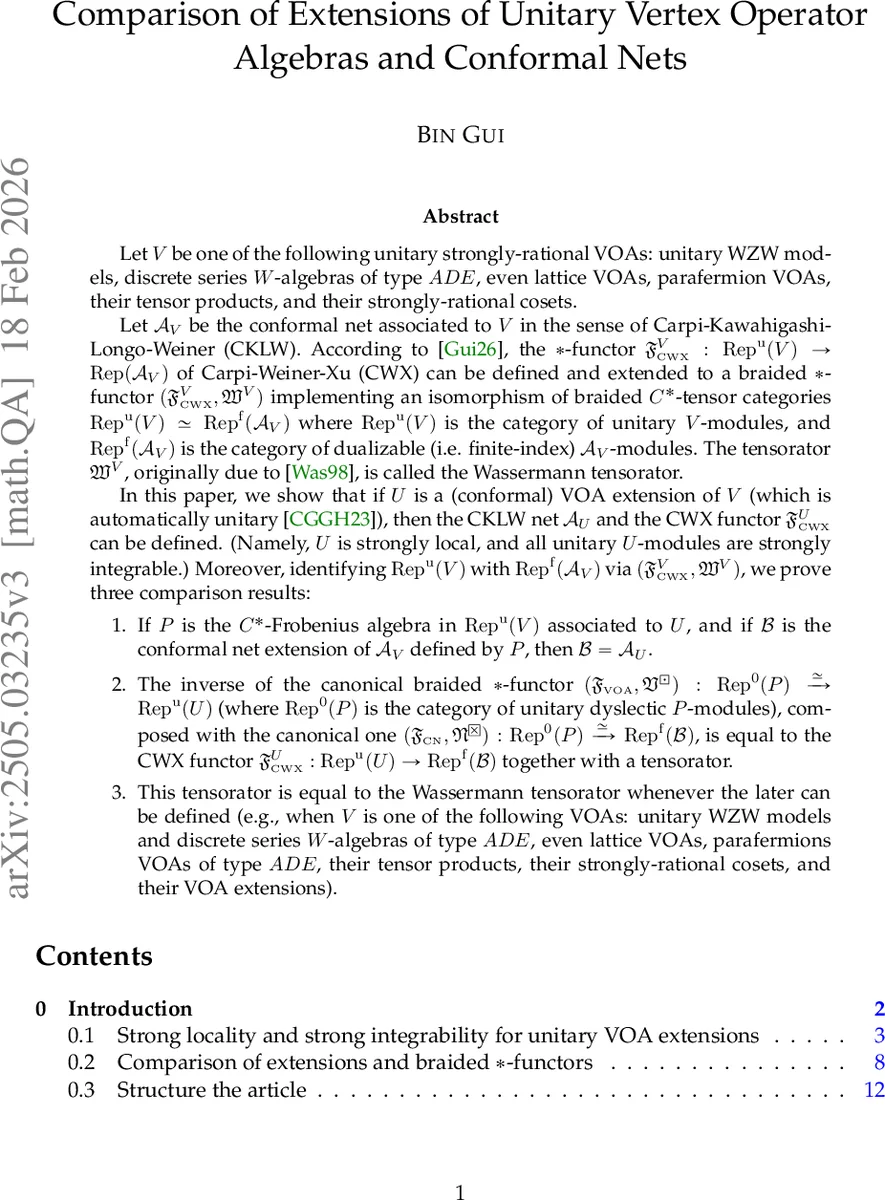
Let $V$ be one of the following unitary strongly-rational VOAs: unitary WZW models, discrete series W-algebras of type ADE, even lattice VOAs, parafermion VOAs, their tensor products, and their strongly-rational cosets. Let $U$ be a (unitary) VOA extension of $V$, described by a Q-system $Q$. We prove that $U$ is strongly local. Let $\mathcal A_V,\mathcal A_U$ be the conformal nets associated to $V,U$ in the sense of Carpi-Kawahigashi-Longo-Weiner (CKLW). We prove that $\mathcal A_U$ is canonically isomorphic to the conformal net extension of $\mathcal A_V$ defined by the Q-system $Q$. We prove that all unitary $U$-modules are strongly integrable in the sense of Carpi-Weiner-Xu (CWX). We show that the CWX $$-functor from the $C^$-category of unitary $U$-modules to the $C^$-category of finite-index $\mathcal A_U$-modules is naturally isomorphic to $$-functor defined by $Q$.
💡 Research Summary
The paper establishes a comprehensive bridge between unitary vertex operator algebras (VOAs) and conformal nets, focusing on extensions. Starting with a unitary, strongly rational VOA V drawn from a well‑studied list (unitary WZW models, ADE discrete‑series W‑algebras, even lattice VOAs, parafermion VOAs, their tensor products, and rational cosets), the author assumes V is completely unitary (C₂‑cofinite, rational, all modules unitarizable) and strongly energy‑bounded. Under these hypotheses, every intertwining operator of V satisfies polynomial energy bounds and the strong intertwining property, which together imply strong braiding for the categorical extension of V.
Given a unitary VOA extension U of V (automatically sharing the same conformal vector), the paper proves three main results:
-
Strong locality of U – By viewing U as the categorical extension of V modulo the relations encoded by a haploid commutative C*‑Frobenius algebra (a Q‑system) P in Repᵤ(V), the author shows that the strong braiding of V’s categorical extension descends to U. Consequently, all smeared vertex operators of U localized in disjoint intervals strongly commute, i.e., U is strongly local. This extends earlier techniques that required linear energy bounds, now relying on the more flexible strong intertwining property.
-
Canonical identification of conformal nets – Using the CKLW construction, V gives rise to a conformal net 𝔄_V. The Q‑system P defines a finite‑index net extension 𝔅 of 𝔄_V. The paper proves that 𝔅 is canonically isomorphic to the net 𝔄_U obtained from U by the same CKLW procedure. Thus the algebraic data of the Q‑system completely determines the analytic net extension.
-
Strong integrability of U‑modules and functorial equivalence – For any unitary U‑module, the strong intertwining property ensures the existence of a unique 𝔄_U‑module structure compatible with smeared vertex operators; this is the notion of strong integrability introduced by Carpi‑Weiner‑Xu (CWX). The CWX *‑functor F_U^CWX: Repᵤ(U) → Rep_f(𝔄_U) is fully faithful. Moreover, the *‑functor induced by the Q‑system P (via induction from Rep₀(P) to Rep_f(𝔅)) is naturally isomorphic to F_U^CWX, and the associated tensorator coincides with the Wassermann tensorator whenever the latter is defined (e.g., for the same class of VOAs listed above).
The paper also introduces Conditions I and II on V. Condition I requires every intertwining operator to be energy‑bounded and to satisfy the strong intertwining property; Condition II asks for a generating set of modules with this property. Condition I implies Condition II and is preserved under unitary extensions, allowing the author to propagate strong locality and strong integrability from V to U. Several corollaries follow: any extension of a tensor product of unitary affine VOAs and even lattice VOAs is strongly local; all unitary VOAs with central charge ≤ 1 are strongly local; and many concrete families (holomorphic VOAs of central charge 24, chiral WZW models, extensions of low‑rank affine VOAs) fall under the theory.
Methodologically, the work blends analytic techniques (energy bounds, smeared operators, von Neumann algebra commutation) with categorical tools (Q‑systems, modular tensor categories, categorical extensions). The key technical input is the strong intertwining property, which guarantees that smeared intertwining operators intertwine smeared vertex operators in a strongly commuting way. This property, together with the complete unitarity of V, enables the construction of categorical extensions that inherit strong braiding, ultimately yielding the desired analytic results for U.
In summary, the paper proves that for a broad class of unitary strongly rational VOAs, any unitary VOA extension is strongly local, its associated conformal net coincides with the net extension defined by the corresponding Q‑system, and all unitary modules are strongly integrable. Moreover, the CWX functor and the Q‑system induction functor are naturally equivalent, providing a unified categorical‑analytic picture of VOA extensions and conformal net extensions. This work significantly advances the understanding of the VOA–conformal net correspondence, especially in the context of extensions and modular tensor categories.
Comments & Academic Discussion
Loading comments...
Leave a Comment