$L_p$ estimates in the Androulidakis-Mohsen-Yuncken calculus
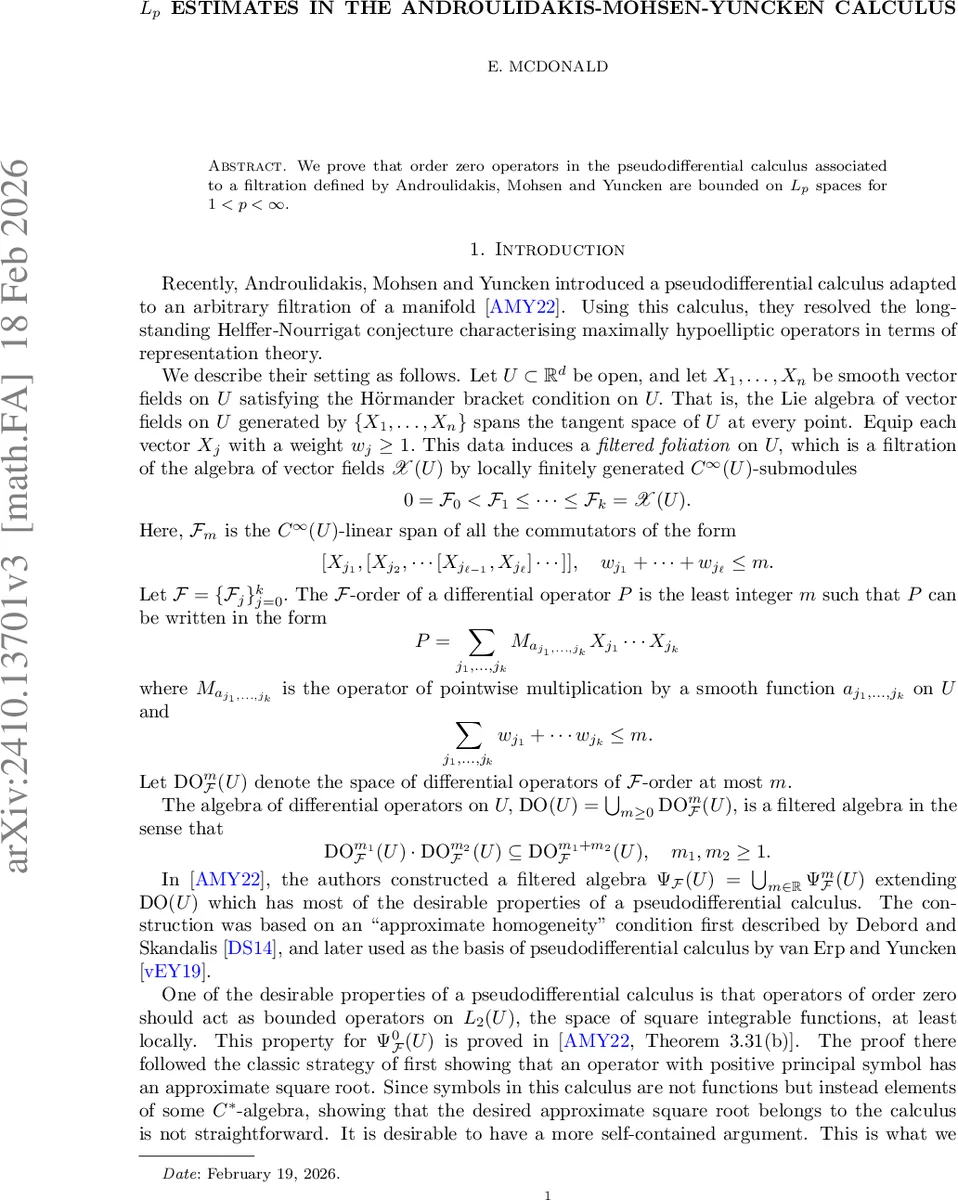
We prove that order zero operators in the pseudodifferential calculus associated to a filtration defined by Androulidakis, Mohsen and Yuncken are bounded on $L_p$ spaces for $1<p<\infty.$
💡 Research Summary
The paper addresses the boundedness of order‑zero operators in the pseudodifferential calculus introduced by Androulidakis, Mohsen and Yuncken (AMY) for an arbitrary filtration of a smooth manifold. The AMY calculus extends the filtered algebra of differential operators generated by a family of smooth vector fields {X₁,…,Xₙ} satisfying Hörmander’s bracket condition, each equipped with a weight wⱼ≥1. The filtration F={F₀<F₁<…<F_k}=X(U) is defined by the total weight of commutators, and the F‑order of a differential operator is the smallest integer m for which the operator can be written as a product of vector fields whose total weight does not exceed m. The authors of AMY constructed a filtered algebra Ψ_F^m(U) of pseudodifferential operators extending the differential algebra, proving that operators of order zero are locally bounded on L²(U) (Theorem 3.31(b) in AMY22). Their proof relies on a delicate construction of an approximate square root for operators with positive principal symbol, a step that is technically involved because symbols live in a C*‑algebra rather than in a function space.
The present work supplies a self‑contained proof that order‑zero operators are bounded on all Lᵖ spaces with 1<p<∞, and moreover that the associated ℏ‑family {T_ℏ} is uniformly continuous as ℏ→0. The main theorem (Theorem 2.1) states: if T∈Ψ_F^m(X) and Re m≤0, then T is locally bounded on Lᵖ(X) for every 1<p<∞; if Re m<0 the family {T_ℏ} is uniformly continuous on Lᵖ for all 1≤p≤∞ and T is locally compact. The proof does not invoke the AMY L²‑boundedness result; instead it uses an almost‑orthogonal decomposition of kernels with respect to a scaling action (the “R‑action”) introduced in Theorem 6.5 of the paper. This decomposition, suggested by Omar Mohsen, yields a series T=∑_{j≥1}T^{(j)}_ℏ whose terms are essentially orthogonal in Lᵖ, allowing unconditional convergence and uniform operator norm estimates.
To implement this strategy the authors work in an abstract setting of a quasi‑metric doubling measure space (X,ρ,μ). They introduce a sequence of locally integrable kernels {K_j} satisfying four technical conditions (I)–(IV): support size, L¹‑bound, Hölder continuity in the second variable, and cancellation. Lemmas 3.2 and 3.3 show that the finite linear combinations K_α=∑α_jK_j satisfy the Calderón‑Zygmund kernel estimates. The crucial almost‑orthogonality is established in Theorem 3.4, where they prove that the mixed convolution ∫K_j(x,y₀)K_ℓ(y,y₀) dμ(y₀) decays like 2^{-|j-ℓ|}. This decay, together with the Calderón‑Zygmund theory, yields L²‑boundedness of Op(K_α) (Theorem 4.1) and, via interpolation and Marcinkiewicz, Lᵖ‑boundedness for all 1<p<∞. The authors also remark that the same conclusion follows from Street’s general Lᵖ‑boundedness theorem for operators with standard symbol estimates (Street 2014, 2023), but their proof is independent of those results and only uses the closure of Ψ_F under composition and adjoint.
Beyond the main Lᵖ‑boundedness theorem, the paper outlines further applications. In Section 8 the authors develop an Lᵖ‑Sobolev scale adapted to the filtration, establishing Sobolev embedding theorems. Section 9 uses the Lᵖ‑boundedness to prove maximal sub‑elliptic estimates for Hörmander operators in Lᵖ, extending classical L² results. The authors also discuss the limitations of their method for multiparameter pseudodifferential operators, which generally fall outside the weak‑type (1,1) framework.
In summary, the paper provides a clean, harmonic‑analysis‑driven proof that order‑zero operators in the AMY calculus act boundedly on all Lᵖ spaces, clarifies the relationship with existing results by Street, and opens the way to a systematic Lᵖ‑theory (Sobolev spaces, sub‑elliptic estimates) for filtered pseudodifferential calculi. The approach is notable for its reliance on almost‑orthogonal kernel decompositions rather than algebraic square‑root constructions, making it potentially adaptable to other non‑standard pseudodifferential frameworks.
Comments & Academic Discussion
Loading comments...
Leave a Comment