Signatures of Quantum Phase Transitions in Driven Dissipative Spin Chains
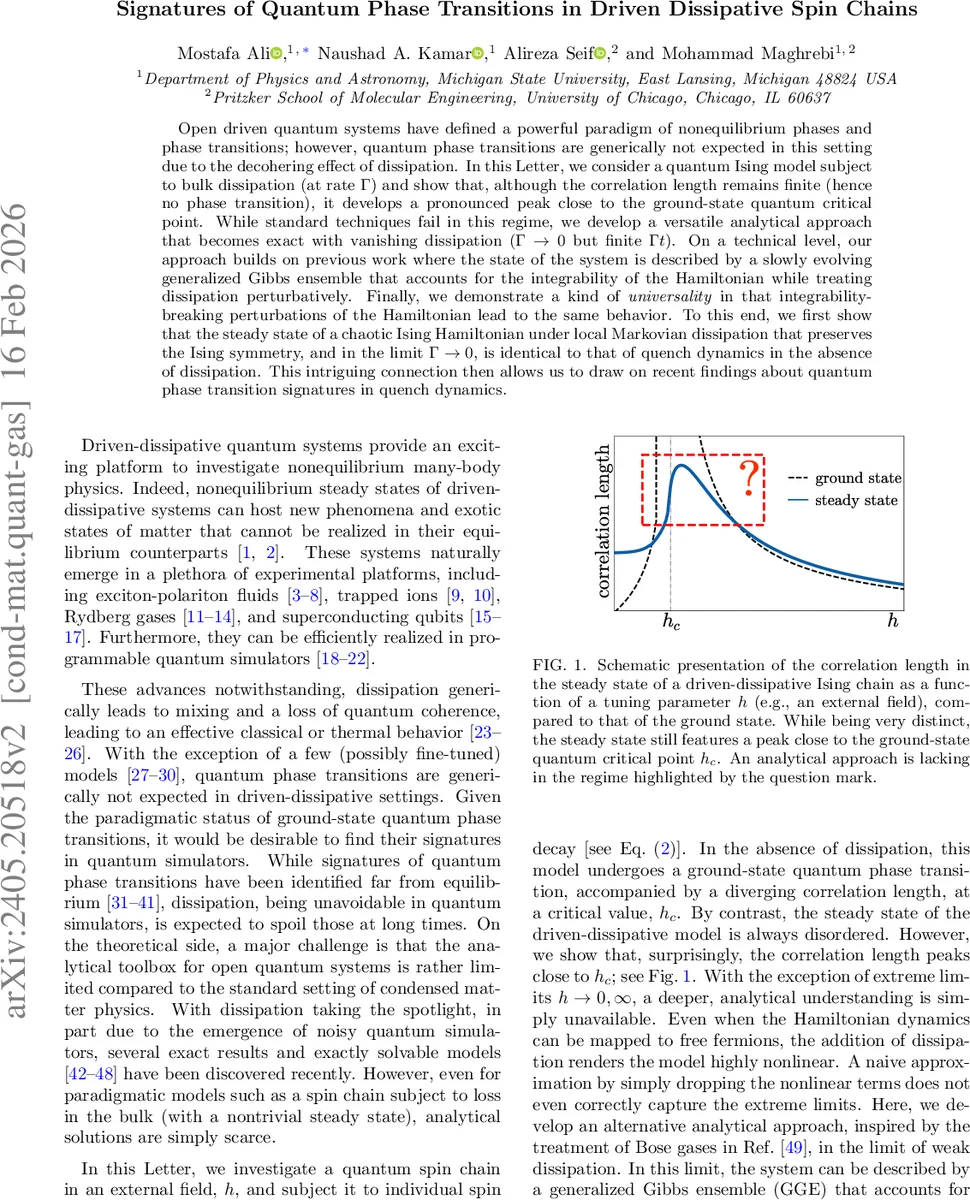
Open driven quantum systems have defined a powerful paradigm of nonequilibrium phases and phase transitions; however, quantum phase transitions are generically not expected in this setting due to the decohering effect of dissipation. In this Letter, we consider a quantum Ising model subject to bulk dissipation (at rate $Γ$) and show that, although the correlation length remains finite (hence no phase transition), it develops a pronounced peak close to the ground-state quantum critical point. While standard techniques fail in this regime, we develop a versatile analytical approach that becomes exact with vanishing dissipation ($Γ\to 0$ but finite $Γt$). On a technical level, our approach builds on previous work where the state of the system is described by a slowly evolving generalized Gibbs ensemble that accounts for the integrability of the Hamiltonian while treating dissipation perturbatively. Finally, we demonstrate a kind of universality in that integrability-breaking perturbations of the Hamiltonian lead to the same behavior. To this end, we first show that the steady state of a chaotic Ising Hamiltonian under local Markovian dissipation that preserves the Ising symmetry, and in the limit $Γ\to 0$, is identical to that of quench dynamics in the absence of dissipation. This intriguing connection then allows us to draw on recent findings about quantum phase transition signatures in quench dynamics.
💡 Research Summary
In this work the authors address a fundamental question in non‑equilibrium quantum many‑body physics: can signatures of a ground‑state quantum phase transition survive in a driven‑dissipative setting where Markovian loss continuously destroys quantum coherence? To answer this, they study the paradigmatic one‑dimensional transverse‑field Ising model subjected to uniform single‑spin decay at rate Γ. The closed system (Γ = 0) undergoes a quantum phase transition at the critical transverse field h_c = 1, where the correlation length ξ diverges. When bulk dissipation is added, the steady state is always disordered and ξ remains finite, so a true phase transition is absent. Nevertheless, numerical matrix‑product‑state (MPS) simulations reveal a pronounced peak of ξ when the field is tuned close to h_c. The peak persists over a wide range of Γ and becomes sharper as Γ→0, suggesting that the quantum critical point leaves a detectable imprint even in the presence of loss.
Standard analytical tools fail in the regime h≈h_c. A naive spin‑wave (Holstein‑Primakoff) expansion works only for large h, while a free‑fermion treatment that drops the Jordan‑Wigner string in the Lindblad operators misses the peak entirely. The authors therefore develop a new analytical framework that becomes asymptotically exact in the weak‑dissipation limit (Γ→0 while Γ t is finite). The key idea is to describe the system at any time by a slowly evolving generalized Gibbs ensemble (GGE). In the integrable closed Ising chain, the GGE is fully characterized by the occupation numbers of Bogoliubov quasiparticles Q_k = α_k†α_k, which are conserved. Weak dissipation renders these occupations only approximately conserved; their dynamics is governed by the adjoint dissipator D_i† acting on the GGE. Importantly, after the Jordan‑Wigner transformation the Lindblad jump operators contain a non‑local parity string, which couples the even and odd fermionic parity sectors. The authors retain this coupling by working with a block‑diagonal density matrix that contains two Gaussian pieces, one for each parity sector.
Using Wick’s theorem together with a basis transformation that relates periodic and antiperiodic momentum modes, they derive closed equations for the real‑space fermionic correlators A_k = ⟨c_k†c_k⟩ and B_k = ⟨c_kc_{−k}⟩. These equations are non‑linear and non‑local in momentum space; after taking the thermodynamic limit they can be expressed compactly with a Hilbert transform on the unit circle. Together with the GGE constraint C_k = 0 (which enforces the relation between A_k and B_k), the system of equations can be solved analytically (by continuation into the complex plane) or numerically with high precision. The resulting fermionic correlators are then used to construct the spin‑spin correlation function ⟨σ_i^xσ_j^x⟩ via a determinant of a Toeplitz‑like matrix, from which the correlation length ξ is extracted.
The analytical results reproduce the MPS data quantitatively. In the Γ→0 limit the peak position h_peak lies slightly above the critical field (h_peak ≳ 1), a shift that originates from the parity‑mixing terms absent in the naive free‑fermion approximation. As Γ increases the height of the peak diminishes, but its location remains essentially unchanged, confirming the robustness of the effect.
To test the universality of the phenomenon, the authors introduce an integrability‑breaking perturbation: a next‑nearest‑neighbour ferromagnetic coupling J₂ σ_i^xσ_{i+2}^x. This “NNN Ising” model no longer maps to free fermions, yet the steady‑state correlation length still exhibits a clear peak near the corresponding quantum critical point for a broad range of J₂ (0 ≤ J₂ ≤ 0.5). The peak moves only marginally, indicating that the imprint of the underlying quantum criticality survives even when the Hamiltonian is chaotic, provided the dissipation remains weak.
Finally, the authors point out a deep connection to quantum quenches: in the limit Γ→0 the steady state of the driven‑dissipative system coincides with the long‑time state after a sudden quench of the closed Ising chain from the fully polarized down state. Consequently, known results on quench dynamics near criticality can be directly imported to explain the observed peak in ξ.
In summary, the paper demonstrates three major insights: (i) weak Markovian bulk loss does not completely erase quantum critical signatures; instead, the steady‑state correlation length displays a pronounced, universal peak near the closed‑system critical point. (ii) A GGE‑based perturbative treatment, combined with careful handling of parity strings and Hilbert‑transform techniques, yields an asymptotically exact analytical description of the steady state in the weak‑dissipation regime. (iii) This behavior persists under integrability‑breaking perturbations, suggesting a form of universality that could be exploited in experimental quantum simulators where dissipation is unavoidable. The work thus provides a powerful theoretical framework for probing quantum criticality in realistic, open quantum many‑body platforms.
Comments & Academic Discussion
Loading comments...
Leave a Comment