Comparing Fabrication Workflows in CAD to Support Design Reasoning
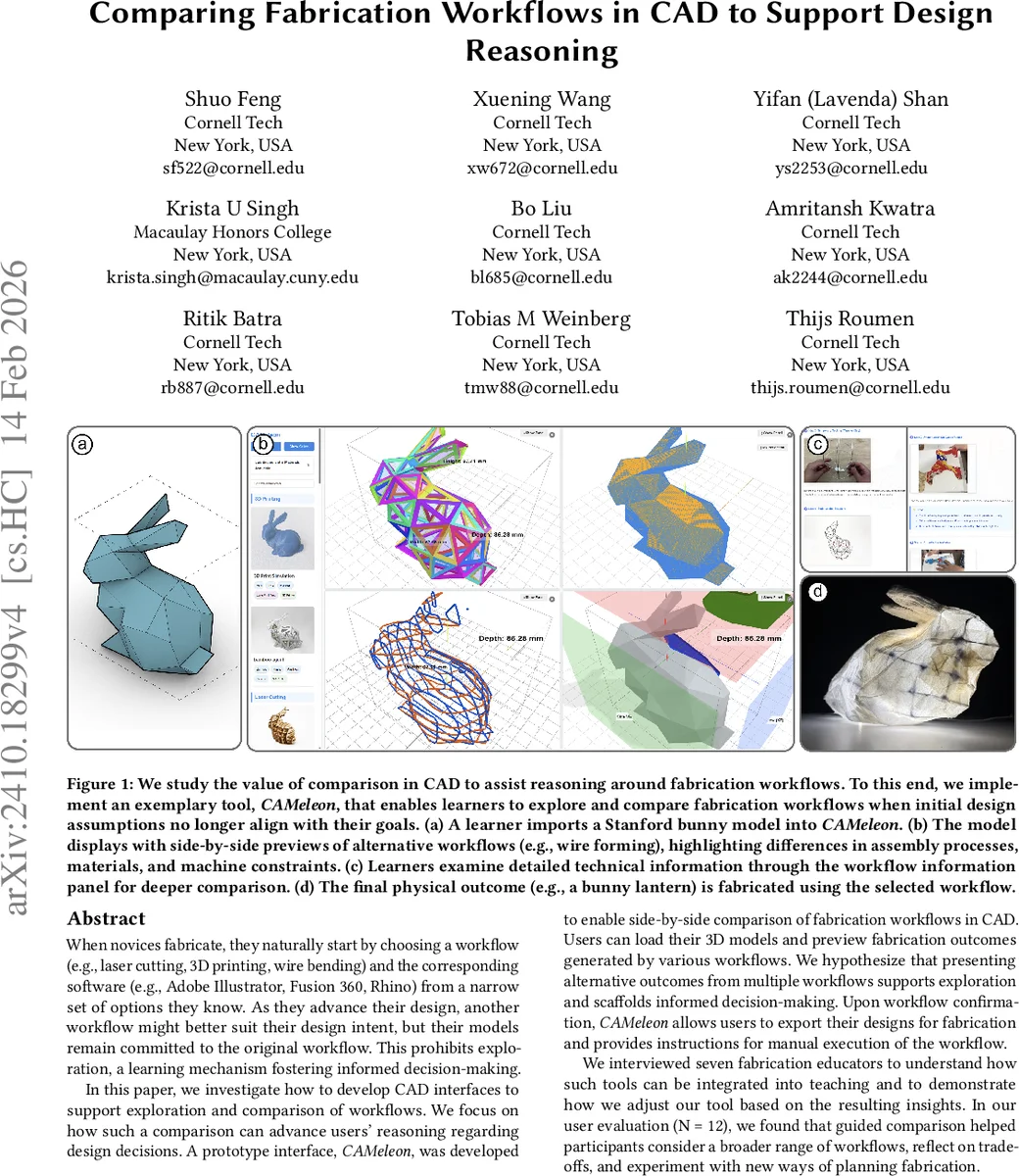
When novices fabricate, they start by choosing a workflow (e.g., laser cutting, 3D printing, etc.) and corresponding software from a narrow set they know. As they advance their design, another workflow might better suit their intent, but their models remain committed to the original workflow. This prohibits exploration, which fosters informed decision-making. In this paper, we investigate how CAD interfaces can guide exploration and comparison of workflows. Specifically, comparison can advance users’ reasoning about design decisions. We developed a prototype interface, CAMeleon, which lets users compare fabrication workflows. Users load 3D models and preview outcomes from different workflows. We hypothesize that presenting alternative outcomes supports exploration and scaffolds informed decision-making. Upon workflow confirmation, CAMeleon allows users export both machine and human instructions for the chosen fabrication workflow. We interviewed seven fabrication educators to understand how such tools can be integrated into teaching and to demonstrate how we adjust our tool based on their insights. In user evaluation (N = 12), guided comparison helped participants consider a broader range of workflows, reflect on trade-offs, and experiment with new ways of planning.
💡 Research Summary
The paper addresses a common problem in digital fabrication education: novices often become locked into the first workflow (e.g., laser cutting, 3D printing, or wire bending) they learn, even when later design iterations would be better served by a different process. This “workflow lock‑in” limits exploration, a key mechanism for developing informed decision‑making and design reasoning. To mitigate this, the authors introduce CAMeleon, a prototype CAD interface that makes multiple fabrication workflows directly comparable within a single environment.
CAMeleon’s core functionality consists of four tightly integrated modules. First, a model import pipeline accepts common 3D file formats (STL, OBJ, SVG) and automatically generates simulated fabrication outcomes for a curated set of 16 workflows, ranging from additive (various 3D printing settings) to subtractive (laser cutting, CNC milling) and manual processes (wire forming, epoxy laminating). Each simulated outcome includes not only a visual preview but also a rich metadata package: material properties, machine constraints (bed size, power limits), estimated build time, post‑processing steps, and potential failure warnings.
Second, the side‑by‑side visual comparison view displays the selected workflows in parallel panes. Users can instantly see how the same geometry would look when produced by each process, allowing visual assessment of surface finish, structural form, and overall feasibility. Third, a workflow information panel lists key descriptors (e.g., “lightweight”, “high strength”, “low cost”) and quantitative metrics, enabling users to reason about trade‑offs such as cost versus durability or speed versus design freedom. Finally, after a decision is made, CAMeleon exports the appropriate machine files (SVG for laser cutters, G‑code for 3D printers, etc.) and provides step‑by‑step instructional content, including videos and textual guides, to support both automated and manual fabrication.
To ground the design in real teaching practice, the authors conducted semi‑structured interviews with seven fabrication educators from diverse institutional contexts (high schools, maker spaces, university labs). The educators highlighted three design imperatives: (1) early exposure to multiple workflows encourages broader creative thinking; (2) explicit comparison promotes metacognitive reflection on why a particular process is chosen; and (3) tools must support “reconstruction import” so that a model originally designed for one workflow can be re‑interpreted for another without starting from scratch. In response, CAMeleon implements a reconstruction import feature that converts an imported STL into voxel‑based or alpha‑shape representations, thereby decoupling the geometry from its original process‑specific constraints.
The system was evaluated with twelve undergraduate design students in a computational fabrication course. Participants initially gravitated toward the familiar 3D printing workflow. After using CAMeleon, they explored an average of four alternative workflows per task, and 75 % of them changed their initial choice. In a case study involving a stool design, students compared 3D printing, hot‑wire foam cutting, wire forming, and epoxy laminating. The metadata revealed that epoxy laminating offered the best strength‑to‑weight ratio for a functional seat, despite higher manual effort, leading most participants to select it. Quantitative findings showed that the number of considered workflows increased by a factor of 3.2, and participants reported heightened awareness of trade‑offs such as build time versus material cost and structural integrity versus aesthetic flexibility.
The authors acknowledge limitations. The current prototype supports only 16 workflows, omitting emerging hybrid processes (e.g., multi‑material 3D printing, robot‑assisted assembly). The user study was short‑term, focusing on immediate decision‑making rather than longitudinal learning outcomes. Consequently, future work should expand the workflow library, integrate hybrid process modeling, and conduct long‑duration field studies to assess impacts on design expertise development.
In conclusion, CAMeleon demonstrates that embedding comparative exploration directly into CAD tools can break workflow lock‑in, foster goal‑oriented design reasoning, and broaden novices’ perception of fabrication possibilities. By providing visual, quantitative, and procedural information side‑by‑side, the system scaffolds the reflective decision‑making process that experts employ when selecting a fabrication method. This work opens a promising research direction for educational technology that bridges conceptual design thinking with practical manufacturing constraints.
Comments & Academic Discussion
Loading comments...
Leave a Comment