A Separation Method of the Positivity of A Quartic Polynomial
Although the positivity of a quartic polynomial is a well-researched topic, existing conditions are often highly complex. Some necessary and sufficient conditions for the positivity of a quartic polynomial are presented through a separation method based on Ferrari’s technique of solving a quartic equation. We apply the result to the problem of the projection of the coefficient space.
💡 Research Summary
The paper addresses the classic problem of determining when a quartic polynomial is strictly positive for all real arguments. While many criteria exist in the literature, they are often cumbersome and not easy to apply. The authors propose a novel “separation method” that is rooted in Ferrari’s technique for solving quartic equations.
Core Idea
Starting from the reduced quartic
(f(x)=x^{4}+p x^{2}+q x+r),
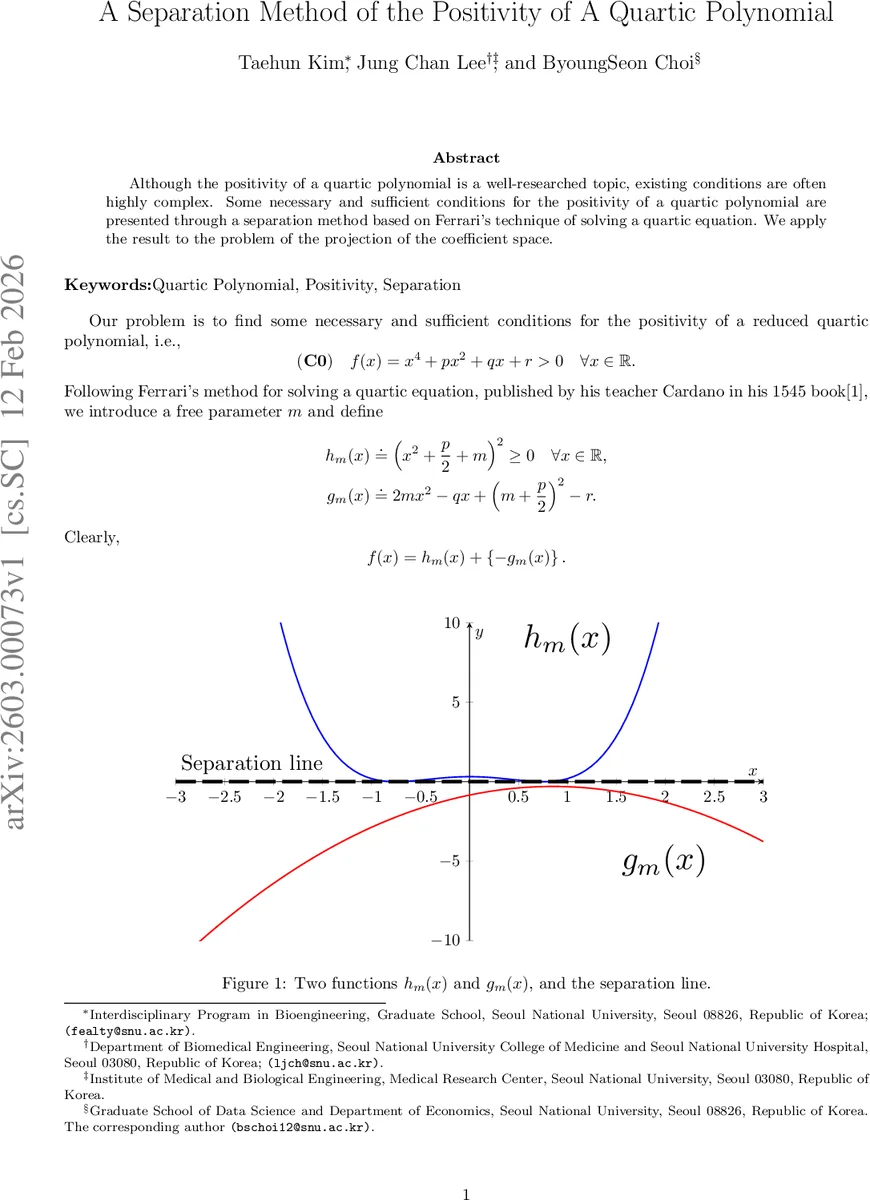
they introduce a free parameter (m) and rewrite the polynomial as the difference of two simpler functions:
(h_{m}(x)=\bigl(x^{2}+p/2+m\bigr)^{2}) (always non‑negative) and
(g_{m}(x)=2 m x^{2}-q x+\bigl(m+p/2\bigr)^{2}-r).
Thus (f(x)=h_{m}(x)-g_{m}(x)). If one can find a negative (m) such that (h_{m}(x)\ge 0) for all (x) (trivially true) and (g_{m}(x)<0) for all (x), then (f(x)>0) everywhere.
Discriminant Analysis
The sign of (g_{m}(x)) is governed by its discriminant
(D(m)=-8m\bigl(m^{2}+p m+p^{2}/4-r\bigr)+q^{2}).
The paper builds a chain of equivalent statements (C0–C5):
- (C0) (f(x)>0) for all real (x).
- (C1) There exists a negative (m) with (D(m)<0).
- (C2) The equation (D(m)=0) has at least two distinct real roots, one of which is a simple negative root.
- (C3) The derivative (D’(m)=0) has two distinct real solutions (m_{-}<m_{+}) satisfying (m_{-}<0), (D(m_{-})<0) and (D(m_{+})\ge0).
- (C4) In terms of the original coefficients, define the classical quartic discriminant
(\Delta = 16p^{4}r-4p^{3}q^{2}-128p^{2}r^{2}+144p q^{2}r-27q^{4}+256r^{3})
and auxiliary quantities (\Delta_{D}=4r-p^{2}), (\Delta_{P}=p), (\Delta_{Q}=q). Then (C0) holds iff
({ \Delta>0}\cap\bigl({\Delta_{D}>0}\cup{\Delta_{P}>0}\bigr))
or ({ \Delta_{D}=0}\cap{ \Delta_{P}>0}\cap{ \Delta_{Q}=0}). - (C5) There exists a negative (m) such that (h_{m}(x)\ge0) and (g_{m}(x)<0) for every real (x).
The authors prove the equivalence of these statements by treating the special case (q=0) separately from the generic case (q\neq0). They repeatedly use the Intermediate Value Theorem to guarantee the existence of roots of (D(m)) and (D’(m)), and they translate sign conditions on (D(m)) into algebraic inequalities involving (\Delta) and the auxiliary discriminants.
Link to General Quartic
For a general quartic (a x^{4}+b x^{3}+c x^{2}+d x+e), a standard Tschirnhaus transformation reduces it to the form above with
(p=(8ac-3b^{2})/(8a^{2})),
(q=(b^{3}-4abc+8a^{2}d)/(8a^{3})),
(r=(256a^{3}e-64a^{2}bd+16ab^{2}c-3b^{4})/(256a^{4})).
Consequently, the whole chain of conditions (C0–C5) applies to any quartic after this reduction.
Projection onto the (p,r)‑Plane
The paper demonstrates an application: eliminating the (q)‑axis to obtain the orthogonal projection of the positivity region onto the ((p,r)) plane. From the inequality (D(m)<0) they derive the simpler condition
(b(m)=m^{2}+p m+p^{2}/4-r<0) for some negative (m). Analyzing the quadratic (b(m)) yields:
- If (p>0), a negative root exists iff (r>0).
- If (p\le0), a negative root exists iff (p^{2}<4r).
Thus the admissible region in the ((p,r)) plane is
({p^{2}<4r}\cup{p>0,;r>0}),
which coincides with ({\Delta_{D}>0}\cup{\Delta_{P}>0\ &\ r>0}). This geometric description clarifies how the coefficients must relate for the quartic to stay positive.
Significance
By recasting Ferrari’s classical solution into a separation framework, the authors provide a set of conditions that are both algebraically rigorous and geometrically intuitive. The equivalence between the discriminant‑based condition (C4) and the existence of a separating parameter (m) (C5) bridges the gap between abstract algebraic criteria and constructive verification. Moreover, the projection analysis offers a visual tool for designers and analysts dealing with stability or positivity constraints in engineering, control theory, and optimization. The paper thus contributes a fresh perspective on an old problem, making positivity testing more accessible and interpretable.
Comments & Academic Discussion
Loading comments...
Leave a Comment