Transmit or Idle: Efficient AoI Optimal Transmission Policy for Gossiping Receivers
We study the optimal transmission and scheduling policy for a transmitter (source) communicating with two gossiping receivers aiming at tracking the source’s status over time using the age of information (AoI) metric. Gossiping enables local information exchange in a decentralized manner without relying solely on the transmitter’s direct communication, which we assume incurs a transmission cost. On the other hand, gossiping may be communicating stale information, necessitating the transmitter’s intervention. With communication links having specific success probabilities, we formulate an average-cost Markov Decision Process (MDP) to jointly minimize the sum AoI and transmission cost for such a system in a time-slotted setting. We employ the Relative Value Iteration (RVI) algorithm to evaluate the optimal policy for the transmitter and then prove several structural properties showing that it has an age-difference threshold structure with minimum age activation in the case where gossiping is relatively more reliable. Specifically, direct transmission is optimal only if the minimum AoI of the receivers is large enough and their age difference is below a certain threshold. Otherwise, the transmitter idles to effectively take advantage of gossiping and reduce direct transmission costs. Numerical evaluations demonstrate the significance of our optimal policy compared to multiple baselines. Our result is a first step towards characterizing optimal freshness and transmission cost trade-offs in gossiping networks.
💡 Research Summary
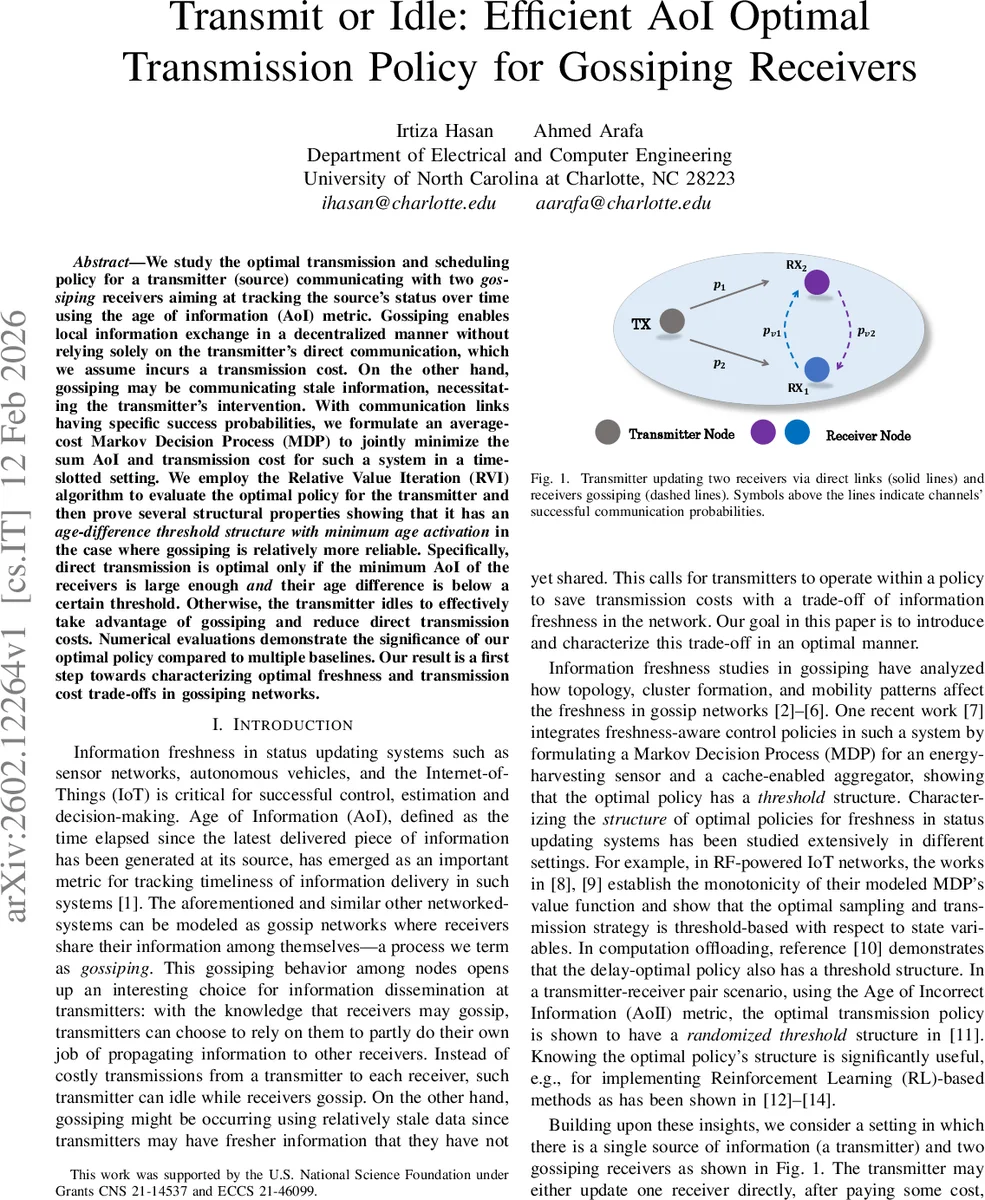
The paper investigates how a single source should schedule its transmissions when two receivers are able to exchange information locally through gossip. The authors model the system as a discrete‑time Markov decision process (MDP) where, at each time slot, the source can either (i) transmit a fresh update to receiver 1, (ii) transmit to receiver 2, or (iii) remain idle and let the two receivers gossip with each other. Direct transmissions succeed with probabilities p₁ and p₂, while gossip links succeed independently with probabilities pᵥ₁ and pᵥ₂. A fixed cost C_tx is incurred for every direct transmission; gossip incurs no cost. The age of information (AoI) of each receiver evolves by increasing by one each slot unless a successful update (direct or gossip) reduces it to the minimum possible value (one slot delay for a fresh packet, or the minimum of the two incremented ages after a successful gossip). The state of the system is the pair (a₁, a₂) of the two AoIs, bounded by a maximum A_max.
The objective is to minimize the long‑run average cost, defined as the expected sum of the two AoIs at the next slot plus the transmission cost, over all admissible stationary policies. The Bellman optimality equation is solved using Relative Value Iteration (RVI), which yields the optimal average cost ρ* and the relative value function U(s). The optimal stationary policy π* selects, for each state, the action that minimizes the Q‑value Q(s,u)=c(s,u)+∑ₛ′P(s′|s,u)U(s′).
Key theoretical contributions are two structural lemmas about the relative value function: (1) monotonicity – U(s) is non‑decreasing in each AoI component, and (2) symmetry – U(a₁,a₂)=U(a₂,a₁). These properties imply that the optimal policy is symmetric with respect to swapping the two receivers. The authors focus on the regime where gossip is more reliable than direct transmission (pᵥ>p) and the channels are symmetric (p₁=p₂=p, pᵥ₁=pᵥ₂=pᵥ). In this setting, extensive numerical RVI results reveal a clear “age‑difference threshold with minimum‑age activation” structure:
- Minimum‑Age Activation: The source transmits only when the smaller of the two AoIs exceeds a certain threshold. Below this threshold the source always idles, allowing gossip to keep the system fresh at no cost.
- Age‑Difference Threshold: When the minimum‑age condition is satisfied, the source still transmits only if the absolute age difference |a₁−a₂| is below a second threshold Δ*. If the difference exceeds Δ*, the source prefers to idle, trusting gossip to reduce the larger age without incurring the transmission cost.
Graphically (Fig. 3), the policy is symmetric about the diagonal a₁=a₂. Along the diagonal, the action switches from idle to transmit at a specific point (e.g., (4,4) in the example). Moving horizontally or vertically away from the diagonal, a horizontal (or vertical) line of constant a₁ shows a transition from transmit to idle as a₂ grows, illustrating the age‑difference threshold. The thresholds depend on the system parameters p, pᵥ, and C_tx; higher transmission cost or more reliable gossip pushes the thresholds outward, encouraging more idling.
Performance evaluation compares the optimal policy (denoted AoI‑optimal) against several baselines: Max‑Age‑First (MAF), Threshold‑based MAF (MAFT), Throughput‑Optimal (TPO), and a random action policy. Simulations vary three key parameters:
- Direct transmission reliability p (Fig. 4): As p increases, all policies improve, but AoI‑optimal achieves the steepest decline because it balances the benefit of successful direct updates against the cost of unnecessary transmissions.
- Gossip reliability pᵥ (Fig. 5): When gossip becomes more reliable, AoI‑optimal’s advantage grows dramatically, while the greedy baselines remain essentially flat because they never exploit gossip.
- Transmission cost C_tx (Fig. 6): With low C_tx, the gap between AoI‑optimal and greedy policies is modest; as C_tx rises, greedy policies suffer large cost spikes, whereas AoI‑optimal increasingly idles, preserving freshness through gossip and avoiding expensive transmissions.
The numerical results confirm that the structural policy dramatically reduces the average cost, especially in regimes where gossip is reliable and transmission cost is non‑negligible. The authors argue that such a policy is highly relevant for IoT sensor networks, vehicular ad‑hoc networks, and UAV swarms, where energy or spectrum constraints make frequent direct updates undesirable. Moreover, because the optimal policy reduces to a pair of simple thresholds, it can be implemented with negligible computational overhead, and the structural insight can guide the design of reinforcement‑learning agents that approximate the optimal policy in larger or more complex networks.
In summary, the paper provides a rigorous MDP formulation for AoI‑aware transmission scheduling with gossiping receivers, proves monotonicity and symmetry of the value function, and uncovers a clear threshold‑based optimal policy. The work bridges the gap between freshness‑driven scheduling and cost‑aware communication, offering both theoretical insight and practical guidelines for designing efficient, low‑cost status‑update systems that leverage peer‑to‑peer gossip.
Comments & Academic Discussion
Loading comments...
Leave a Comment