Tininess and right adjoints to exponentials
Objects $T$ whose exponential functor $(-)^T$ admits a right adjoint $(-)_T$ are known under different names. The fact that they exist, yet that the only set that satisfies this in the category of sets is the singleton made Lawvere suggest they ought to be amazingly tiny'' -- hence Lawvere's acronym A.T.O.M.’’ This report explores how intuitively tiny any such object is. Evidences both in favor and to the contrary are produced by looking at their categorical behavior (subobjects, quotients, retracts, etc) when the ambient category is a topos. The topological behavior (connectedness, contractibility, connected components, etc) of both $T$ and $(-)_T$ is further analyzed in toposes that satisfy certain precohesive conditions over their decidable objects, where this tininess is tested against parts of Lawvere’s foundational proposal for Synthetic Differential Geometry.
💡 Research Summary
The paper investigates objects (T) in a cartesian closed category (\mathcal{E}) for which the exponential functor ((-)^{T}) admits a right adjoint ((-)_{T}). Such objects have appeared under various names (infinitesimal, tiny, atomic) and were famously called “amazingly tiny” (A.T.O.M.) by Lawvere because in the category of sets the only example is the singleton. The authors ask how “tiny’’ these objects really are, especially when the ambient category is a topos and, more specifically, a precohesive topos over its decidable objects—a setting that underlies synthetic differential geometry (SDG).
Section 1 establishes the basic theory of atomic objects. Terminal objects are always atomic; initial objects are never atomic unless the category is trivial. Finite products of atomic objects remain atomic, while limits in general do not. For any arrow (f:S\to T) between atomic objects there is a natural transformation ((-)^{f}:(-)^{S}\to(-)^{T}) and, dually, ((-){f}:(-){T}\to(-)_{S}), built from the unit (\eta) and counit (\varepsilon) of the adjunctions. These transformations satisfy the usual triangular identities.
Section 2 proves that retracts of atomic objects are again atomic (Theorem B). The proof constructs explicit adjunction data for ((-)^{Q}) when (Q) is a retract of an atomic (T), using epi‑mono factorizations and the transpose operation under the original adjunction. This shows that the class of atomic objects is closed under retractions, mirroring the behavior of “small‑projective’’ objects in the sense of Kelly.
Section 3 works inside an elementary topos. Given an atomic object (T) with a global point (p:1\to T), the authors define a map (j_{p,X}:(X)^{T}\to\Omega^{T}X) (the transpose of the evaluation at (p)). Theorem A shows that (j_{p,X}) is monic for every (X) and that a family of commuting squares involving ({-},\Omega) and the exponential functors holds. Consequently (j_{p,X}) behaves like a generalized singleton: it embeds each “(T)-power’’ into the subobject classifier, and for any morphism (f:T\to S) the corresponding squares commute. For (T=1) the map reduces to the identity, confirming the intuition that atomic objects generalize singletons.
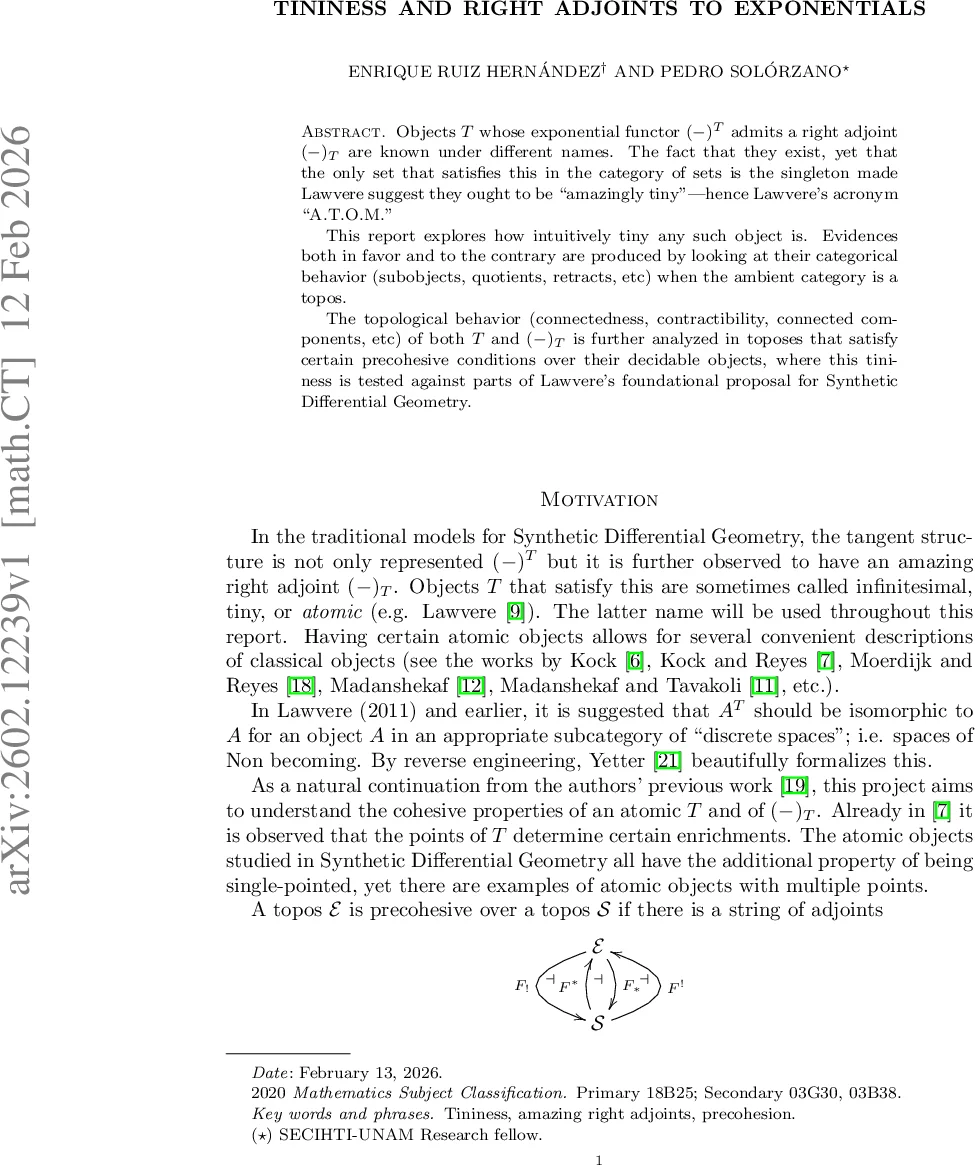
Section 4 introduces a precohesive context. A precohesive geometric morphism (F^{}\dashv F_{!}\dashv F_{}) between toposes (\mathcal{E}) and (\mathcal{S}) comes equipped with the string of adjoints (\Pi\dashv\Gamma\dashv\Delta\dashv\Lambda) (connected components, points, etc.). Theorem C proves that (F^{}) reflects atomic objects and (F_{!}) preserves them, but in general (F_{!}) need not reflect them and (F^{}) need not preserve them. Counterexamples are supplied, showing that the behavior of atomicity is subtle under change of base.
Section 5 specializes to McLarty toposes (2‑valued, support‑splitting, precohesive over a Boolean base). Theorem D establishes that every atomic object is terminal, hence connected, and that for any object (Y) one has (\Gamma(Y^{T})\cong\Gamma(Y)) and (\Pi(Y^{T})\cong\Pi(Y)). Thus the right adjoint ((-)_{T}) is “as tiny as possible’’: it does not alter points or connected components.
Section 6 studies contractibility. In any Grothendieck topos whose canonical geometric morphism to Set is precohesive, every atomic object is contractible (Theorem E). In a McLarty topos, contractibility of an atomic (T) is equivalent to the map (2^{T}\to2) being an isomorphism. No non‑contractible atomic objects are known in precohesive contexts, and the authors pose the open question whether such objects exist.
Section 7 supplies concrete examples and counterexamples. Atomic objects can have multiple global points (contrary to the singleton intuition) and can be disconnected (e.g., the terminal object in (\mathbf{Set}\times\mathbf{Set})). Conversely, there are connected objects whose exponential functor lacks a right adjoint. The paper also discusses how atomic objects appear in SDG models (e.g., the Kock‑Lawvere infinitesimals) and why the terms “atomic”, “tiny”, or “infinitesimal’’ are all imperfect.
Overall contribution: The authors demonstrate that the existence of a right adjoint to ((-)^{T}) is a categorical property distinct from the naive notion of “tiny”. While atomic objects enjoy many pleasant features—closure under retracts, preservation of points and components in McLarty toposes, and automatic contractibility in many precohesive settings—they need not be singletons, need not be connected, and can behave quite differently under base change. The work clarifies the landscape of such objects, situates them within the foundations of SDG, and highlights several open problems, notably the existence of non‑contractible atomic objects in precohesive toposes.
Comments & Academic Discussion
Loading comments...
Leave a Comment