Equivalent Circuit Modeling of Grid-Forming Inverters in (Sub)-Transient Time-Frame
The widely accepted definition of grid-forming (GFM) inverter states that it should behave as a (nearly) constant voltage source behind an impedance by maintaining a (nearly) constant internal voltage phasor in the sub-transient to transient time frame. Some system operators further mandate permissible ranges for this effective impedance. However, these specifications do not clearly define the location of the internal voltage source, and no systematic method exists to quantify its effective impedance for a black-box GFM model. To address this, we first compare the transient responses of an ideal voltage source and a GFM to show that an idealistic GFM maintains a (nearly) constant voltage across the filter capacitor, rather than at the inverter switches. Then we propose a systematic method to quantify the effective impedance of a GFM from its black-box model using frequency-domain admittance plots. Using standard PSCAD GFM models developed by NREL, we demonstrate that the GFM’s equivalent impedance model captures the sub-transient response and static voltage stability limit reasonably accurately.
💡 Research Summary
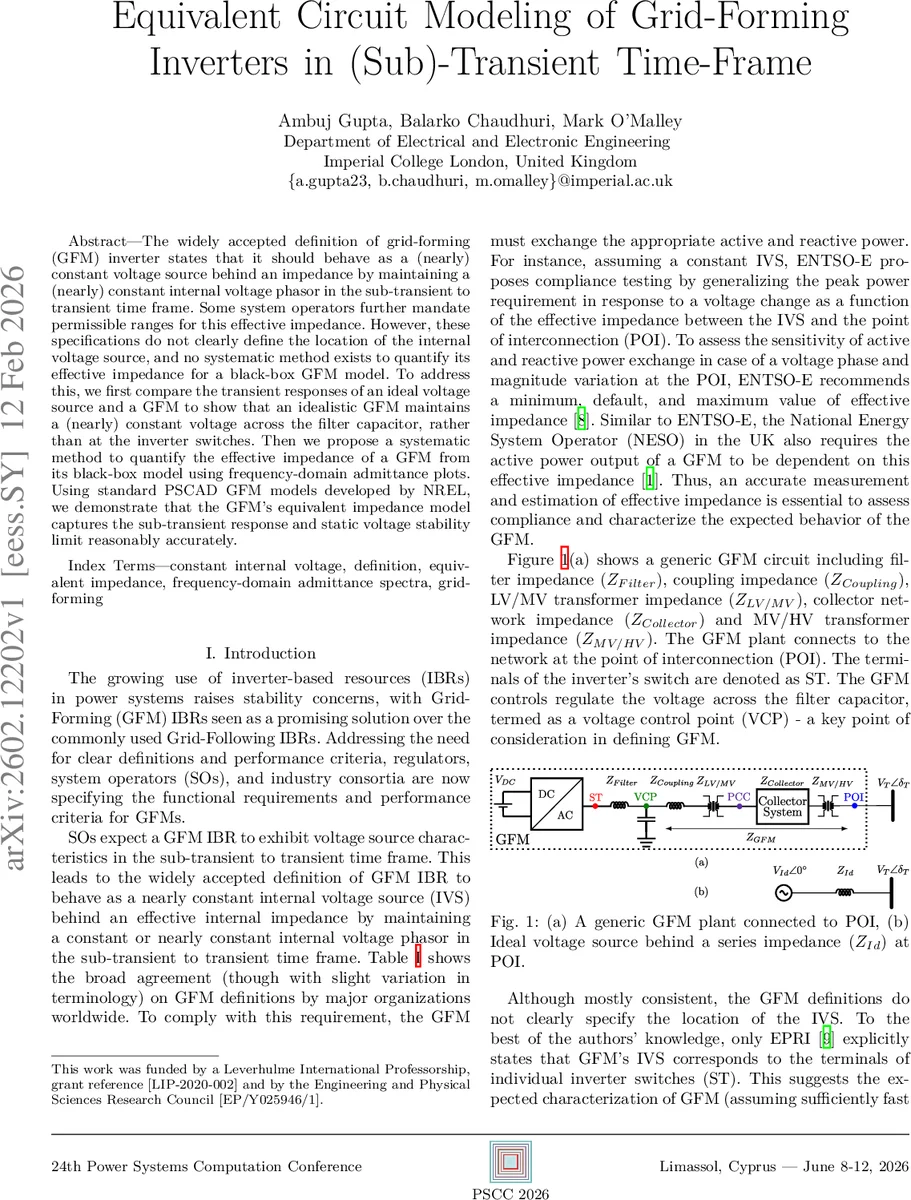
The paper addresses a fundamental ambiguity in the definition of grid‑forming (GFM) inverters: while standards and industry groups (e.g., ENTSO‑E, NERC, FINGRID) agree that a GFM should behave like a nearly constant internal voltage source (IVS) behind an effective impedance during the sub‑transient to transient time frame, they do not specify where that internal voltage actually resides in the physical circuit. Some documents (e.g., EPRI) locate the IVS at the inverter switches (ST), but most control strategies regulate the voltage across the filter capacitor, termed the voltage control point (VCP).
To resolve this, the authors first compare the transient response of an ideal voltage source (IDVS) with that of a GFM under identical voltage magnitude and phase jumps at the point of interconnection (POI). Analytical expressions for the active and reactive power transients of an IDVS (equations 1a‑1b) are validated by PSCAD EMT simulations. When the same disturbances are applied to a GFM model, the simulation shows that the voltage at the VCP changes far less than the voltage at the inverter switches, indicating that the GFM maintains a nearly constant voltage at the VCP rather than at the switches.
Four case studies are conducted to test the hypothesis across a range of network impedances:
- Varying the total GFM impedance Z_GFM (the series combination of coupling, LV/MV transformer, collector, and MV/HV transformer impedances).
- Varying Z_GFM while keeping the filter impedance Z_filter constant.
- Varying Z_filter while preserving a fixed control bandwidth (300 Hz).
- Using the full NREL GFM model (including droop control and realistic voltage‑control dynamics).
In all cases, the peak active/reactive power and current responses of the GFM align closely with those of an IDVS whose series impedance equals Z_GFM, not Z_GFM + Z_filter. The filter impedance has negligible impact on the peak responses, confirming that the effective internal impedance of a GFM is the electrical distance from the POI to the VCP.
Based on these observations, the authors propose an equivalent circuit: a constant voltage source V*_GFM behind an effective impedance Z_eff = Z_control + Z_GFM, where Z_control represents any intentionally added virtual impedance. This model mirrors the classic Thevenin representation of a synchronous machine (internal emf E behind reactance X) but extends it to include controllable virtual impedance.
To quantify Z_eff for a black‑box GFM model, the paper introduces a frequency‑domain admittance‑based method. The dq‑domain relationship between voltage and current at the POI is expressed in matrix form (equation 2). For an ideal voltage source with series impedance Z_Id = R_Id + sL_Id, the admittance matrix (equation 3) yields a second‑order transfer function Y_qd that exhibits a resonance at the fundamental frequency. By measuring the GFM’s Y_qd (reactive‑power response to a voltage‑magnitude perturbation) and fitting it to the analytical IDVS form, the effective resistance and inductance (or reactance) can be extracted. This yields an effective reactance X_Eff that can be directly compared with the ENTSO‑E prescribed ranges for different POI voltage levels (Table III).
The method is demonstrated using standard PSCAD GFM models developed by NREL. The extracted equivalent impedance accurately reproduces the sub‑transient time‑domain response and the static voltage‑stability limit of the original GFM model. Moreover, the approach works for both idealized GFM models (with zero virtual impedance) and realistic models that include droop and slower voltage‑control dynamics.
In conclusion, the paper clarifies that the “internal voltage source” of a GFM resides at the VCP, and its effective impedance is the series network between the VCP and the POI (Z_GFM). The proposed admittance‑fitting technique provides a systematic, measurement‑based way to obtain this equivalent impedance from any black‑box GFM representation, facilitating compliance testing, stability analysis, and design of virtual impedance strategies.
Comments & Academic Discussion
Loading comments...
Leave a Comment