Rational elliptic surfaces with six singular double fibres
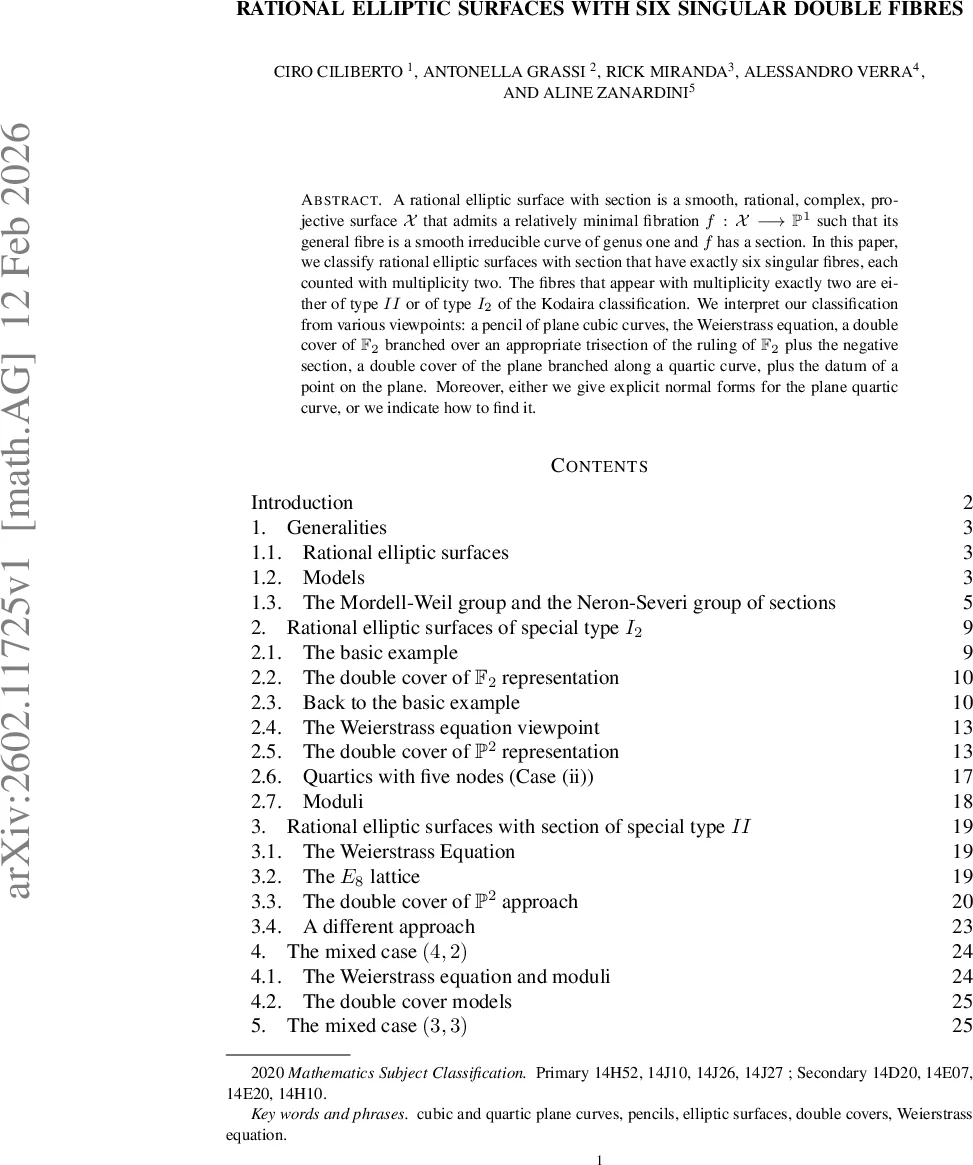
A rational elliptic surface with section is a smooth, rational, complex, projective surface $\mathcal{X}$ that admits a relatively minimal fibration $f: \mathcal{X}\longrightarrow \bbP^1$ such that its general fibre is a smooth irreducible curve of genus one and $f$ has a section. In this paper, we classify rational elliptic surfaces with section that have exactly six singular fibres, each counted with multiplicity two. The fibres that appear with multiplicity exactly two are either of type $II$ or of type $I_2$ of the Kodaira classification. We interpret our classification from various viewpoints: a pencil of plane cubic curves, the Weierstrass equation, a double cover of $\bbF_2$ branched over an appropriate trisection of the ruling of $\bbF_2$ plus the negative section, a double cover of the plane branched along a quartic curve, plus the datum of a point on the plane. Moreover, either we give explicit normal forms for the plane quartic curve, or we indicate how to find it.
💡 Research Summary
The paper undertakes a complete classification of rational elliptic surfaces with a section (RESS) that possess exactly six singular fibres, each of multiplicity two. According to Kodaira’s classification, the only fibre types with multiplicity two are type II (a cuspidal cubic) and type I₂ (a union of two smooth rational curves intersecting transversely twice). Consequently the surfaces are denoted by a pair (a, b) where a is the number of type II fibres and b the number of type I₂ fibres, with a + b = 6. The authors treat the pure cases (6, 0) and (0, 6) as well as the mixed cases (4, 2), (3, 3) and (2, 4).
The study is organized around four equivalent geometric models:
-
Pencil of plane cubic curves. A RESS can be obtained by blowing up the nine base points of a pencil of (generically smooth) plane cubics; the last blow‑up provides the chosen section. The authors describe precisely which pencils resolve to a surface of a given (a, b) type, using the configuration of base points and the behaviour of the discriminant.
-
Weierstrass model. By fixing the section, the elliptic fibration is written globally as
y²z = x³ + A(s,t) xz² + B(s,t) z³,
where A and B are homogeneous polynomials of degrees 4 and 6 on the base P¹. The discriminant Δ = 4A³ + 27B² is a degree‑12 polynomial; the hypothesis that all singular fibres have multiplicity two forces Δ to be a perfect square of a sextic with six distinct simple roots. This condition translates into explicit normal forms for A and B in each (a, b) case, and determines the moduli count: the (0, 6) case has a two‑dimensional moduli space, the (6, 0) case is rigid, and the mixed cases have dimensions 1, 0 or 1 as detailed later. -
Double cover of the Hirzebruch surface F₂. The Weierstrass equation can be interpreted as a double cover g : Z → F₂ branched over the negative section B (self‑intersection –2) and a trisection T in the linear system |3B + 6F|. The pre‑image of B is the zero section, while the pull‑back of the ruling of F₂ gives the elliptic pencil. A type I₂ fibre occurs when T has an ordinary double point (node) with distinct tangents from the ruling; a type II fibre occurs when T is smooth but meets a ruling with multiplicity three (a flex). Thus the combinatorics of nodes and flexes of T encode the (a, b) data. The authors give explicit equations for T in each case and compute the corresponding branch loci.
-
Double cover of the plane branched over a quartic. A degree‑2 Del Pezzo surface Y → P² branched along a plane quartic C together with a distinguished point p ∈ P² yields another model. The elliptic pencil is the pull‑back of the pencil of lines through p. If p ∉ C the model is “split” (two disjoint sections appear after blowing up the pre‑image of p); if p ∈ C (the “ramified” model) the tangent line at p gives a type I₂ fibre, while a flex line through p gives a type II fibre. Lemma 2 shows that in the ramified situation p cannot be a flex of C, which forces the surface to be of pure I₂ type. The authors classify all possible pairs (C, p) for each (a, b) and provide normal forms for the quartic equation, recovering the classical description of Chisini for the (6, 0) case.
A substantial part of the paper is devoted to the interaction between the Mordell–Weil group MW(X) of sections and the Néron–Severi lattice NS(X). After fixing the zero section S₀, the sublattice U generated by S₀ and a fibre class F has signature (1, 1) and splits off a negative‑definite even lattice U⊥ ≅ –E₈. The lattice R generated by the components of the I₂ fibres that do not meet S₀ is a direct sum of (–2)‑classes inside U⊥. The exact sequence
0 → R → U⊥ → MW(X) → 0
allows the authors to compute MW(X) in each case. For pure I₂ type (0, 6) one obtains MW(X) ≅ (ℤ/2ℤ)², reflecting the two independent 2‑torsion sections; for pure II type (6, 0) one gets MW(X) ≅ E₈, and the surface is rigid (no moduli). Mixed cases yield intermediate groups, e.g. (4, 2) gives MW(X) ≅ ℤ/2ℤ ⊕ ℤ, (3, 3) gives a trivial Mordell–Weil group, and (2, 4) yields MW(X) ≅ ℤ. These group structures are directly linked to the number of nodes and flexes of the trisection T or, equivalently, to the configuration of bitangents and flex lines of the quartic C.
The paper also computes the dimension of the moduli space for each family. Using the Weierstrass normal forms and the condition that the discriminant is a square, the authors find:
- (0, 6): two parameters (the positions of the six double roots up to PGL₂ action).
- (6, 0): no parameters; the surface is uniquely determined (the smooth fibres are equianharmonic with j‑invariant 0).
- (4, 2) and (2, 4): one‑dimensional families, corresponding to the relative position of a flex and a node on the trisection.
- (3, 3): a zero‑dimensional (rigid) family, matching Chisini’s classification of pencils of equianharmonic cubics with three flexes.
Throughout, the authors provide explicit equations. For instance, in the (4, 2) case the Weierstrass coefficients can be written as
A(t)=t⁴−2αt³+βt²−2γt+δ, B(t)=λ(t³+μt²+νt+ρ)²,
with parameters constrained so that Δ(t)=(t−t₁)²…(t−t₆)². In the (6, 0) case they recover the classical normal form y² = x³ + t⁴ x + t⁶, which yields j = 0 everywhere. The quartic models are given similarly; for (6, 0) the quartic is the Fermat quartic x⁴ + y⁴ + z⁴ = 0 with p a generic point, while for mixed cases the quartic acquires nodes or tacnodes according to the required number of I₂ fibres.
In summary, the article achieves a thorough classification of rational elliptic surfaces with six double fibres by exploiting four complementary viewpoints, establishing explicit normal forms, determining Mordell–Weil groups, and computing moduli dimensions. The work bridges classical constructions (pencils of cubics, Chisini’s quartic models) with modern lattice‑theoretic techniques, thereby completing the picture of these special elliptic surfaces and providing a valuable reference for further investigations in elliptic fibrations, surface geometry, and arithmetic aspects of rational elliptic surfaces.
Comments & Academic Discussion
Loading comments...
Leave a Comment