A partial classification of 3-dimensional clasp number two, genus two fibered knots
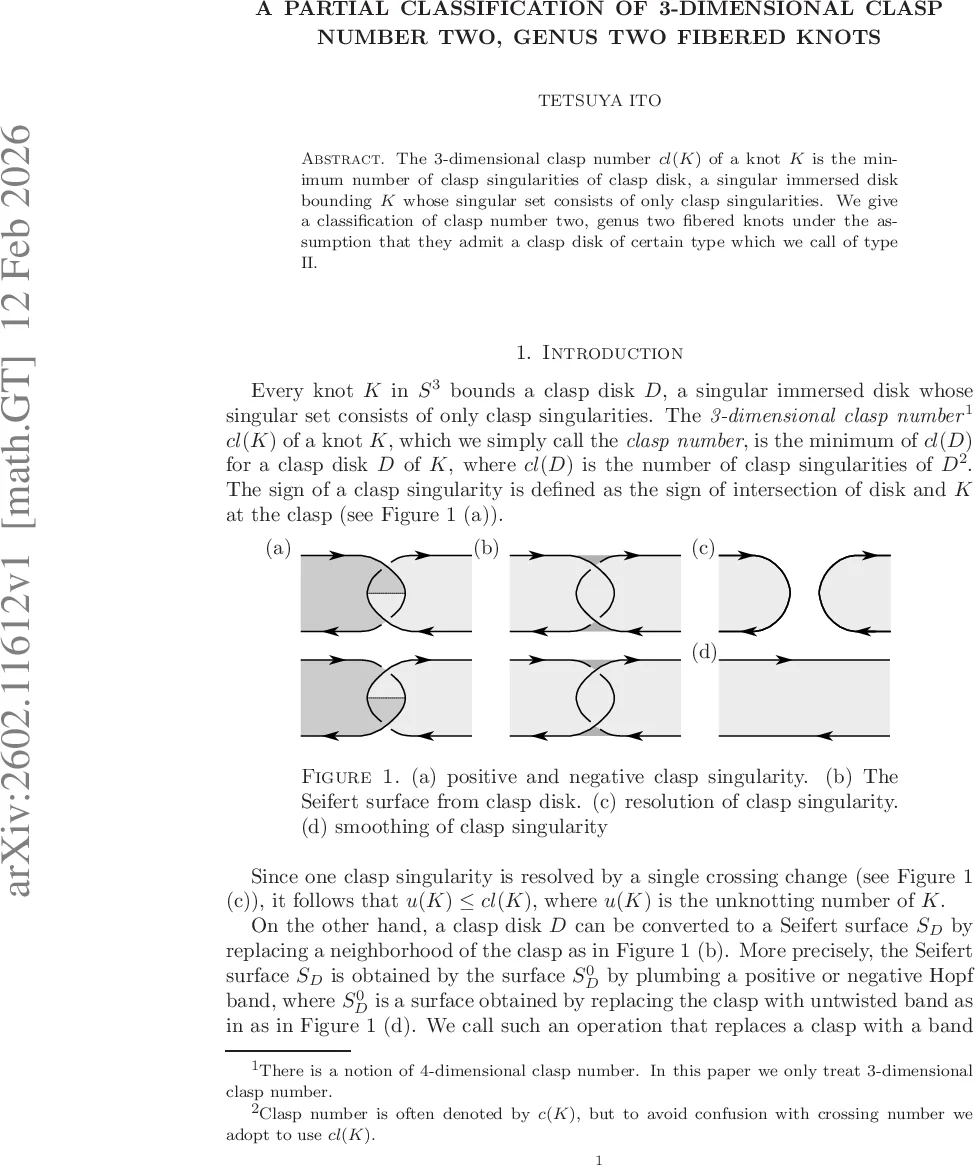
The 3-dimensional clasp number $cl(K)$ of a knot $K$ is the minimum number of clasp singularities of clasp disk, a singular immersed disk bounding $K$ whose singular set consists of only clasp singularities. We give a classification of clasp number two, genus two fibered knots under the assumption that they admit a clasp disk of certain type which we call of type II.
💡 Research Summary
The paper studies the three‑dimensional clasp number cl(K), defined as the minimal number of clasp singularities of a clasp disk – an immersed disk bounded by a knot K whose only singularities are clasp points. Since each clasp can be resolved by a single crossing change, cl(K) bounds the unknotting number u(K) from above, and the construction of a Seifert surface from a clasp disk shows that the genus g(K) is also bounded above by cl(K). The author focuses on the case cl(K)=2 and g(K)=2, assuming that the knot admits a clasp disk of a particular configuration called “type II”.
A clasp disk can be of type X or type II, depending on the topology of the surface obtained after smoothing the clasp neighborhoods. In type X the smoothing yields a genus‑1 surface with one boundary component; in type II it yields a genus‑0 surface with three boundary components. This dichotomy leads to different skein‑tree analyses and distinct formulas for the Conway polynomial ∇_K(z) and the zeroth HOMFLY coefficient p₀(K). For type X, the fourth‑order coefficient a₄(K) of ∇_K(z) reduces modulo 2 to ℓ₁ℓ₂, where ℓ₁,ℓ₂ are the linking numbers of the two two‑component links obtained after resolving each clasp. Consequently, if a₄(K)≡1 (mod 2) then a₂(K) must be even, providing a strong obstruction to the existence of a type X clasp disk. For type II the fourth‑order term takes the form ε₁ε₂(ℓ₁ℓ₂−ℓ₂), involving an extra integer ℓ that records the intersection between the two core curves of the annuli appearing after smoothing.
The key geometric observation is that the genus‑2 Seifert surface S_D derived from a clasp disk is obtained from a genus‑0 surface S_{o,o} by plumbing two Hopf bands simultaneously. By a theorem of Stallings and Gabai, a surface obtained by Hopf plumbing is fibered if and only if the original surface is fibered. Hence S_{o,o} must itself be a fiber surface, and its boundary must be either (a) a genus‑1 fibered knot (the trefoil, its mirror, or the figure‑eight knot) or (b) a genus‑0 three‑component fibered link. The latter class has been completely classified by Rolfson: it consists of (A) the connected sum of two Hopf links, (B) pretzel links P(2,2n,−2) for any integer n, and (C) a single exceptional link L_ex together with its mirror.
Using this classification, the author enumerates all genus‑2, fibered, clasp‑number‑two knots that admit a type II clasp disk. The list falls into four families:
- Non‑prime knots: connected sums 3₁#3₁, 3₁#4₁, 4₁#4₁, and the mirror of 3₁#3₁.
- Two‑bridge knots: the knots denoted 6₂, 6₃, 7₆, and 7₇ in the standard tables.
- Montesinos knots: knots of the form K(½,−2/3,2/(4n±1)), K(½,−2/5,2/(4n±1)), K(1/(2n),2/3,−2/3), K(1/(2n),2/3,−2/5), K(1/(2n),2/5,−2/3), and K(1/(2n),2/5,−2/5) for any integer n.
- Exceptional knots: twelve knots K_ex^{i;ε₁,ε₂} (i=1,2,3, ε₁,ε₂=±1) displayed in Figure 2 of the paper.
The paper also identifies knots that have cl(K)=2 but admit neither a type X nor a type II clasp disk, namely 11n74, 11n116, 11n142, 12n462, and 12n838. These knots are fibered, have genus 2 and unknotting number ≤2, and possess even a₂(K), which rules out type X disks. Since they do not appear in the type II list, they also lack a type II disk. Consequently they satisfy u(K)≤g(K)=2<3≤cl(K), providing the first known examples of fibered knots where the clasp number strictly exceeds both genus and unknotting number, while evading the Kadokami‑Kawamura modular obstruction (their a₄(K)=±1, not congruent to 3 mod 8).
In summary, the work combines combinatorial knot invariants (Conway and HOMFLY polynomials), the topology of clasp disks, and the theory of Hopf plumbing to achieve a complete classification of genus‑2, fibered knots with clasp number two under the type II hypothesis. It also demonstrates how algebraic constraints derived from the polynomials can be used to detect the non‑existence of certain clasp disks, thereby deepening the understanding of the interplay between clasp number, unknotting number, genus, and fiberedness.
Comments & Academic Discussion
Loading comments...
Leave a Comment