Möbius Strip Diagram Algebras
We introduce Möbius strip diagram algebras (and their monoid and categorical versions) as subalgebras of a partition-style diagram calculus in which strands may carry handles and Möbius strip features. We identify the resulting diagram category with a linear quotient of a nonorientable two-dimensional cobordism category. Finally, we develop the associated cell theory and use it to classify the simple modules and compute dimensions in a range of cases.
💡 Research Summary
**
The paper introduces a new family of diagram algebras called Möbius strip diagram algebras, together with their monoid and categorical versions. These algebras extend the classical partition‑style diagram calculus by allowing each strand to carry two new decorations: a handle (denoted by a white dot) and a Möbius strip (denoted by a red dot). The handle corresponds to adding a 1‑handle to the underlying surface, while the Möbius strip encodes a half‑twist, i.e., a non‑orientable feature.
The authors start from the well‑known partition monoid (P_a(n)) and its planar submonoid (P_{ap}(n)), recalling the usual generators (identity, multiplication, unit, comultiplication, counit, crossing) and their relations. They then adjoin the two new generators (h) (handle) and (m) (Möbius) and impose additional relations: the handle is central, the Möbius dot commutes with the crossing, and most importantly the “Möbius relation” (m^3 = h\circ m). This relation captures the topological fact that three half‑twists are equivalent to a full twist together with a handle.
A linear version of the diagram category is built over a ground field (K). Closed components are evaluated by three rational functions (Z_\alpha, Z_\beta, Z_\gamma) which assign scalars to loops of handles, Möbius dots, and ordinary loops respectively. The evaluation rules are given in equations (2.27)–(2.29). Moreover, a “handle relation” (\sigma) is introduced, derived from a polynomial (q(T)=1-a_1T+\dots+(-1)^Ma_MT^M). This relation limits the number of handles on any connected component to at most (K-1), ensuring that the resulting algebras are finite‑dimensional.
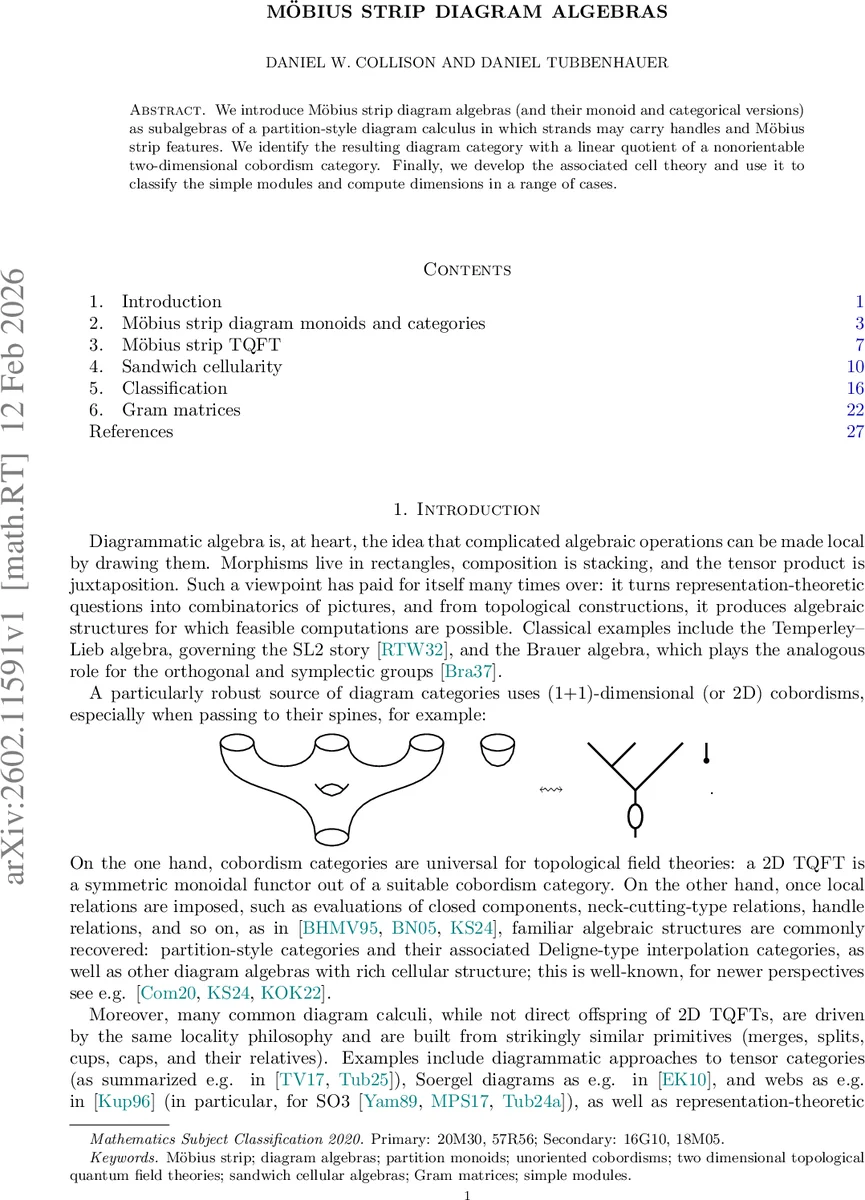
The central topological motivation is provided by a non‑orientable 2‑dimensional cobordism category, denoted (2\text{Cob}^{\text{non-or}}). Objects are non‑negative integers (numbers of boundary circles) and morphisms are diffeomorphism classes of compact surfaces possibly containing handles and Möbius strips. The authors construct a symmetric monoidal functor from this cobordism category to the diagram category, sending a cobordism to its spine diagram decorated with (h) and (m). After imposing the evaluation rules and the handle relation, this functor becomes an equivalence, showing that the Möbius strip diagram category is precisely a linear quotient of the non‑orientable cobordism category.
Having established the algebraic framework, the paper develops a “sandwich cellular” theory for these algebras. Each cell is built from a left partition cell, a right partition cell, and a middle part consisting of a configuration of handles and Möbius dots. The authors construct cell modules, compute their Gram matrices, and prove that the algebras are cellular in the sense of Graham–Lehrer. Using the cellular structure, they classify all simple modules: every simple module appears as the head (or socle) of a cell module, and the parametrisation is given by certain combinatorial data (partitions together with a parity condition on the number of Möbius dots).
Explicit dimension formulas are derived for a wide range of simples and cell modules. In low rank examples (up to (n=6)), the presence of Möbius dots dramatically changes the dimensions compared with the ordinary partition, Brauer, or Temperley–Lieb algebras. For odd values of the parameter (K), a “root‑of‑unity” relation (K=) arises from the choice (p_\alpha(T)=1) and (q(T)=1-T^K), further restricting the representation theory.
The paper concludes by highlighting several avenues for future work: extending the construction to higher‑dimensional TQFTs, exploring connections with non‑orientable graph colourings, and investigating potential applications to quantum groups with non‑orientable ribbon structures. Overall, the work provides a coherent and computable algebraic model for non‑orientable 2‑dimensional topology, enriching the landscape of diagrammatic algebras and opening new pathways between low‑dimensional topology, categorical algebra, and representation theory.
Comments & Academic Discussion
Loading comments...
Leave a Comment