Quantitative longest-run laws for partial quotients
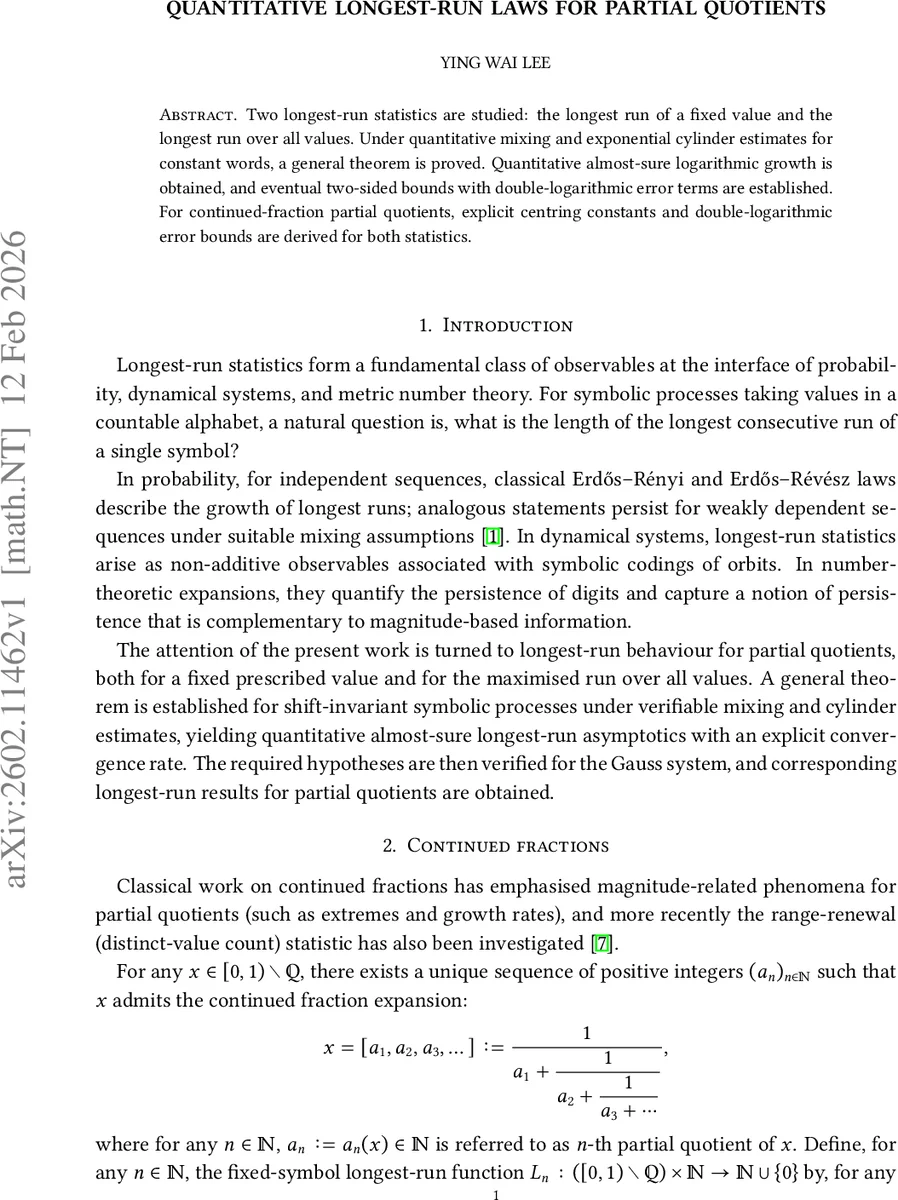
Two longest-run statistics are studied: the longest run of a fixed value and the longest run over all values. Under quantitative mixing and exponential cylinder estimates for constant words, a general theorem is proved. Quantitative almost-sure logarithmic growth is obtained, and eventual two-sided bounds with double-logarithmic error terms are established. For continued-fraction partial quotients, explicit centring constants and double-logarithmic error bounds are derived for both statistics.
💡 Research Summary
The paper investigates the asymptotic behaviour of longest‑run statistics for symbolic processes, with a particular focus on the partial quotients arising from continued‑fraction expansions. Two statistics are considered: (i) the longest consecutive block of a prescribed symbol λ within the first n symbols, denoted Lₙ(x,λ), and (ii) the maximal length of a consecutive block over all possible symbols, denoted Rₙ(x). While earlier works (Song–Zhou 2020, Wang–Wu 2011) established first‑order logarithmic laws for these quantities—namely Lₙ(x,λ)∼(log n)/(2 log τ(λ)) and Rₙ(x)∼(log n)/(2 log φ) with τ(λ)=λ+√(λ²+4)/2 and φ=(1+√5)/2—their convergence rates were not quantified.
The authors develop a general framework applicable to any measure‑preserving dynamical system (Ω,𝔽,μ,T) equipped with a countable alphabet 𝔄 and a symbolic observable X:Ω→𝔄. Three quantitative hypotheses are imposed:
-
Quantitative mixing (Assumption 1). There exist constants C₀>0 and 0<θ<1 such that for any blocks separated by a gap g, the correlation between events A and B satisfies |μ(A∩B)−μ(A)μ(B)| ≤ C₀θ^{g} μ(A)μ(B). This is essentially an exponential ψ‑mixing condition.
-
Exponential cylinder estimate for a fixed symbol (Assumption 2). For a distinguished symbol m* there are constants c₋,c₊>0 and ρ>1 with c₋ρ^{-2k} ≤ μ(Δ_k(m*)) ≤ c₊ρ^{-2k} for all k, where Δ_k(m*) denotes the cylinder where the first k symbols are all m*.
-
Uniform summed cylinder bound (Assumption 3). The sum over all symbols of the cylinder probabilities satisfies ∑_{m∈𝔄} μ(Δ_k(m)) ≤ C₁ρ^{-2k} for some C₁>0.
Under these assumptions, Theorem 1 proves that for any c>½, almost every ω∈Ω there exists N_{c,ω} such that for all n≥N_{c,ω}:
|Lₙ(ω,m*) – (log n)/(2 log ρ)| ≤ c log log n·log ρ,
and, when both Assumptions 2 and 3 hold,
|Rₙ(ω) – (log n)/(2 log ρ)| ≤ c log log n·log ρ.
The proof splits into upper and lower bounds. Upper bounds use a union bound over all possible starting positions of a run, together with the exponential cylinder estimates and the mixing inequality to obtain a probability of order n ρ^{-2(k+j)}. Choosing k≈(log n)/(2 log ρ) and j≈c log log n yields a summable series ∑ j^{-2c₁} (with c₁∈(½,c)), allowing Borel–Cantelli to give the desired additive error. Lower bounds employ a “separated trials” construction: one looks at disjoint blocks of length k−j, each separated by a gap g_j≈−log_{θ} n_j, where n_j≈2^{j}. The mixing condition guarantees near‑independence of these blocks, and the cylinder estimate provides a lower bound p_j≈c n_j j^{-2c₁} for the occurrence of a run of length k−j. By estimating the expected number of successful trials E
Comments & Academic Discussion
Loading comments...
Leave a Comment