Altermagnetic Skyrmions in 2D Lattices Exhibiting Anisotropic Skyrmion Hall Effect
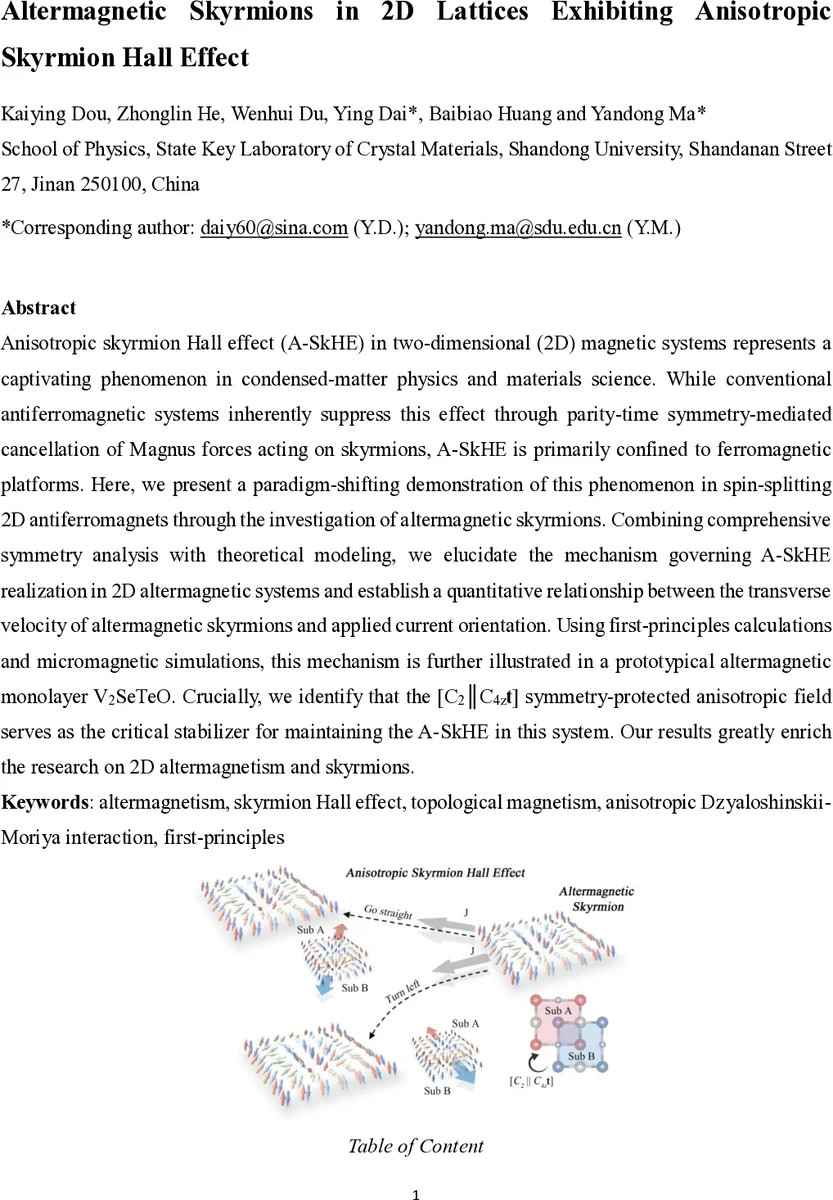
Anisotropic skyrmion Hall effect (A-SkHE) in two-dimensional (2D) magnetic systems represents a captivating phenomenon in condensed-matter physics and materials science. While conventional antiferromagnetic systems inherently suppress this effect through parity-time symmetry-mediated cancellation of Magnus forces acting on skyrmions, A-SkHE is primarily confined to ferromagnetic platforms. Here, we present a paradigm-shifting demonstration of this phenomenon in spin-splitting 2D antiferromagnets through the investigation of altermagnetic skyrmions. Combining comprehensive symmetry analysis with theoretical modeling, we elucidate the mechanism governing A-SkHE realization in 2D altermagnetic systems and establish a quantitative relationship between the transverse velocity of altermagnetic skyrmions and applied current orientation. Using first-principles calculations and micromagnetic simulations, this mechanism is further illustrated in a prototypical altermagnetic monolayer V2SeTeO. Crucially, we identify that the [C2C4zt] symmetry-protected anisotropic field serves as the critical stabilizer for maintaining the A-SkHE in this system. Our results greatly enrich the research on 2D altermagnetism and skyrmions.
💡 Research Summary
This paper reports the discovery and theoretical explanation of an anisotropic skyrmion Hall effect (A‑SkHE) in two‑dimensional altermagnetic (AT‑M) materials, a class of spin‑split antiferromagnets that retain zero net magnetization. In conventional antiferromagnets, parity‑time (PT) symmetry forces the Magnus forces on opposite sublattices to cancel, suppressing both the ordinary skyrmion Hall effect (SkHE) and its anisotropic variant. The authors show that by introducing a symmetry‑protected anisotropic field—specifically the combined
Comments & Academic Discussion
Loading comments...
Leave a Comment