Discrete Triebel-Lizorkin spaces and expansive matrices
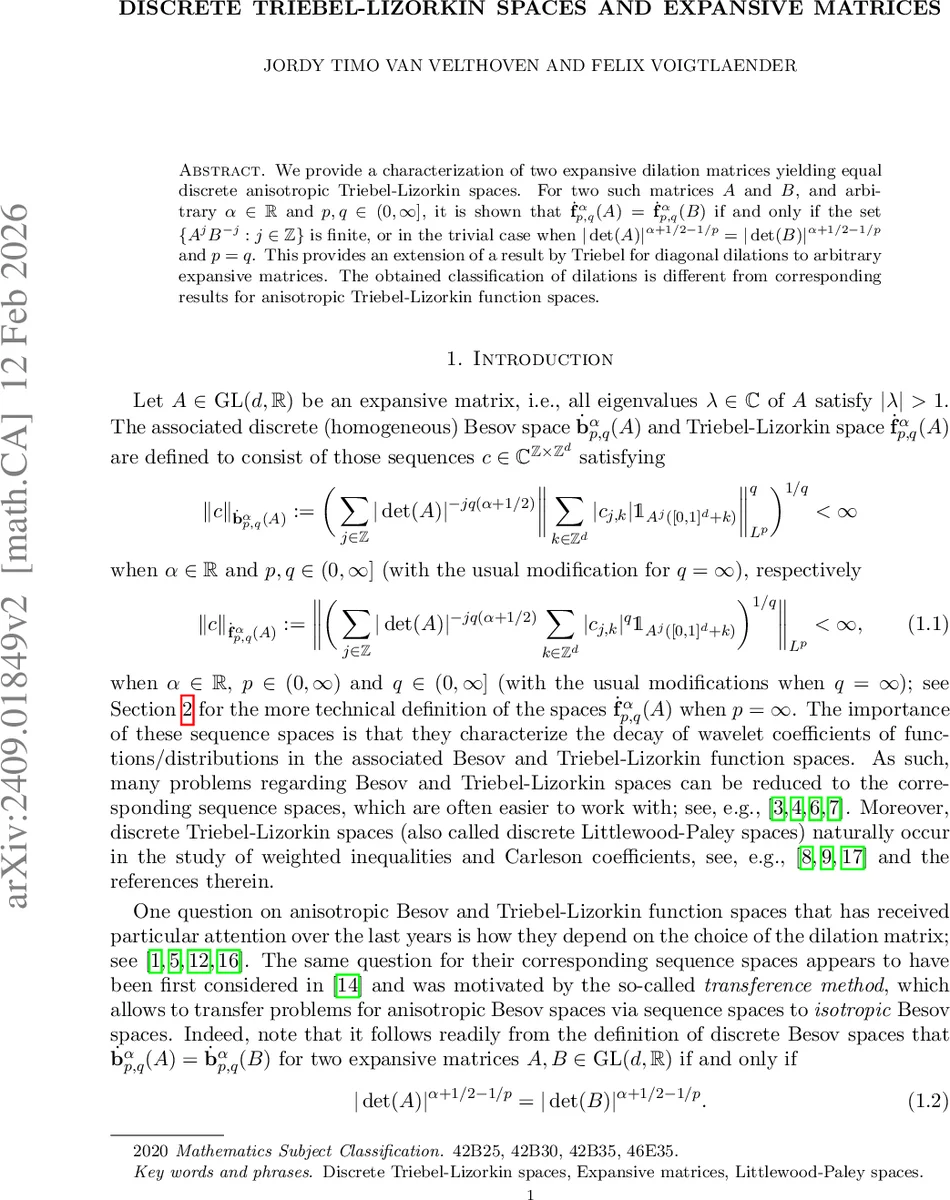
We provide a characterization of two expansive dilation matrices yielding equal discrete anisotropic Triebel-Lizorkin spaces. For two such matrices $A$ and $B$, it is shown that $\dot{\mathbf{f}}^α_{p,q}(A) = \dot{\mathbf{f}}^α_{p,q}(B)$ for all $α\in \mathbb{R}$ and $p, q \in (0, \infty]$ if and only if the set ${A^j B^{-j} : j \in \mathbb{Z}}$ is finite, or in the trivial case when $p = q$ and $|\det(A)|^{α+ 1/2 - 1/p} = |\det(B)|^{α+ 1/2 - 1/p}$. This provides an extension of a result by Triebel for diagonal dilations to arbitrary expansive matrices. The obtained classification of dilations is different from corresponding results for anisotropic Triebel-Lizorkin function spaces.
💡 Research Summary
The paper addresses the fundamental question of when two expansive dilation matrices generate the same discrete anisotropic Triebel‑Lizorkin sequence spaces. For an expansive matrix A∈GL(d,ℝ) (all eigenvalues have modulus >1) the associated homogeneous discrete Triebel‑Lizorkin space ˙f⁽ᵅ⁾{p,q}(A) consists of sequences c{j,k} indexed by scale j∈ℤ and spatial shift k∈ℤ^d, equipped with the quasi‑norm
‖c‖{˙f⁽ᵅ⁾{p,q}(A)} = (∫{ℝ^d} (∑{j∈ℤ} |det A|^{-j(α+½)} (∑{k∈ℤ^d} |c{j,k}| 1_{A^j(
Comments & Academic Discussion
Loading comments...
Leave a Comment