Filmsticking++: Rapid Film Sticking for Explicit Surface Reconstruction
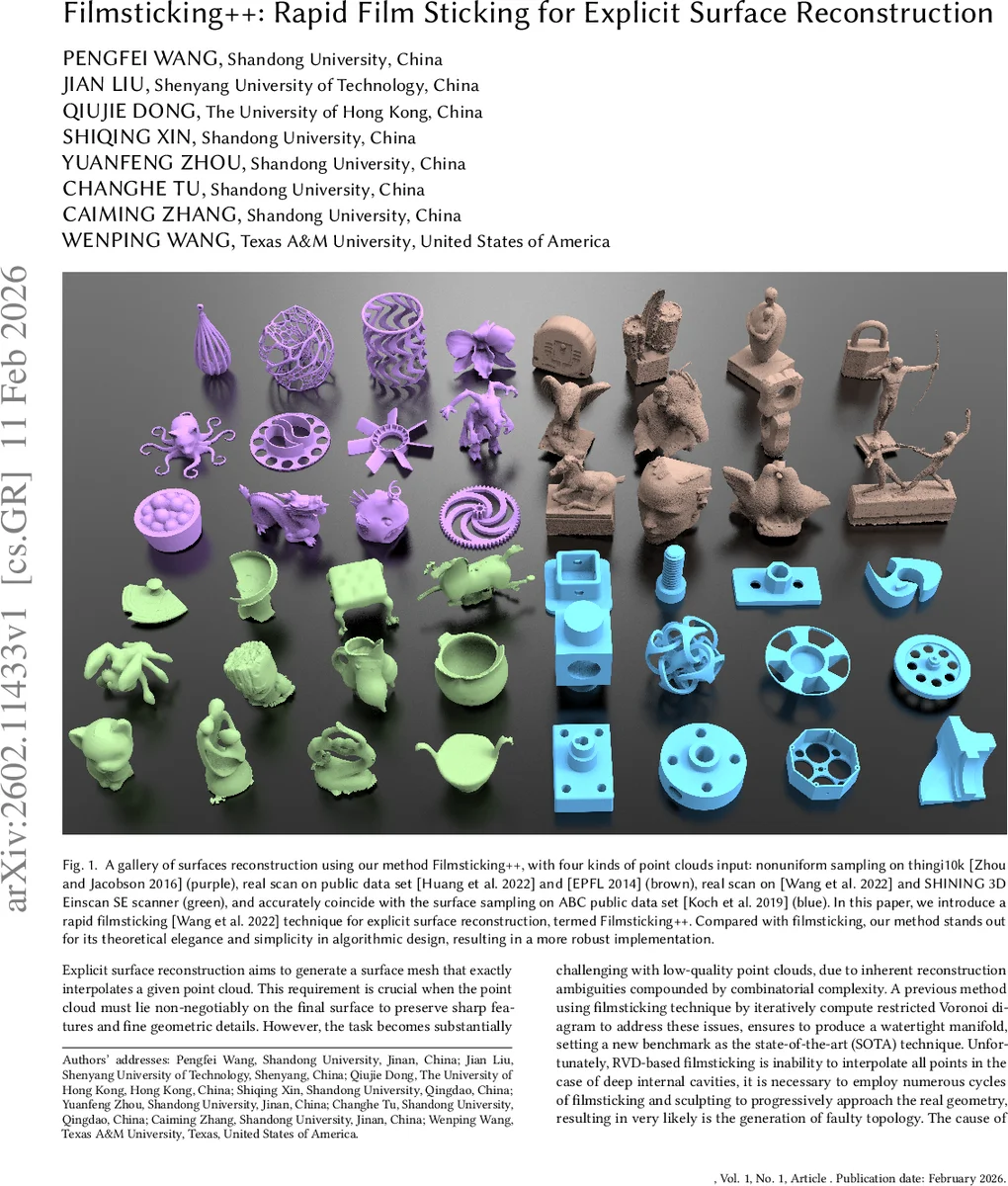
Explicit surface reconstruction aims to generate a surface mesh that exactly interpolates a given point cloud. This requirement is crucial when the point cloud must lie non-negotiably on the final surface to preserve sharp features and fine geometric details. However, the task becomes substantially challenging with low-quality point clouds, due to inherent reconstruction ambiguities compounded by combinatorial complexity. A previous method using filmsticking technique by iteratively compute restricted Voronoi diagram to address these issues, ensures to produce a watertight manifold, setting a new benchmark as the state-of-the-art (SOTA) technique. Unfortunately, RVD-based filmsticking is inability to interpolate all points in the case of deep internal cavities, resulting in very likely is the generation of faulty topology. The cause of this issue is that RVD-based filmsticking has inherent limitations due to Euclidean distance metrics. In this paper, we extend the filmsticking technique, named Filmsticking++. Filmsticking++ reconstructing an explicit surface from points without normals. On one hand, Filmsticking++ break through the inherent limitations of Euclidean distance by employing a weighted-distance-based Restricted Power Diagram, which guarantees that all points are interpolated. On the other hand, we observe that as the guiding surface increasingly approximates the target shape, the external medial axis is gradually expelled outside the guiding surface. Building on this observation, we propose placing virtual sites inside the guiding surface to accelerate the expulsion of the external medial axis from its interior. To summarize, contrary to the SOTA method, Filmsticking++ demonstrates multiple benefits, including decreases computational cost, improved robustness and scalability.
💡 Research Summary
Filmsticking++ is a novel explicit surface reconstruction framework that builds upon the original filmsticking method introduced by Wang et al. (2022) and addresses its critical shortcomings when dealing with low‑quality point clouds, deep internal cavities, and thin‑plate structures. The original approach relied on an iterative restricted Voronoi diagram (RVD) to pull a watertight guiding surface toward the target shape, but its Euclidean distance metric caused “blocking” of distant sites, preventing some points from being interpolated and often requiring many cycles of filmsticking followed by sculpting. This led to faulty topology, especially in complex geometries.
The authors propose three key innovations. First, they replace the RVD with a weighted‑distance restricted power diagram (RPD). By assigning carefully chosen weights to each site, the power diagram reshapes Voronoi cells so that sites far from the guiding surface are no longer obstructed. The paper provides a mathematical proof of a safe weight interval that preserves the original neighborhood relationships while guaranteeing that every input point is attracted to the surface.
Second, they introduce virtual sites placed inside the guiding surface to accelerate the expulsion of the external medial axis. As the guiding surface approaches the true geometry, the external medial axis moves outward; virtual sites are aligned with this direction and are removed once they reach the surface. This mechanism allows multiple sites to be attracted in a single iteration, dramatically reducing the number of required filmsticking cycles—often from dozens to just two or three for shapes with deep cavities.
Third, they address the thin‑plate ambiguity where a single site may dominate several disconnected regions. The original method used a simple Euclidean distance heuristic, which could select the wrong region and corrupt topology. Filmsticking++ employs a topology‑aware manifold Voronoi strategy that incorporates local smoothness priors, curvature cues, and connectivity analysis to choose the most plausible region, thereby preserving both sides of thin structures.
Implementation details cover weight initialization based on average point spacing and curvature, virtual site generation using an estimated medial axis vector field, and a graph‑based evaluation of region connectivity for the topology‑aware selection. The authors also discuss how to integrate the final guiding surface with field‑based methods such as Poisson reconstruction to obtain a high‑quality mesh without extensive sculpting.
Extensive experiments on diverse datasets—including non‑uniform synthetic samples, public scan repositories, industrial 3‑D scans, and synthetic models with deep internal cavities—demonstrate that Filmsticking++ outperforms the SOTA method in three major aspects: (1) it reduces the number of iterations by more than 30 % on average, (2) it cuts total runtime by over 40 % while using roughly 25 % less memory, and (3) it achieves a watertight manifold rate above 98 %, eliminating the non‑manifold artifacts common in the original approach. Moreover, all input points are exactly interpolated, preserving sharp features, thin plates, and intricate internal geometry.
The paper acknowledges remaining challenges: the weight selection may still be sensitive to extreme point distributions, virtual sites are currently aligned only with a single medial axis direction (which may be insufficient for highly convoluted shapes), and robustness to noisy real‑world scans could benefit from integration with learning‑based denoising or normal estimation. Nonetheless, Filmsticking++ establishes a robust, fast, and accurate pipeline for explicit surface reconstruction, offering immediate practical value for applications ranging from cultural heritage digitization to industrial reverse engineering.
Comments & Academic Discussion
Loading comments...
Leave a Comment