Solution for the Einstein-Maxwell equations invariant under an $(n - 1)$-dimensional group of dilations
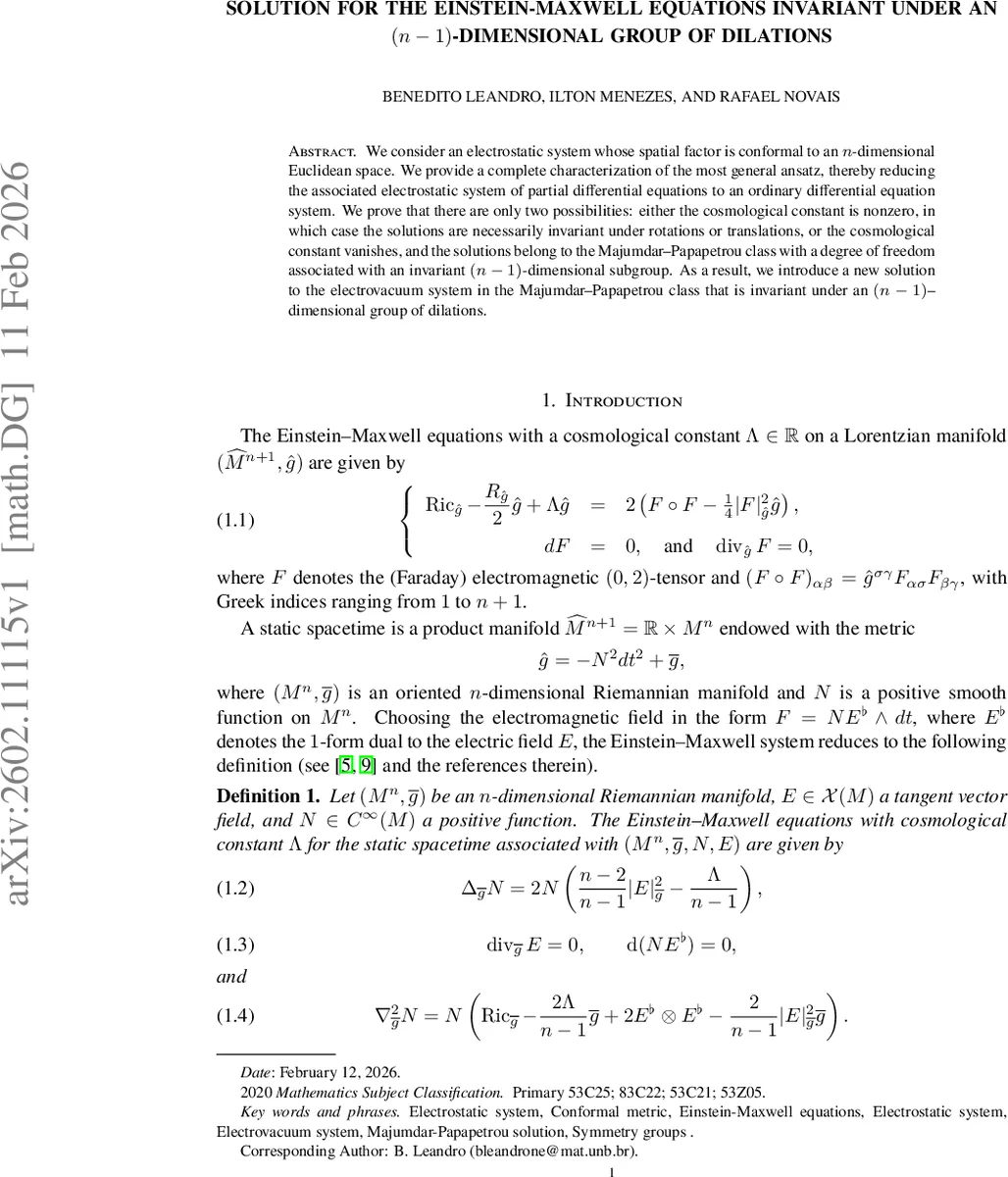
We consider an electrostatic system whose spatial factor is conformal to an $n$-dimensional Euclidean space. We provide a complete characterization of the most general ansatz, thereby reducing the associated electrostatic system of partial differential equations to an ordinary differential equation system. We prove that there are only two possibilities: either the cosmological constant is nonzero, in which case the solutions are necessarily invariant under rotations or translations, or the cosmological constant vanishes, and the solutions belong to the Majumdar-Papapetrou class with a degree of freedom associated with an invariant $(n-1)$-dimensional subgroup. As a result, we introduce a new solution to the electrovacuum system in the Majumdar-Papapetrou class that is invariant under an $(n-1)$-dimensional group of dilations.
💡 Research Summary
The paper investigates static solutions of the Einstein–Maxwell equations in (n + 1) dimensions, focusing on electrostatic configurations whose spatial metric is conformal to the flat Euclidean metric. Starting from the standard static ansatz (\hat g = -N^2 dt^2 + g) with an electric field (F = N,E^\flat \wedge dt), the authors rewrite the field equations in terms of the lapse function (N), the electric potential (\psi) (defined by (N E^\flat = d\psi)), and the spatial metric (g). Equation (1.5) links the scalar curvature of (g) to the electric field strength and the cosmological constant (\Lambda).
A key methodological step is to express the spatial metric as a conformal rescaling of the Euclidean metric: (g = \phi^{-2} g_{\text{Eucl}}). Lemma 1 derives a basic relation (2.1) that (\phi, N,\psi) must satisfy. Theorem 3 then reduces the full Einstein–Maxwell system to a set of coupled partial differential equations (2.2)–(2.5) involving only (\phi, N,\psi) and their first and second derivatives.
The authors impose the strong symmetry assumption that all three functions depend solely on a single scalar invariant (\xi(x)). Under this assumption the PDE system collapses to an ordinary differential equation (1.9) for (\xi). Solving (1.9) reveals that only two families of solutions are possible:
-
Non‑zero cosmological constant ((\Lambda\neq0)) – the equations force the solution to be invariant under either the rotation group (SO(n-1)) or the translation group (\mathbb{R}^{n-1}). This reproduces known results for static Einstein–Maxwell spacetimes with (\Lambda\neq0).
-
Zero cosmological constant ((\Lambda=0)) – the solution belongs to the Majumdar–Papapetrou (MP) class, characterized by the algebraic relation (\pm\sqrt{2(n-2)(n-1)},\psi = 1-N) and the conformal factor (\phi = N^{1/(n-2)}). Within this class the authors discover a new family of solutions that are invariant under an ((n-1))-dimensional dilation group rather than the usual translation symmetry.
The new MP solutions are constructed by taking the invariant (\xi) as a product of two linear forms, \
Comments & Academic Discussion
Loading comments...
Leave a Comment