Cutoff Sobolev inequalities for local and non-local $p$-energies on metric measure spaces
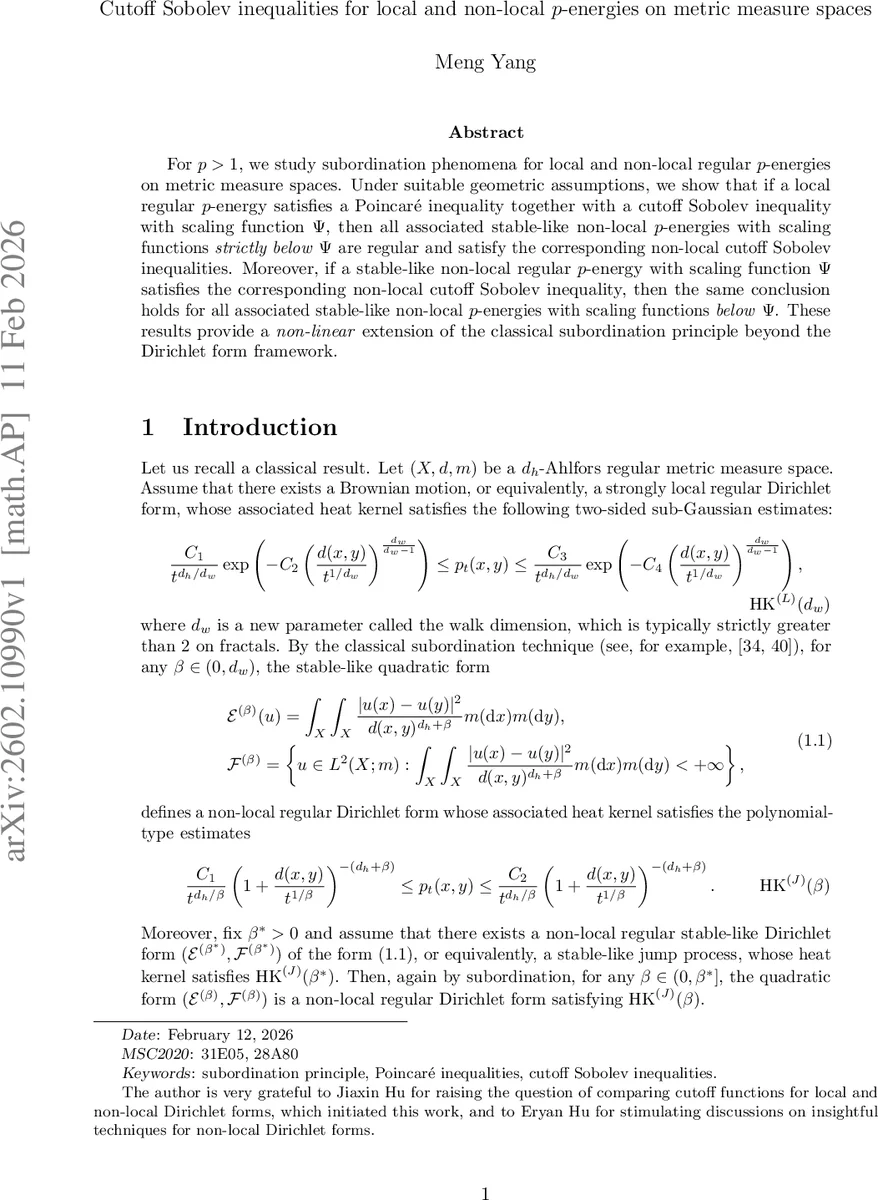
For $p>1$, we study subordination phenomena for local and non-local regular $p$-energies on metric measure spaces. Under suitable geometric assumptions, we show that if a local regular $p$-energy satisfies a Poincaré inequality together with a cutoff Sobolev inequality with scaling function $Ψ$, then all associated stable-like non-local $p$-energies with scaling functions strictly below $Ψ$ are regular and satisfy the corresponding non-local cutoff Sobolev inequalities. Moreover, if a stable-like non-local regular $p$-energy with scaling function $Ψ$ satisfies the corresponding non-local cutoff Sobolev inequality, then the same conclusion holds for all associated stable-like non-local $p$-energies with scaling functions below $Ψ$. These results provide a non-linear extension of the classical subordination principle beyond the Dirichlet form framework.
💡 Research Summary
The paper investigates a nonlinear analogue of the classical subordination principle for p‑energies (p>1) on metric measure spaces. In the linear (p=2) setting, subordination allows one to derive heat kernel estimates for a family of non‑local (stable‑like) Dirichlet forms from those of a local Dirichlet form. The author extends this idea to the fully nonlinear regime, where heat kernels are unavailable and the underlying objects are p‑energies rather than quadratic forms.
The setting is a complete, unbounded, locally compact metric measure space (X,d,m) satisfying the chain condition (CC) and volume doubling (VD). Two scaling functions Ψ and Υ are assumed to be doubling homeomorphisms obeying a two‑sided power comparison (Equation 2.1). These functions encode the “walk dimension’’ for local energies and the jump intensity for non‑local energies.
A local regular p‑energy (E(L,p),F(L,p)) is a strongly local p‑form satisfying the Markov property, Clarkson’s inequality, and a Poincaré inequality PI(L). A non‑local p‑form (E(J,Υ),F(J,Υ)) is defined via a symmetric kernel K(J,Υ)(x,y) comparable to V(x,d(x,y))^{-1}·Υ(d(x,y))^{-1}. Under VD and the kernel bounds, the non‑local Poincaré inequality PI(J) and a tail estimate T(J) hold.
The central analytic objects are cutoff Sobolev inequalities (CS). For the local case CS(L) and for the non‑local case CS(J) the author introduces three variants: strong (including a Hölder continuity estimate for the cutoff function), continuous (the cutoff is continuous), and weak (only the energy inequality). The strong version requires a cutoff ϕ supported in a slightly larger ball such that |ϕ(x)−ϕ(y)| ≤ C (d(x,y)/r ∧ 1)^δ for some δ∈(0,1).
A major technical achievement is proving that the various CS conditions are equivalent to the recently introduced CE condition (Theorems 2.1 and 2.2). This equivalence simplifies the verification of CS and connects it to capacity estimates. In particular, the paper shows that CS(L) implies the existence of Hölder continuous cutoffs, and the same cutoffs serve simultaneously for all non‑local energies whose scaling function lies strictly below Ψ.
The main results are encapsulated in Theorem 2.8, which answers two natural questions:
-
If a local regular p‑energy satisfies PI(L) and CS(L) (or the capacity upper bound cap(L)≤), then for every scaling function β with β<Ψ the associated non‑local p‑energy (E(β,p),F(β,p)) is regular and satisfies CS(J)(β).
-
Conversely, if a non‑local regular p‑energy with scaling β* satisfies CS(J)(β*) (or cap(J)(β*)≤), then for every β≤β* the corresponding non‑local p‑energy is regular and satisfies CS(J)(β).
The proofs rely on constructing Hölder continuous cutoffs from CS(L) (or cap(L)≤) using interior and boundary regularity theory for nonlinear p‑Laplace type equations. Because p≠2 eliminates the availability of heat kernel bounds, the author works directly with the energy functional, employing the chain condition to control geometric chains and applying a self‑improvement argument to upgrade weak CS to strong CS.
The paper also establishes that the weak non‑local CS inequality is equivalent to the capacity upper bound cap(J)≤ (Lemma 11.9), and that the capacity condition together with regularity yields CS(J) via known results in the non‑local setting.
Beyond the core theorems, the author shows that the strong CS(J) condition is essentially equivalent to the AB condition and the CSJ condition previously studied for Dirichlet forms, thereby unifying several strands of the literature. The results have immediate implications for the analysis of p‑harmonic functions, Harnack inequalities, potential theory, and heat kernel type estimates on fractals, graphs, and other irregular spaces where non‑local operators naturally arise.
In summary, the work provides a comprehensive nonlinear subordination framework: starting from a local p‑energy with suitable Sobolev and Poincaré control, one can generate an entire hierarchy of stable‑like non‑local p‑energies, each inheriting regularity, cutoff Sobolev inequalities, and capacity bounds. This bridges a gap between local and non‑local analysis in the nonlinear regime and opens the door to further developments in metric measure space analysis, stochastic processes with jumps, and nonlinear potential theory.
Comments & Academic Discussion
Loading comments...
Leave a Comment