Chemistry in the High expansion-velocity C-rich evolved star AFGL2233. Isotopic ratios, peculiarities and evolutionary status
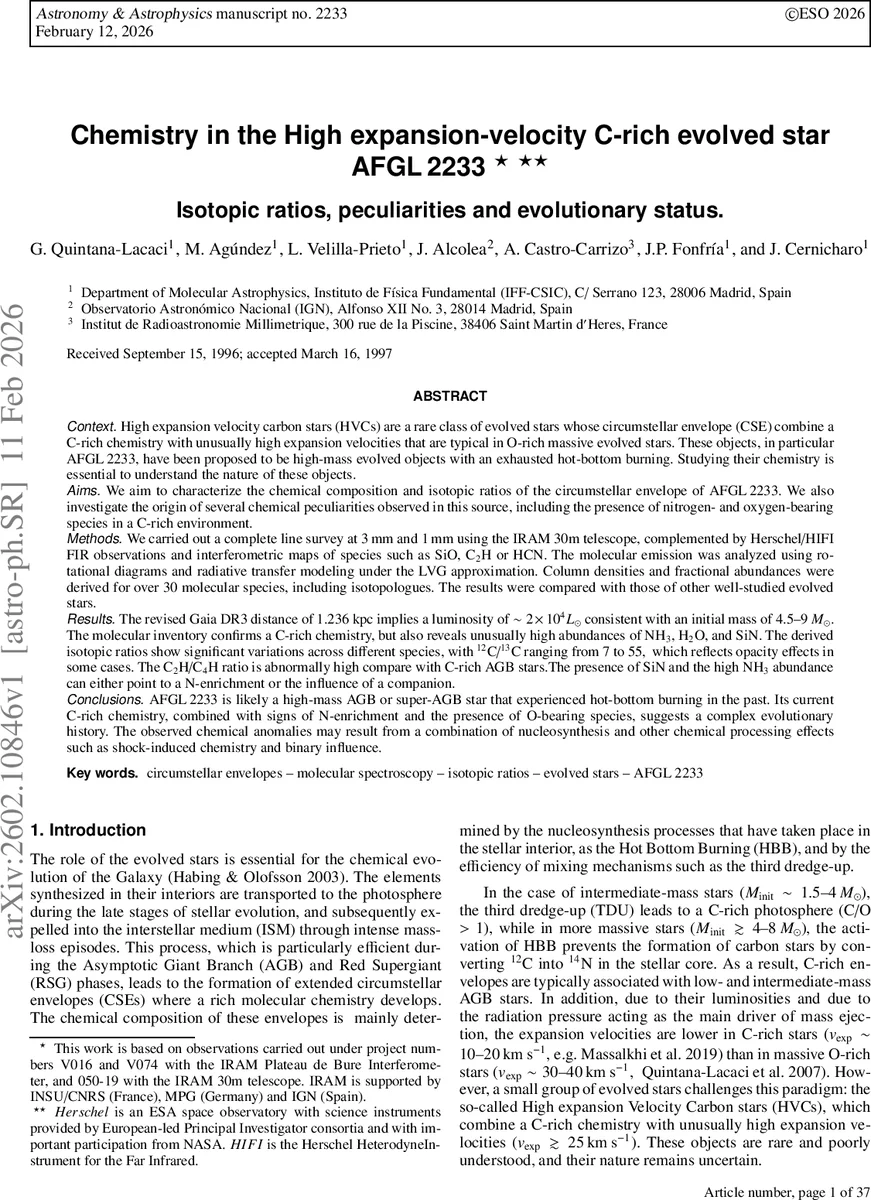
High expansion velocity carbon stars (HVCs) are a rare class of evolved stars whose circumstellar envelopes (CSEs) combine C-rich chemistry with unusually high expansion velocities typical of O-rich massive evolved stars. AFGL2233 has been proposed as a high-mass evolved object that exhausted hot-bottom burning. Studying its chemistry is essential to understand the nature and evolution of these objects. We characterize the chemical composition and isotopic ratios of the CSE of AFGL2233 and investigate chemical peculiarities, including the presence of N- and O-bearing species in a C-rich environment. We carried out a complete line survey at 3 mm and 1 mm using the IRAM 30m telescope, complemented by Herschel/HIFI FIR observations and interferometric maps of SiO, C2H, and HCN. Molecular emission was analyzed using rotational diagrams and radiative transfer modeling under the LVG approximation. Column densities and fractional abundances were derived for more than 30 molecular species, including isotopologues, and compared with other evolved stars. The Gaia DR3 distance of 1.236 kpc implies a luminosity of ~2 Lsun, consistent with an initial mass of 4.5-9 Msun. The molecular inventory confirms C-rich chemistry but reveals unusually high abundances of NH3, H2O, and SiN. The isotopic ratios vary among species, with 12C/13C ranging from 7 to 55. The C2H/C4H ratio is abnormally high compared with C-rich AGB stars. The presence of SiN and high NH3 may indicate N-enrichment or the influence of a companion. AFGL2233 is likely a high-mass AGB or super-AGB star with a complex evolutionary history involving nucleosynthesis, shocks, and possible binary interaction.
💡 Research Summary
AFGL 2233 belongs to the rare class of high‑expansion‑velocity carbon stars (HVCs), objects that display a carbon‑rich circumstellar envelope (CSE) while expanding at velocities typical of massive oxygen‑rich evolved stars. The authors revisited the fundamental stellar parameters using the latest Gaia DR3 parallax, obtaining a distance of 1.236 kpc. This places the luminosity at log (L/L⊙)=4.3 (≈2 × 10⁴ L⊙), considerably lower than the value derived from the earlier Gaia DR2 distance. Evolutionary tracks (Meynet & Maeder 2003; Girardi et al. 2000) then imply an initial mass between 4.5 and 9 M⊙, consistent with a high‑mass asymptotic giant branch (AGB) or a super‑AGB star that has already experienced hot‑bottom burning (HBB) and is now in a carbon‑rich phase.
The observational campaign combined a complete 3 mm and 1 mm line survey with the IRAM 30 m telescope, far‑infrared spectroscopy with Herschel/HIFI, and interferometric maps of SiO, C₂H and HCN obtained with the former Plateau de Bure Interferometer (now NOEMA). The IRAM survey used seven frequency setups, each observed twice with a 50 MHz shift to disentangle image‑band contamination. The HIFI data covered bands 1b, 2a, 5a, 4b and 7b, providing access to high‑energy transitions of H₂O, NH₃, CO, SiO and isotopologues. The interferometric data delivered sub‑arcsecond maps of several key species, allowing the authors to probe the spatial distribution of the gas.
Line identification was performed with careful baseline subtraction and averaging of the two orthogonal polarizations. Rotational‑diagram analysis and large‑velocity‑gradient (LVG) radiative‑transfer modeling were applied to derive column densities, excitation temperatures and fractional abundances for more than thirty molecular species, including a suite of isotopologues. The chemical inventory confirms a carbon‑rich environment (abundant CO, HCN, C₂H, HC₃N, etc.) but also reveals unusually high abundances of NH₃, H₂O and SiN—molecules that are typically associated with oxygen‑rich or nitrogen‑rich chemistries. NH₃ and H₂O column densities are 1–2 dex higher than in canonical C‑rich AGB stars, while SiN is detected for the first time in a carbon‑rich CSE.
Isotopic ratios show significant scatter among different molecules. The ¹²C/¹³C ratio ranges from 7 to 55, reflecting both real nucleosynthetic variations and opacity effects that can bias the apparent ratio in optically thick lines. The C₂H/C₄H ratio is markedly higher than in standard carbon‑rich AGB stars, suggesting that the growth of carbon chains is somehow suppressed, possibly by nitrogen enrichment or shock processing. Other isotopic ratios (e.g., ¹⁴N/¹⁵N, ¹⁶O/¹⁸O) also deviate from typical AGB values, hinting at a complex nucleosynthetic history.
The CO line profiles were modeled with a constant mass‑loss rate, a uniform expansion velocity of ≈32 km s⁻¹, and a temperature law T(r)=T₁₆ (r/10¹⁶ cm)^α + T_min. The LVG model simultaneously reproduces the single‑dish CO J=1‑0 and J=2‑1 spectra and the azimuthally averaged interferometric maps, yielding a mass‑loss rate of ≈2 × 10⁻⁵ M⊙ yr⁻¹. The model confirms that the CSE is dense and warm enough to sustain the observed high‑excitation lines.
The authors discuss three main mechanisms that could account for the observed chemical peculiarities: (1) residual nitrogen enrichment after the cessation of HBB, which would naturally boost NH₃ and SiN; (2) shock‑induced chemistry driven by the high expansion velocity, enhancing non‑equilibrium pathways that form H₂O and nitrogen‑bearing species; and (3) possible binary interaction, where a companion could supply additional nitrogen‑rich material or trigger mixing processes. The combination of these effects likely explains the simultaneous presence of carbon‑rich molecules, nitrogen‑rich species, and oxygen‑bearing water vapor.
In summary, AFGL 2233 appears to be a high‑mass AGB or super‑AGB star that has transitioned from an HBB‑dominated phase to a carbon‑rich chemistry while retaining signatures of nitrogen enrichment and shock processing. Its complex molecular inventory, especially the detection of SiN and the elevated NH₃ and H₂O abundances, provides a valuable benchmark for models of massive stellar evolution, nucleosynthesis, and circumstellar chemistry. The study underscores the importance of multi‑wavelength, high‑resolution spectroscopy in disentangling the intertwined physical and chemical processes that shape the envelopes of massive evolved stars.
Comments & Academic Discussion
Loading comments...
Leave a Comment