Generalized Decidability via Brouwer Trees
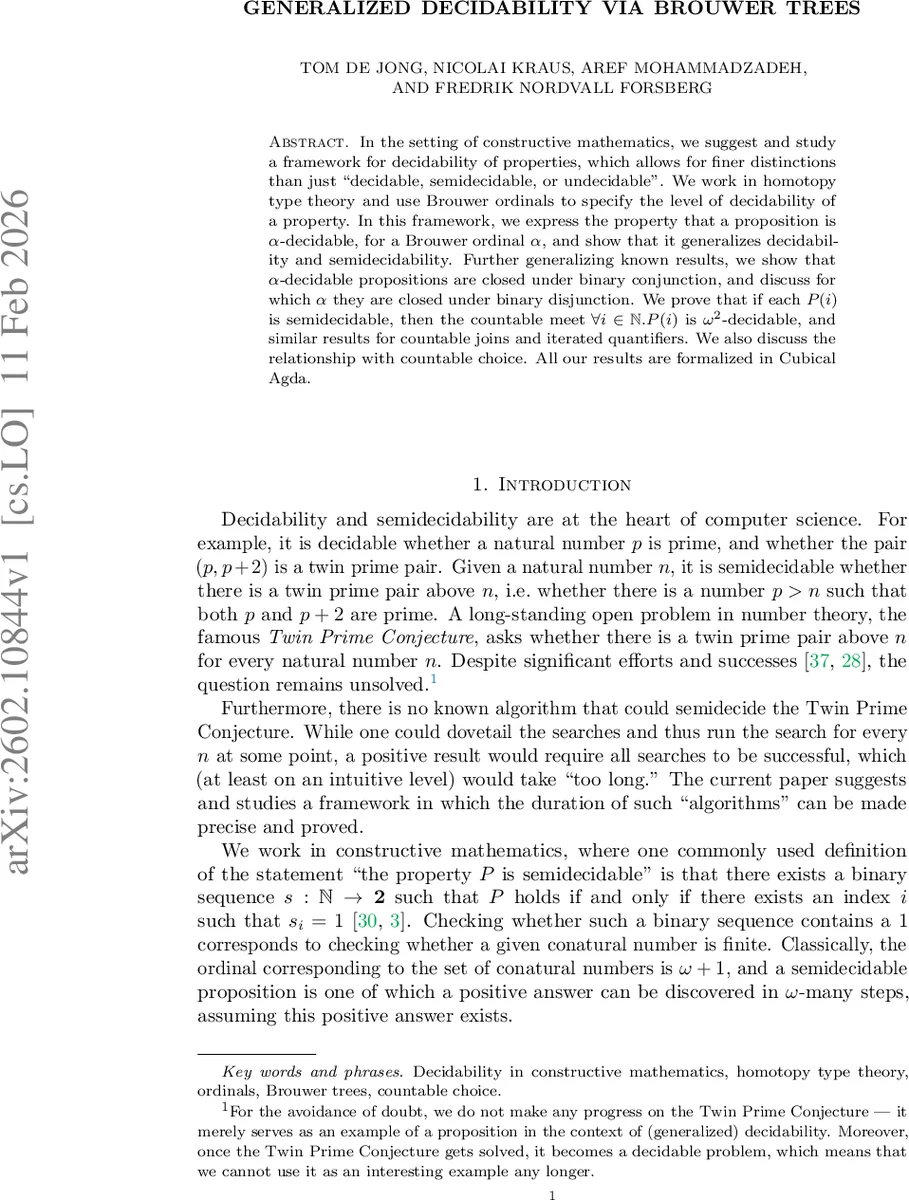
In the setting of constructive mathematics, we suggest and study a framework for decidability of properties, which allows for finer distinctions than just “decidable, semidecidable, or undecidable”. We work in homotopy type theory and use Brouwer ordinals to specify the level of decidability of a property. In this framework, we express the property that a proposition is $α$-decidable, for a Brouwer ordinal $α$, and show that it generalizes decidability and semidecidability. Further generalizing known results, we show that $α$-decidable propositions are closed under binary conjunction, and discuss for which $α$ they are closed under binary disjunction. We prove that if each $P(i)$ is semidecidable, then the countable meet $\forall i\in \mathbb N. P(i)$ is $ω^2$-decidable, and similar results for countable joins and iterated quantifiers. We also discuss the relationship with countable choice. All our results are formalized in Cubical Agda.
💡 Research Summary
The paper introduces a novel hierarchy of decidability based on Brouwer ordinals within constructive mathematics and homotopy type theory (HoTT). Traditional computability theory distinguishes only three classes—decidable, semi‑decidable, and undecidable—whereas the authors define “α‑decidable” for any Brouwer ordinal α. A proposition P is α‑decidable if there exists a Brouwer ordinal y such that P holds exactly when α ≤ y. This definition captures ordinary decidability (α = 1) and semi‑decidability (α = ω + 1) as special cases, using a “jumping sequence” construction that translates binary sequences into strictly increasing ordinal sequences and a converse “downward” translation.
The underlying ordinal structure, Brw, is a quotient inductive‑inductive type with constructors zero, succ, and limit, where limit only accepts strictly increasing sequences. This design makes finiteness decidable (zero and succ of a finite ordinal are finite; limit is always infinite) and makes the comparison α ≤ β semi‑decidable in general. The authors prove basic algebraic properties of Brw (addition, multiplication, exponentiation) and show that any ordinal can be uniquely expressed as a sum λ + n where λ is zero or a limit and n is a natural number.
Key logical results:
- Closure under conjunction – If P and Q are α‑decidable for the same α, then P ∧ Q is also α‑decidable. The proof uses the fact that the meet of the witnesses y₁ and y₂ (the least ordinal above both) still satisfies the α‑≤ condition.
- Partial closure under disjunction – The set of (ω·n + k)‑decidable propositions is closed under binary disjunction. This reflects the additive structure of Brouwer ordinals: the disjunction corresponds to taking the supremum of the witnesses, which increases the ordinal by at most a finite amount. Full closure under arbitrary disjunction fails without additional assumptions.
For countable families {P(i)}₍ᵢ∈ℕ₎ of semi‑decidable propositions, the authors obtain stronger ordinal bounds:
- The countable meet ∀i P(i) is ω²‑decidable. The construction builds a doubly indexed sequence of ordinals witnessing each P(i) and then takes a limit of limits, yielding an ordinal of type ω·ω = ω².
- The countable join ∃i P(i) is ω·3‑decidable in general. If the axiom of countable choice is assumed, the join becomes semi‑decidable (ω + 1‑decidable). The paper also introduces Sierpiński‑semi‑decidability, an alternative notion that is closed under countable joins without invoking choice.
The authors explore the impact of constructive principles such as the Limited Principle of Omniscience (LPO) and Markov’s Principle (MP). Under LPO, the hierarchy of α‑decidability collapses at certain levels, allowing separation results that show, for example, that ω·n‑decidable does not imply ω·(n+1)‑decidable.
All definitions, lemmas, and theorems are formalized in Cubical Agda. The accompanying repository contains the full Agda code, type‑checked with Agda 2.8.0, and a browsable HTML rendering linking each formal statement to its source. The formalization demonstrates that the synthetic approach to computability—where computability is built into the logic rather than modeled by Turing machines—can be extended to transfinite time via Brouwer ordinals.
In conclusion, the paper provides a robust framework for “ordinal decidability,” bridging constructive type theory, ordinal analysis, and computability. It refines the classical binary classification of decidability, offers precise closure properties for logical connectives and countable quantifiers, and shows how choice principles affect the hierarchy. The Agda formalization ensures that the results are mechanically verified, opening avenues for further research in synthetic infinite‑time computation, formal verification of algorithms with transfinite bounds, and the study of constructive principles in higher‑order type theories.
Comments & Academic Discussion
Loading comments...
Leave a Comment