Charged particle motion in a strong magnetic field: The first order expansion
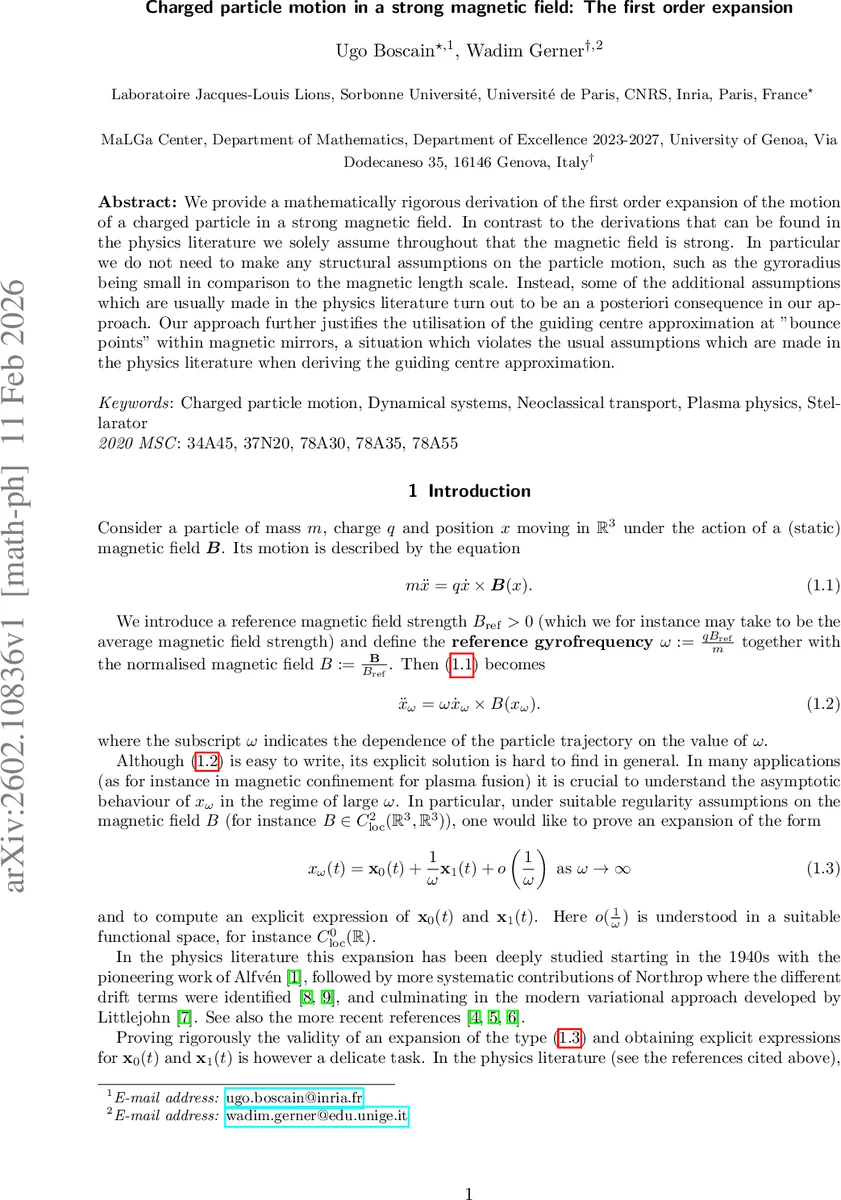
We provide a mathematically rigorous derivation of the first order expansion of the motion of a charged particle in a strong magnetic field. In contrast to the derivations that can be found in the physics literature we solely assume throughout that the magnetic field is strong. In particular we do not need to make any structural assumptions on the particle motion, such as the gyroradius being small in comparison to the magnetic length scale. Instead, some of the additional assumptions which are usually made in the physics literature turn out to be an a posteriori consequence in our approach. Our approach further justifies the utilisation of the guiding centre approximation at “bounce points” within magnetic mirrors, a situation which violates the usual assumptions which are made in the physics literature when deriving the guiding centre approximation.
💡 Research Summary
The paper presents a mathematically rigorous derivation of the first‑order asymptotic expansion for the trajectory of a charged particle moving in a strong, static magnetic field. Starting from the Lorentz force law (m\ddot x = q\dot x\times B(x)), the authors introduce a reference magnetic field strength (B_{\text{ref}}) and the associated gyro‑frequency (\omega = qB_{\text{ref}}/m). By normalising the magnetic field, the equation becomes (\ddot x_\omega = \omega,\dot x_\omega\times B(x_\omega)), where the subscript (\omega) emphasizes the dependence of the solution on the strength of the field. The regime of interest is (\omega\to\infty), i.e. an asymptotically strong magnetic field.
The central goal is to prove, under minimal assumptions on the magnetic field (namely (B\in C^2_{\text{loc}}(\mathbb R^3,\mathbb R^3)) and (\nabla\cdot B=0)), that the particle trajectory admits an expansion of the form
\
Comments & Academic Discussion
Loading comments...
Leave a Comment