Self-Supervised Learning for Speaker Recognition: A study and review
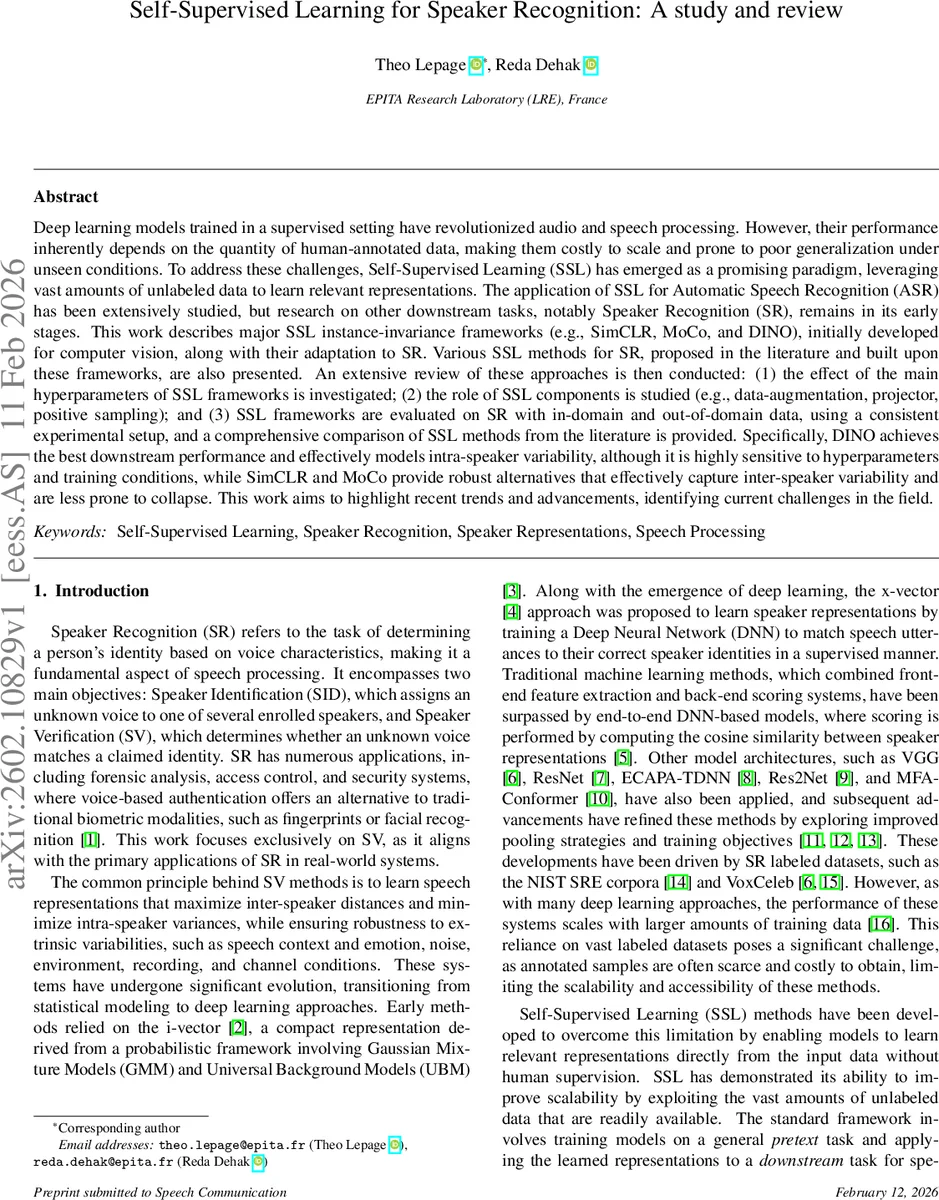
Deep learning models trained in a supervised setting have revolutionized audio and speech processing. However, their performance inherently depends on the quantity of human-annotated data, making them costly to scale and prone to poor generalization under unseen conditions. To address these challenges, Self-Supervised Learning (SSL) has emerged as a promising paradigm, leveraging vast amounts of unlabeled data to learn relevant representations. The application of SSL for Automatic Speech Recognition (ASR) has been extensively studied, but research on other downstream tasks, notably Speaker Recognition (SR), remains in its early stages. This work describes major SSL instance-invariance frameworks (e.g., SimCLR, MoCo, and DINO), initially developed for computer vision, along with their adaptation to SR. Various SSL methods for SR, proposed in the literature and built upon these frameworks, are also presented. An extensive review of these approaches is then conducted: (1) the effect of the main hyperparameters of SSL frameworks is investigated; (2) the role of SSL components is studied (e.g., data-augmentation, projector, positive sampling); and (3) SSL frameworks are evaluated on SR with in-domain and out-of-domain data, using a consistent experimental setup, and a comprehensive comparison of SSL methods from the literature is provided. Specifically, DINO achieves the best downstream performance and effectively models intra-speaker variability, although it is highly sensitive to hyperparameters and training conditions, while SimCLR and MoCo provide robust alternatives that effectively capture inter-speaker variability and are less prone to collapse. This work aims to highlight recent trends and advancements, identifying current challenges in the field.
💡 Research Summary
This paper provides the first comprehensive review and empirical study of self‑supervised learning (SSL) applied to speaker verification (SV). While SSL has become a cornerstone of modern automatic speech recognition (ASR), its adoption for speaker recognition remains fragmented. The authors begin by describing the three major instance‑invariance SSL frameworks originally devised for computer vision—SimCLR, MoCo, and DINO—and detail how each can be adapted to the audio domain. All three share a joint‑embedding architecture that creates an anchor and a positive view from the same utterance using data augmentation (noise addition, reverberation, channel perturbations). The key difference lies in how they prevent representation collapse: SimCLR relies on batch‑wise negative sampling, MoCo augments this with a memory queue to enlarge the negative pool, and DINO eliminates explicit negatives by employing a student‑teacher (self‑distillation) scheme with an exponential moving average (EMA) update of the teacher’s weights.
The paper then surveys existing SSL methods for SV, categorizing them into single‑stage approaches (directly training an SSL objective and using the learned embeddings) and multi‑stage approaches (generating pseudo‑labels from an SSL model and fine‑tuning with supervised loss). Most recent works build on contrastive learning or self‑distillation, with DINO currently forming the backbone of state‑of‑the‑art pipelines.
A major contribution is the systematic experimental evaluation under a unified protocol. Using the large‑scale VoxCeleb2 corpus for in‑domain testing and an external dataset (e.g., LibriSpeech‑Other) for out‑of‑domain assessment, the authors train each framework with identical encoders (ResNet‑based) and projectors, then evaluate verification performance via equal error rate (EER) and minimum detection cost function (minDCF). They also release sslsv, an open‑source PyTorch toolkit that encapsulates data loading, augmentation, training loops, and evaluation, ensuring full reproducibility.
Hyper‑parameter analysis reveals that DINO is highly sensitive to temperature (τ) and EMA momentum (m); small deviations can cause dramatic performance swings or even collapse. In contrast, SimCLR and MoCo exhibit robust behavior across a wide range of batch sizes, temperatures, and numbers of negatives. Increasing the negative pool (especially in MoCo) consistently improves inter‑speaker separability, while DINO’s performance hinges more on projector dimensionality and the frequency of teacher updates.
Component‑wise studies highlight the pivotal role of data augmentation. Moderate levels of noise and reverberation help the model focus on speaker identity, but excessive augmentation erodes speaker‑specific cues. The projector layer, often discarded in contrastive setups, is beneficial for DINO and other self‑distillation methods but can degrade SimCLR performance if not carefully sized. Positive sampling strategies that draw two segments from the same utterance (intra‑utterance positives) better capture intra‑speaker variability than cross‑utterance positives, which can introduce unwanted channel differences.
Performance results show that DINO achieves the lowest EER (≈1.2 % on VoxCeleb‑test) and excels at modeling intra‑speaker variability, yet its out‑of‑domain degradation is more pronounced (≈2.3 % EER) due to hyper‑parameter sensitivity. SimCLR and MoCo, while slightly behind in absolute EER (≈1.5–1.6 % in‑domain), maintain more stable performance across domains (≈2.0 % EER) and are less prone to collapse. Multi‑stage pipelines that employ pseudo‑labels do not consistently outperform the best single‑stage DINO model, suggesting that the added labeling complexity may not be justified for many practical scenarios.
The authors conclude by identifying current bottlenecks: (1) class‑collision risk when negatives inadvertently belong to the same speaker, (2) the need for automated hyper‑parameter tuning for self‑distillation methods, (3) limited exploration of multimodal or cross‑domain pre‑training, and (4) the absence of a standardized benchmark suite for SSL‑based SV. They propose future research directions such as adaptive negative sampling, curriculum‑based augmentation, and integration of visual cues. By providing both a thorough literature synthesis and a reproducible experimental framework, this work establishes a solid foundation for advancing self‑supervised speaker recognition.
Comments & Academic Discussion
Loading comments...
Leave a Comment