Fractional Hardy inequalities on $C^{1,1}$ open sets
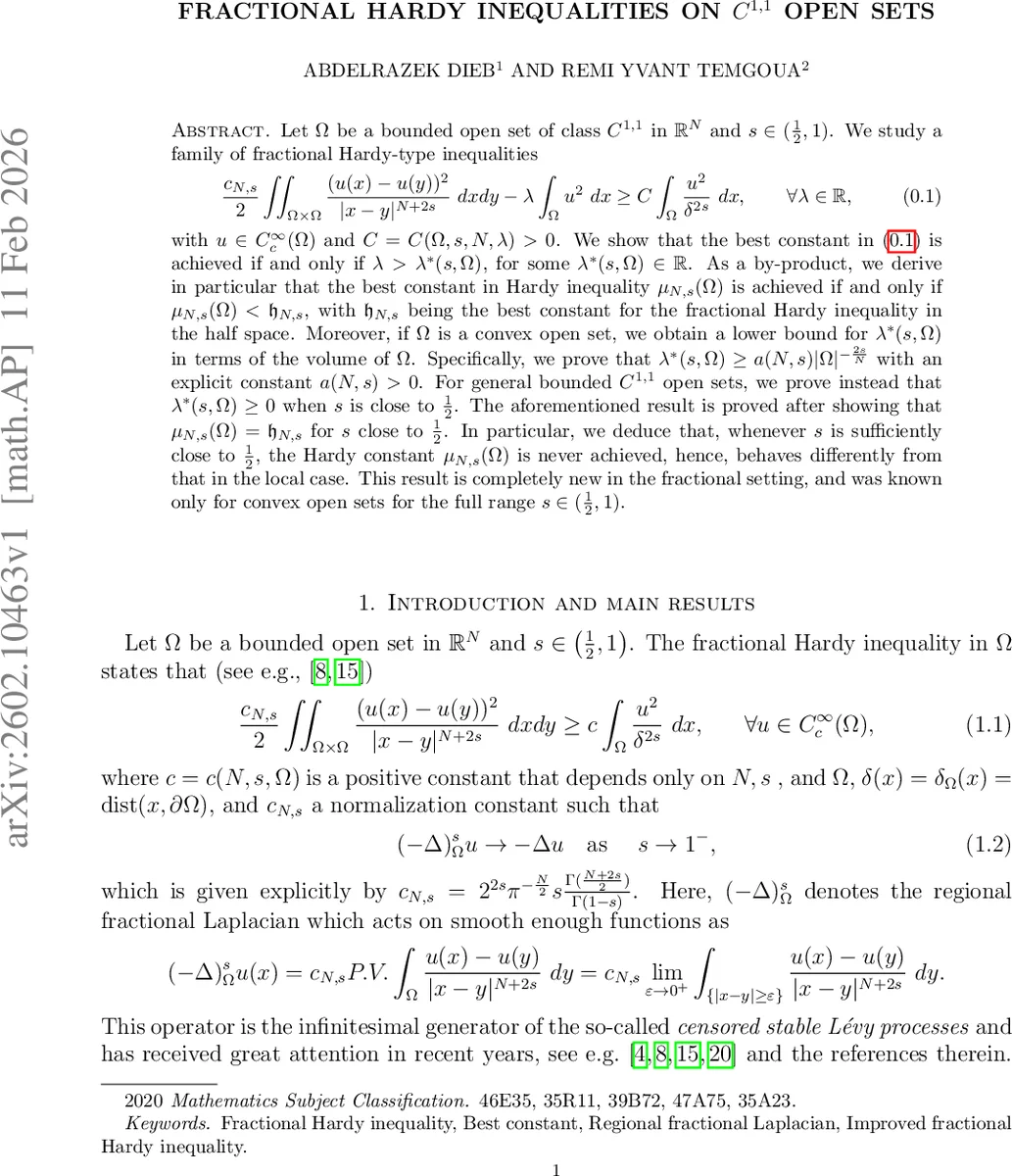
Let $Ω$ be a bounded open set of class $C^{1,1}$ in $\mathbb{R}^N$ and $s\in(\frac{1}{2}, 1)$. We study a family of fractional Hardy-type inequalities \begin{equation} \frac{c_{N,s}}{2}\displaystyle\iint_{Ω\timesΩ}\frac{(u(x)-u(y))^2}{|x-y|^{N+2s}}\ dxdy-\displaystyleλ\int_Ωu^2\ dx\geq C\displaystyle\int_Ω\frac{u^2}{δ^{2s}}\ dx,~~~\quad\forallλ\in\mathbb{R},~~~~~~~(0.1) \end{equation} with $u\in C_c^\infty(Ω)$ and $C=C(Ω,s,N,λ)>0$. We show that the best constant in $(0.1)$ is achieved if and only if $λ>λ^(s,Ω)$, for some $λ^(s,Ω)\in\mathbb{R}$. As a by-product, we derive in particular that the best constant in Hardy inequality $μ_{N,s}(Ω)$ is achieved if and only if $μ_{N,s}(Ω)<\mathfrak{h}{N,s}$, with $\mathfrak{h}{N,s}$ being the best constant for the fractional Hardy inequality in the half space. Moreover, if $Ω$ is a convex open set, we obtain a lower bound for $λ^(s,Ω)$ in terms of the volume of $Ω$. Specifically, we prove that $λ^(s,Ω)\geq a(N,s)|Ω|^{-\frac{2s}{N}}$ with an explicit constant $a(N,s)>0$. For general bounded $C^{1,1}$ open sets, we prove instead that $λ^*(s,Ω)\geq0$ when $s$ is close to $\frac{1}{2}$. The aforementioned result is proved after showing that $μ_{N,s}(Ω)=\mathfrak{h}{N,s}$ for $s$ close to $\frac{1}{2}$. In particular, we deduce that, whenever $s$ is sufficiently close to $\frac{1}{2}$, the Hardy constant $μ{N,s}(Ω)$ is never achieved, hence, behaves differently from that in the local case. This result is completely new in the fractional setting, and was known only for convex open sets for the full range $s\in(\frac{1}{2}, 1)$.
💡 Research Summary
The paper investigates a family of fractional Hardy‑type inequalities on bounded open sets Ω⊂ℝⁿ whose boundary is of class C¹,¹, with the fractional exponent s∈(½,1). The central object is the functional
\
Comments & Academic Discussion
Loading comments...
Leave a Comment