Benchmarking Deep Learning and Statistical Target Detection Methods for PFM-1 Landmine Detection in UAV Hyperspectral Imagery
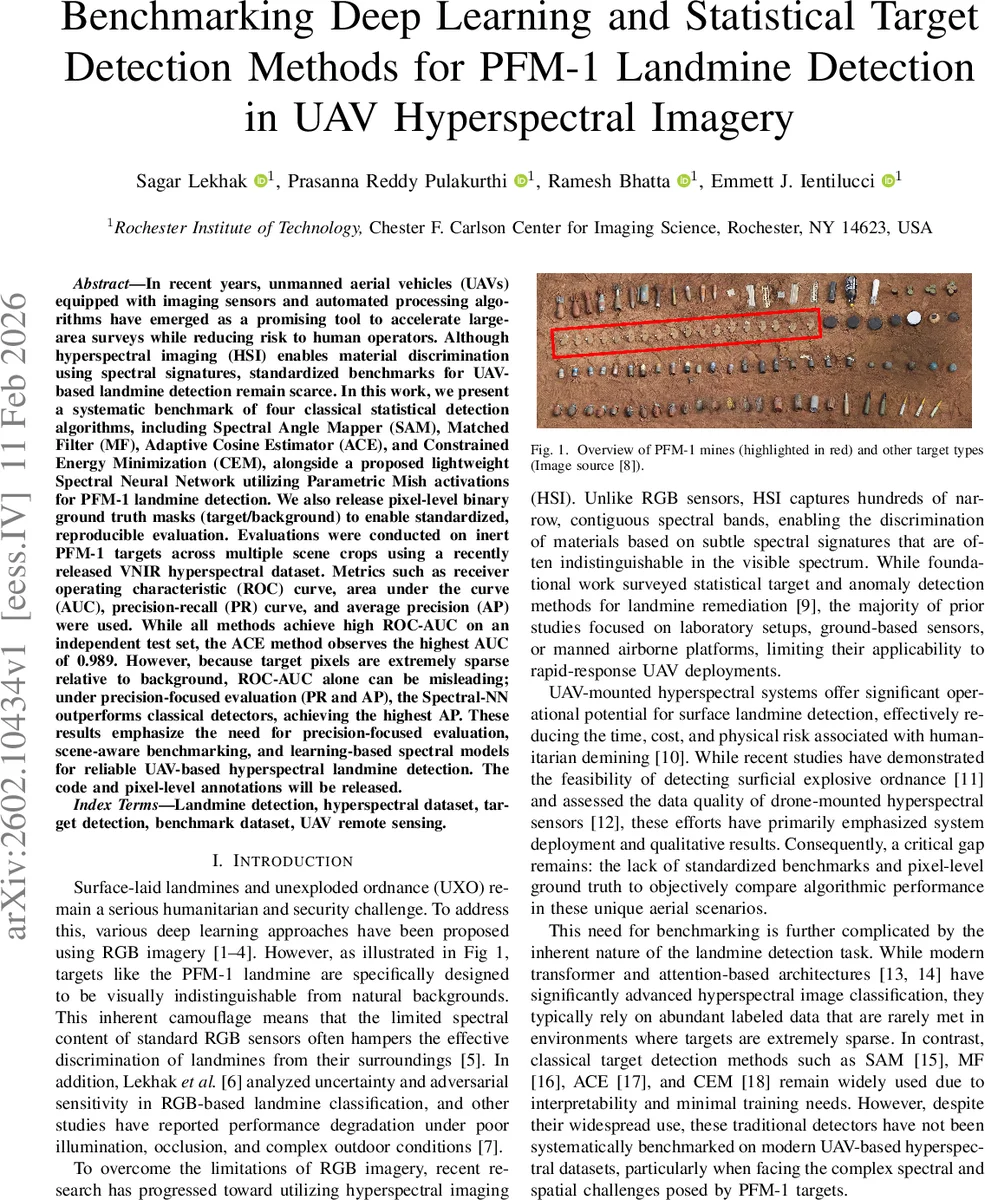
In recent years, unmanned aerial vehicles (UAVs) equipped with imaging sensors and automated processing algorithms have emerged as a promising tool to accelerate large-area surveys while reducing risk to human operators. Although hyperspectral imaging (HSI) enables material discrimination using spectral signatures, standardized benchmarks for UAV-based landmine detection remain scarce. In this work, we present a systematic benchmark of four classical statistical detection algorithms, including Spectral Angle Mapper (SAM), Matched Filter (MF), Adaptive Cosine Estimator (ACE), and Constrained Energy Minimization (CEM), alongside a proposed lightweight Spectral Neural Network utilizing Parametric Mish activations for PFM-1 landmine detection. We also release pixel-level binary ground truth masks (target/background) to enable standardized, reproducible evaluation. Evaluations were conducted on inert PFM-1 targets across multiple scene crops using a recently released VNIR hyperspectral dataset. Metrics such as receiver operating characteristic (ROC) curve, area under the curve (AUC), precision-recall (PR) curve, and average precision (AP) were used. While all methods achieve high ROC-AUC on an independent test set, the ACE method observes the highest AUC of 0.989. However, because target pixels are extremely sparse relative to background, ROC-AUC alone can be misleading; under precision-focused evaluation (PR and AP), the Spectral-NN outperforms classical detectors, achieving the highest AP. These results emphasize the need for precision-focused evaluation, scene-aware benchmarking, and learning-based spectral models for reliable UAV-based hyperspectral landmine detection. The code and pixel-level annotations will be released.
💡 Research Summary
This paper presents a comprehensive benchmark of both classical statistical target‑detection algorithms and a lightweight deep‑learning model for detecting surface‑deployed PFM‑1 plastic landmines using UAV‑mounted VNIR hyperspectral imagery. The authors start by addressing a critical gap: the lack of standardized, pixel‑level ground truth and reproducible evaluation protocols for aerial hyperspectral landmine detection. They use a recently released dataset containing over 140 inert landmine objects captured with a hyperspectral sensor (272 spectral bands). From the original cube (3123 × 6631 × 272) they create three spatial subsets: a “Full Region” (1705 × 3461) that includes all mines, a “PFM‑1 Region” (500 × 1060) that contains only the seven PFM‑1 targets, and a split into training (500 × 610, first five targets) and independent test (500 × 450, remaining two targets) regions to avoid any data leakage. Manual annotation in ENVI, cross‑checked with high‑resolution RGB orthophotos, yields a binary mask with 248 target pixels against millions of background pixels, highlighting the extreme class imbalance typical of landmine detection.
Four well‑known statistical detectors are implemented: Spectral Angle Mapper (SAM), Matched Filter (MF), Adaptive Cosine Estimator (ACE), and Constrained Energy Minimization (CEM). All use the same target signature provided by the original dataset. SAM scores are negated so that larger values indicate stronger target response; MF, ACE, and CEM are mean‑centered and normalized to
Comments & Academic Discussion
Loading comments...
Leave a Comment