Some Bayesian Perspectives on Clinical Trials
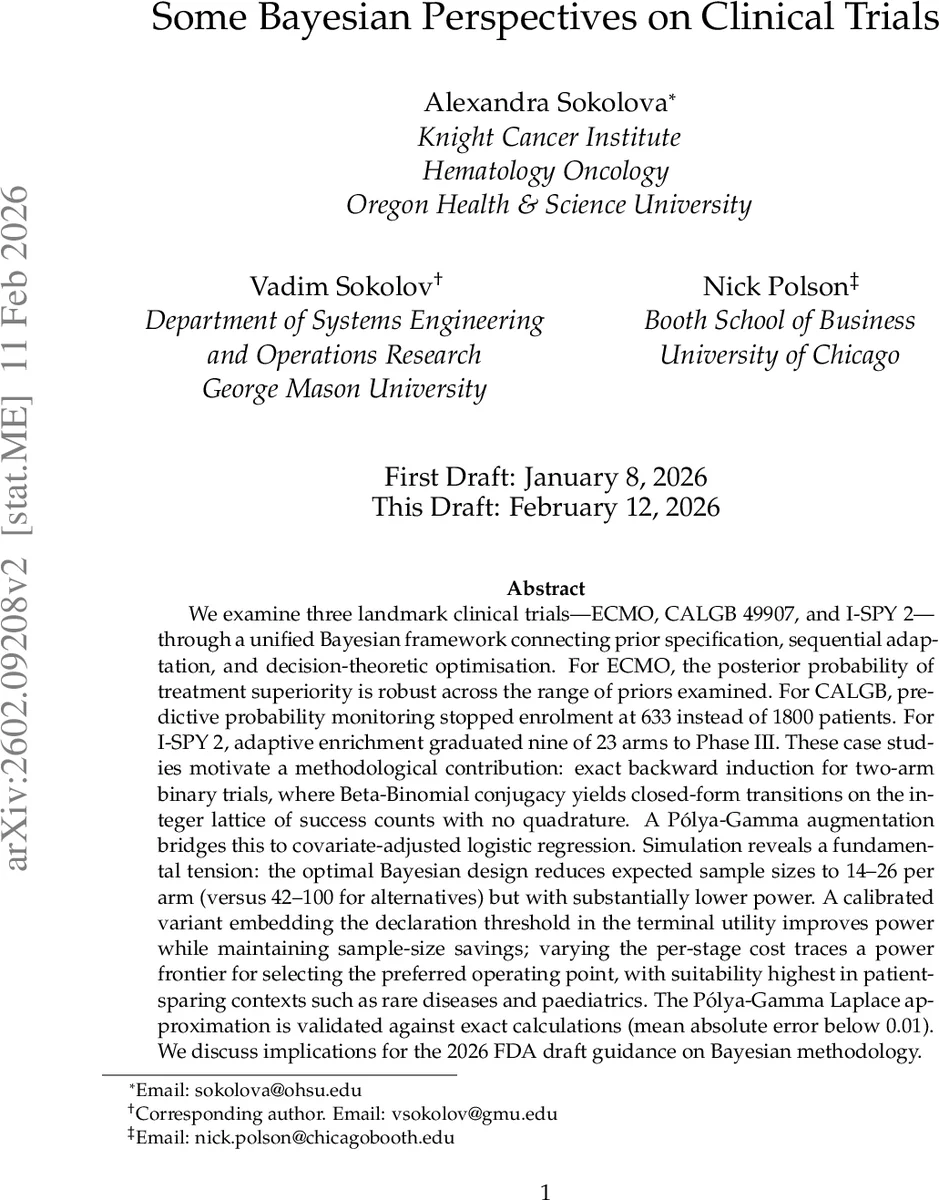
We examine three landmark clinical trials – ECMO, CALGB49907, and I-SPY2 – through a unified Bayesian framework connecting prior specification, sequential adaptation, and decision-theoretic optimisation. For ECMO, the posterior probability of treatment superiority is robust across the range of priors examined. For CALGB, predictive probability monitoring stopped enrolment at 633 instead of 1800 patients. For I-SPY2, adaptive enrichment graduated nine of 23 arms to PhaseIII. These case studies motivate a methodological contribution: exact backward induction for two-arm binary trials, where Beta-Binomial conjugacy yields closed-form transitions on the integer lattice of success counts with no quadrature. A Pólya-Gamma augmentation bridges this to covariate-adjusted logistic regression. Simulation reveals a fundamental tension: the optimal Bayesian design reduces expected sample sizes to 14–26 per arm (versus 42–100 for alternatives) but with substantially lower power. A calibrated variant embedding the declaration threshold in the terminal utility improves power while maintaining sample-size savings; varying the per-stage cost traces a power frontier for selecting the preferred operating point, with suitability highest in patient-sparing contexts such as rare diseases and paediatrics. The Pólya-Gamma Laplace approximation is validated against exact calculations (mean absolute error below 0.01). We discuss implications for the 2026 FDA draft guidance on Bayesian methodology.
💡 Research Summary
**
This paper presents a unified Bayesian perspective on clinical trial design, illustrated through three landmark studies—ECMO, CALGB 49907, and I‑SPY 2—and introduces methodological advances that enable exact optimal designs for two‑arm binary trials. The authors begin by contrasting the frequentist paradigm, which fixes sample size and controls type‑I error, with the Bayesian paradigm that treats trial design as a decision problem driven by expected utility. They show that the familiar frequentist sample‑size formula can be derived from a Bayesian utility maximisation problem, revealing that the usual inputs (α, β, δ) implicitly encode a prior distribution and a loss function.
A central theme is the importance of informative priors. The paper argues that default non‑informative priors (Jeffreys or uniform) are inappropriate for treatment‑effect parameters because they place excessive mass on implausibly large effects. Instead, the authors advocate “logical‑probability” priors derived from historical data, expressed as Beta(z + 1, m − z + 1) where (m, z) represent pseudo‑observations. This formulation makes the prior’s effective sample size transparent and aligns with the effective‑sample‑size literature.
Methodologically, the authors develop an exact backward‑induction algorithm for two‑arm binary trials. By exploiting Beta‑Binomial conjugacy, transition probabilities on the integer lattice of success counts are obtained in closed form, eliminating the need for numerical quadrature that plagues continuous‑state approaches. The algorithm computes the optimal stopping rule that maximises expected utility given a per‑stage cost.
To extend the framework to covariate‑adjusted logistic regression, the paper introduces a Pólya‑Gamma augmentation. This augmentation converts the binary outcome model into a conditionally Gaussian form, allowing a Laplace approximation of the posterior. Validation against exact Beta‑Binomial calculations shows a mean absolute error below 0.01, confirming the approximation’s accuracy for practical use.
Simulation studies compare the utility‑optimised design with conventional fixed‑sample, group‑sequential, and Bayesian α‑spending designs. The optimal design reduces the expected per‑arm sample size to 14–26 patients (versus 42–100 for alternatives) but incurs a substantial loss of power. The authors propose a calibrated variant that embeds the declaration threshold directly into the terminal utility; this modification restores power while preserving most of the sample‑size savings. By varying the per‑stage cost, they trace a power‑versus‑sample‑size frontier, suggesting that the approach is most advantageous in patient‑sparse settings such as rare diseases and pediatrics.
The three case studies demonstrate the practical impact of the Bayesian principles. In the ECMO trial, an asymmetric historical prior yields a posterior probability of superiority exceeding 0.99 after only 12 patients. In CALGB 49907, predictive‑probability monitoring stops enrolment at 633 patients instead of the planned 1,800, saving hundreds of participants. In I‑SPY 2, a hierarchical Bayesian model with adaptive enrichment graduates nine of 23 experimental arms to Phase III, illustrating how utility‑driven adaptive enrichment can accelerate drug development across heterogeneous subpopulations.
Finally, the paper discusses regulatory implications, focusing on the 2026 FDA draft guidance on Bayesian methods. The guidance emphasizes transparency of priors, pre‑specified decision rules, and thorough simulation of operating characteristics. The exact backward‑induction algorithm and the Pólya‑Gamma‑based logistic extension satisfy these requirements by providing analytically tractable, reproducible decision rules and by quantifying the impact of prior choices on trial outcomes. The authors argue that embedding the declaration threshold in the utility function aligns with the FDA’s emphasis on risk‑benefit balance and facilitates regulatory acceptance.
In summary, the manuscript argues that Bayesian trial design—through informative priors, exact optimal stopping via backward induction, and utility‑based decision making—can dramatically reduce patient burden while maintaining rigorous control of error rates. The trade‑off between sample‑size efficiency and statistical power can be managed by calibrating the utility function and per‑stage costs, making the approach especially suitable for contexts where patient recruitment is challenging. The methodological contributions are validated both analytically and through realistic simulations, providing a compelling case for broader adoption of Bayesian designs in modern clinical research.
Comments & Academic Discussion
Loading comments...
Leave a Comment