Anomalous Diffusion in Driven Electrolytes due to Hydrodynamic Fluctuations
The stochastic dynamics of tracers arising from hydrodynamic fluctuations in a driven electrolyte is studied using a self-consistent field-theory framework in all dimensions. A plethora of scaling behaviour that includes two distinct regimes of anomalous diffusion is found, and the crossovers between them are characterized in terms of the different tuning parameters. A short-time ballistic regime is found to be accessible beyond two dimensions, whereas a long-time diffusive regime is found to be present only at four dimensions and above. The results showcase how long-ranged hydrodynamic interactions can dominate the dynamics of non-equilibrium steady states in ionic suspensions and produce strong fluctuations despite the presence of Debye screening.
💡 Research Summary
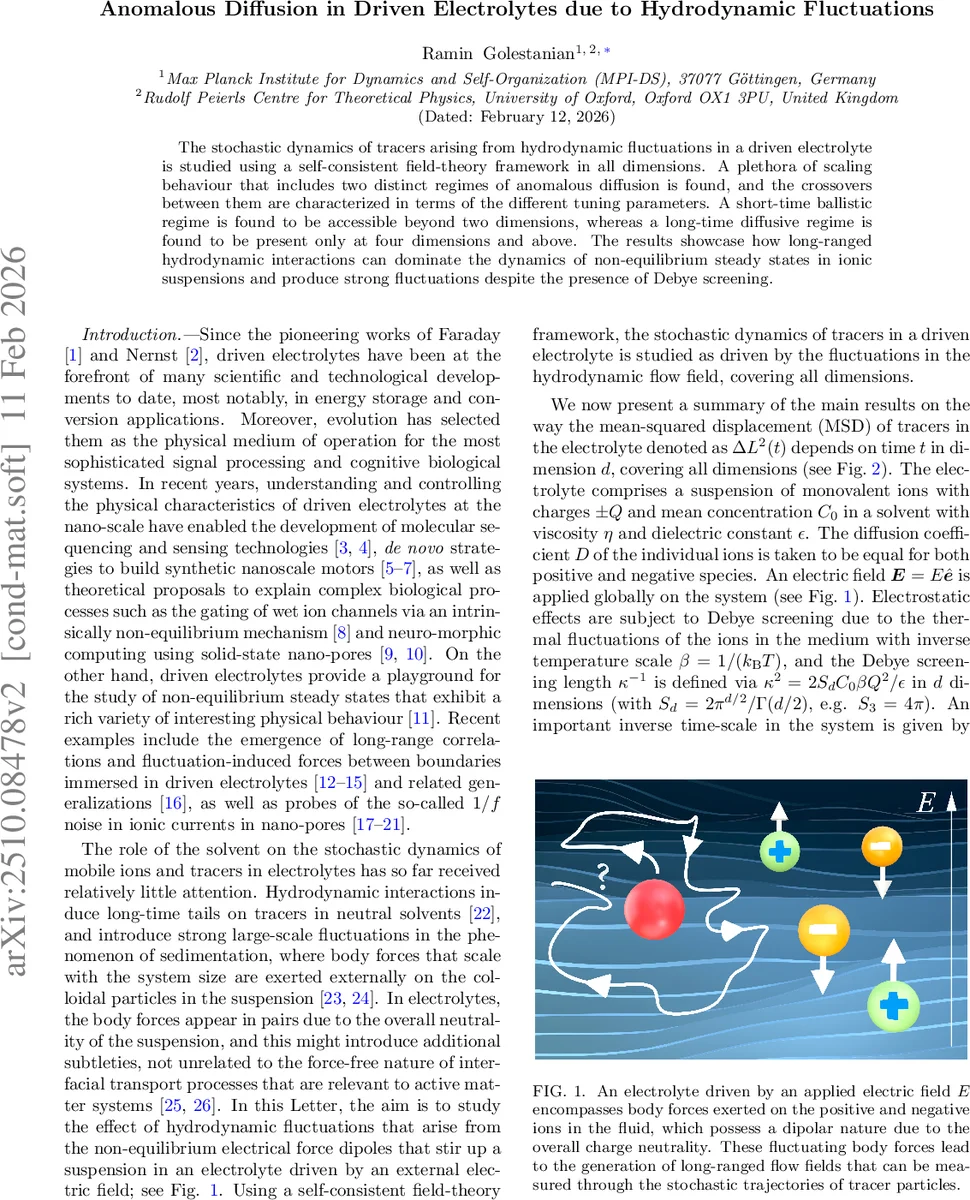
The paper presents a comprehensive theoretical study of tracer dynamics in an electrolyte driven by a uniform external electric field, focusing on the role of hydrodynamic fluctuations generated by the electric-force dipoles formed by oppositely charged ions. Using a self‑consistent field‑theoretic approach that combines the Dean–Kawasaki stochastic density equations with the incompressible Stokes equation, the authors derive coupled linear stochastic equations for the total ion concentration and the charge density. Linearization around a homogeneous background (valid for strong electrolytes where density fluctuations are small) yields explicit expressions for the velocity‑velocity correlation in Fourier space, revealing a q⁻⁴ dependence that leads to strong dimensional dependence.
A key result is the identification of distinct dynamical regimes as a function of spatial dimension d. For d ≥ 2 the short‑time ballistic regime (ΔL² ∝ t²) is present because the mean‑square fluid velocity remains finite; for d < 2 the velocity diverges with system size and the ballistic regime disappears. In the intermediate‑time window, a self‑consistent calculation of the Lagrangian velocity autocorrelation produces two anomalous diffusion regimes characterized by dynamic exponents z₁ = 4/(6 − d) and z₂ = d/2, corresponding to anomalous exponents α₁ = 2/z₁ = (3 − d)/2 and α₂ = 2/z₂ = 4/d. The crossover between these regimes occurs at a time τₐ× that scales as (C₀ D^{d/2}/λ²)^{2/(4 − d)}. Specific dimensional outcomes are:
- d = 1: ΔL² ∝ t^{5/2} for t < τₐ×, crossing to ΔL² ∝ t⁴ for longer times.
- d = 2: a single ballistic regime ΔL² ∝ t² persists at all times.
- d = 3: ballistic (t²) → first anomalous (t^{3/2}) at τ_ba = a²/D → second anomalous (t^{4/3}) at τₐ×.
- d = 4: ballistic (t²) → normal diffusion (t) at τ_bd ∝ a² ln(L/a).
- d > 4: direct ballistic → normal diffusion crossover at τ_bd ∝ a^{d/2}.
Long‑time behavior is further examined by introducing an effective diffusion coefficient D_sc that satisfies a self‑consistency equation involving the fourth‑order momentum integral G(d)⁴. For d ≤ 4 this integral diverges with system size, leading to D_sc ≫ D and effectively suppressing a pure diffusive regime; for d > 4 the integral converges, giving D_sc ≪ D and allowing normal diffusion to dominate.
The analysis demonstrates that even in the presence of Debye screening, long‑range hydrodynamic interactions driven by the electric field generate substantial fluctuations and anomalous transport. The scaling laws depend on the shear‑strain rate λ = εE²/(2S_d η), ion concentration C₀, viscosity η, tracer size a, and system size L. The authors suggest that these predictions are experimentally accessible in microfluidic and nanofluidic platforms, synthetic ionic motors, and biological ion channels, where control of the electric field and electrolyte composition can tune the observed diffusion regimes. The work opens avenues for systematic experimental verification and for extending the framework to include nonlinearities, finite ion size effects, and confinement.
Comments & Academic Discussion
Loading comments...
Leave a Comment