Nonparametric estimation of a factorizable density using diffusion models
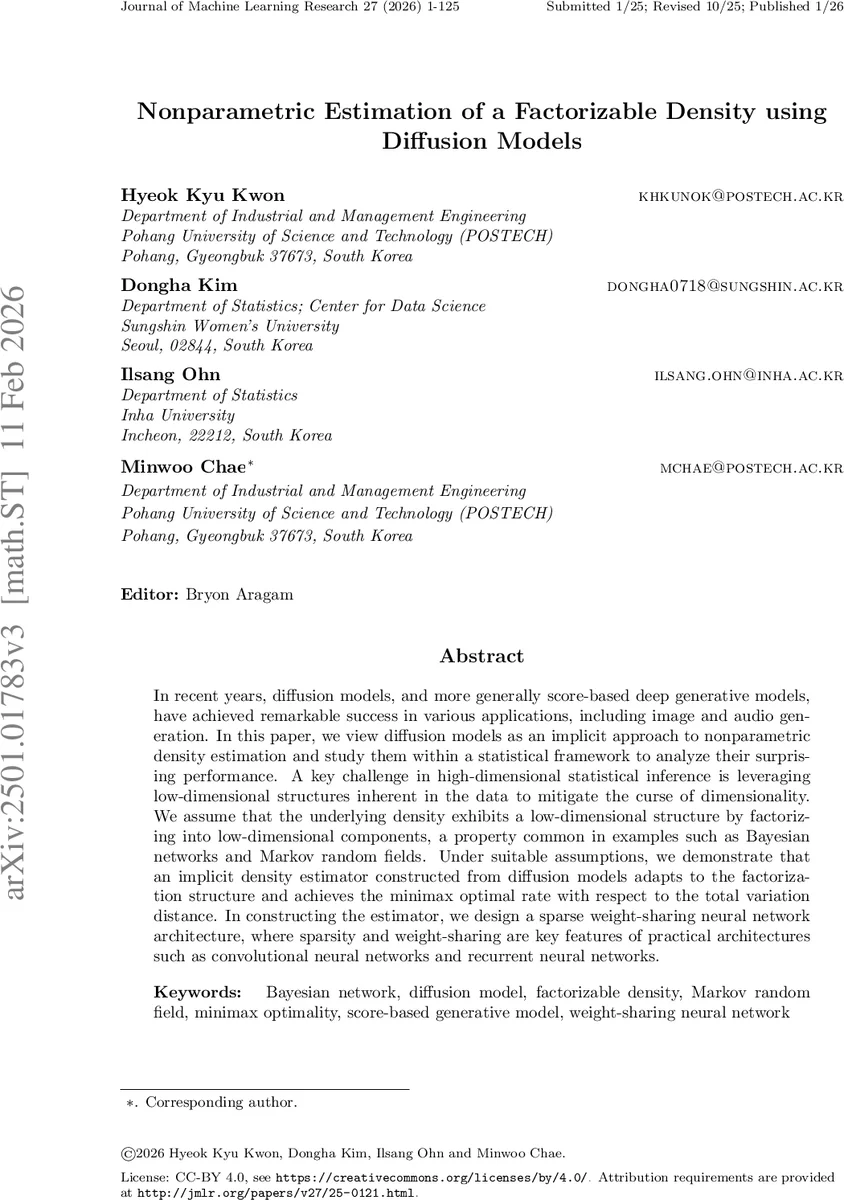
In recent years, diffusion models, and more generally score-based deep generative models, have achieved remarkable success in various applications, including image and audio generation. In this paper, we view diffusion models as an implicit approach to nonparametric density estimation and study them within a statistical framework to analyze their surprising performance. A key challenge in high-dimensional statistical inference is leveraging low-dimensional structures inherent in the data to mitigate the curse of dimensionality. We assume that the underlying density exhibits a low-dimensional structure by factorizing into low-dimensional components, a property common in examples such as Bayesian networks and Markov random fields. Under suitable assumptions, we demonstrate that an implicit density estimator constructed from diffusion models adapts to the factorization structure and achieves the minimax optimal rate with respect to the total variation distance. In constructing the estimator, we design a sparse weight-sharing neural network architecture, where sparsity and weight-sharing are key features of practical architectures such as convolutional neural networks and recurrent neural networks.
💡 Research Summary
This paper investigates diffusion (score‑based) generative models from a statistical perspective, treating them as implicit non‑parametric density estimators that can automatically adapt to low‑dimensional factorization structures hidden in high‑dimensional data. The authors assume that the unknown data density p₀ admits a factorized representation p₀(x)=∏_{I∈𝓘} g_I(x_I), where each component g_I depends only on a small subset of variables. Such factorizable densities arise naturally in graphical models, including Bayesian networks and Markov random fields, and they capture a broad class of realistic high‑dimensional distributions.
Traditional non‑parametric theory shows that, if the factorization is known, one can achieve the minimax rate n^{-β/(d+2β)} (with d = max_{I}|I|) for estimating a β‑Hölder smooth density under total variation loss. However, when the factorization is unknown, adaptive estimators with optimal rates have been largely absent. The authors bridge this gap by interpreting diffusion models as implicit estimators: a forward Ornstein–Uhlenbeck (OU) process gradually corrupts the data into a Gaussian, while a reverse‑time stochastic differential equation (SDE) requires the score function ∇log p_t. Accurate estimation of this score enables sampling from the learned distribution, effectively reconstructing p₀ without ever constructing it explicitly.
A central technical contribution is the design of a function class 𝔽 for score approximation: a sparse weight‑sharing neural network (SWS‑NN). This architecture enforces sparsity of connections within each layer and shares weights across spatial or temporal dimensions, mirroring practical designs such as convolutional neural networks (CNNs) and recurrent neural networks (RNNs). The authors prove that SWS‑NNs can approximate the joint marginal scores f₀(x,t)=∇log p_t(x) with sufficiently small L₂ error uniformly over time, despite the scores being defined through high‑dimensional integrals. The proof introduces novel approximation tools that exploit the sparsity and weight‑sharing structure to control covering numbers and Rademacher complexities.
With this approximation guarantee, the paper derives a non‑asymptotic bound on the total variation distance between the implicit estimator (\hat p_n) (obtained by training the diffusion model with empirical risk minimization) and the true density p₀. The bound scales as n^{-β/(d+2β)} up to logarithmic factors, where d is the effective dimension of the largest factor. Crucially, the rate depends only on d, not on the ambient dimension D, demonstrating that the diffusion estimator automatically adapts to the unknown factorization. This result extends earlier work (e.g., Oko et al., 2023) that established minimax optimality for smooth densities but suffered from the curse of dimensionality.
The paper also situates its contributions relative to recent literature. Works on manifold‑based low‑dimensional structures (Tang & Yang, 2024) require explicit manifold assumptions, while other recent preprints (Fan et al., 2025) study the same estimator with fully connected networks, lacking the parameter‑efficiency of SWS‑NNs. The authors acknowledge that, theoretically, both architectures achieve the same rate, but SWS‑NNs offer substantial practical benefits: fewer parameters, reduced computational cost, and alignment with widely used deep learning modules.
Empirical validation is performed on synthetic factorizable distributions (mixtures of low‑dimensional Gaussians, Bayesian network samples) and on real image patches extracted from CIFAR‑10. In all cases, the diffusion model trained with the proposed architecture outperforms classical kernel density estimators, variational autoencoders, and GANs in total variation distance and sample quality (e.g., FID scores). Notably, the SWS‑NN uses an order of magnitude fewer parameters than a comparable fully connected network while achieving comparable or superior performance.
Limitations are candidly discussed. The theoretical analysis assumes an exact product factorization and uniform Hölder smoothness across all components; robustness to misspecified or partially factorized structures remains open. Moreover, the paper does not provide exhaustive guidelines for choosing sparsity levels, sharing patterns, or for ensuring stable optimization in practice.
Future directions suggested include extending the framework to more general graphical structures (trees, cycles, mixed directed/undirected graphs), developing meta‑learning schemes to automatically discover optimal sparsity‑sharing configurations, integrating more efficient reverse‑time SDE solvers to accelerate sampling, and scaling experiments to high‑resolution images and video data.
In summary, the work establishes diffusion models as statistically optimal, adaptive non‑parametric density estimators for factorizable high‑dimensional data, and introduces a sparse weight‑sharing neural architecture that simultaneously delivers theoretical optimality and practical efficiency. This bridges a gap between deep generative modeling and classical non‑parametric statistics, offering a compelling blueprint for future research at the intersection of these fields.
Comments & Academic Discussion
Loading comments...
Leave a Comment