Humanoid Factors: Design Principles for AI Humanoids in Human Worlds
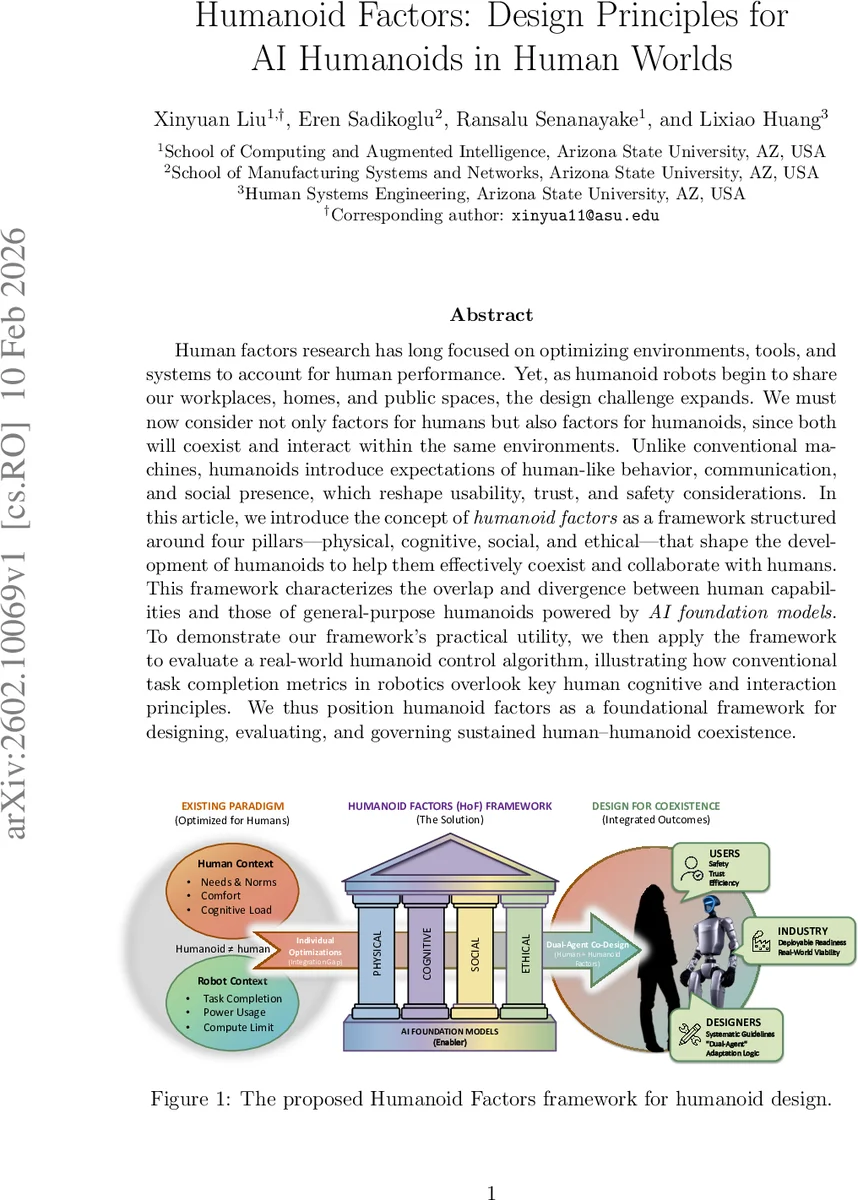
Human factors research has long focused on optimizing environments, tools, and systems to account for human performance. Yet, as humanoid robots begin to share our workplaces, homes, and public spaces, the design challenge expands. We must now consider not only factors for humans but also factors for humanoids, since both will coexist and interact within the same environments. Unlike conventional machines, humanoids introduce expectations of human-like behavior, communication, and social presence, which reshape usability, trust, and safety considerations. In this article, we introduce the concept of humanoid factors as a framework structured around four pillars - physical, cognitive, social, and ethical - that shape the development of humanoids to help them effectively coexist and collaborate with humans. This framework characterizes the overlap and divergence between human capabilities and those of general-purpose humanoids powered by AI foundation models. To demonstrate our framework’s practical utility, we then apply the framework to evaluate a real-world humanoid control algorithm, illustrating how conventional task completion metrics in robotics overlook key human cognitive and interaction principles. We thus position humanoid factors as a foundational framework for designing, evaluating, and governing sustained human-humanoid coexistence.
💡 Research Summary
The paper introduces “Humanoid Factors” (HoF), a comprehensive design framework aimed at enabling safe, efficient, and intelligible coexistence between humans and AI‑powered humanoid robots in shared environments. Recognizing that traditional human factors (HF) focus solely on optimizing environments, tools, and workflows for a single intelligent agent—the human—the authors argue that the emergence of general‑purpose humanoids, driven by large‑scale foundation models, creates a dual‑agent ecosystem where both humans and robots must adapt to each other.
Section 2 defines the HoF framework around four pillars—Physical, Cognitive, Social, and Ethical—each subdivided into concrete layers. The Physical pillar includes morphology, sensing, action, and operation layers that address form factor, multimodal perception, natural communication gestures, and sustainable power/computing management. The Cognitive pillar covers situational awareness, reasoning‑planning‑execution, cognitive guardrails, and memory‑load management, emphasizing the need for models to provide human‑level context while preventing overload. The Social pillar comprises inference of human intent and affect, prediction of future actions, appropriate intervention timing, and social appearance, reflecting the anthropomorphic expectations people place on robots. The Ethical pillar addresses safety and non‑malfeasance, privacy and data ethics, governance and accountability, and fairness/social equity, extending safety concerns to questions of “should it act?” and “who is responsible?”.
Section 3 explains how AI foundation models enable each HoF layer. Pre‑training supplies broad perception and reasoning abilities; mid‑training tailors these abilities to domain‑specific sensor suites and actuation constraints; post‑training aligns the model with human feedback, ethical guidelines, and regulatory constraints. The authors map these stages to the four pillars, showing how a single foundation model can be progressively refined to satisfy physical constraints, cognitive limits, social cues, and ethical policies.
Section 4 presents an empirical case study. A behavior‑cloning control algorithm, built on a foundation model, is deployed on a real humanoid platform. Traditional robotics metrics (task success rate, execution time) are compared with HoF‑derived metrics: cognitive load on the human operator, degree of social expectation fulfillment, and risk of ethical violation. Although the robot achieves high task success, users report elevated cognitive load, reduced trust, and discomfort due to mismatched social signals and ambiguous ethical behavior. By retrofitting the system according to HoF recommendations—adding eye‑contact sensing, implementing cognitive guardrails, and explicitly encoding privacy policies—the authors demonstrate measurable improvements in human‑robot interaction scores. This validates the claim that conventional robotics evaluation overlooks critical human‑centric factors.
Section 5 discusses implications for research, product development, and policy. Researchers are urged to develop HoF‑aligned design methodologies, standardized evaluation protocols, and interdisciplinary curricula that blend ergonomics, AI, and ethics. Industry should adopt “dual‑agent co‑design” pipelines where humans and humanoids are co‑engineered from concept through deployment, and embed continuous model updating with governance oversight. Policymakers are encouraged to codify safety, privacy, and fairness standards specific to anthropomorphic agents, create certification regimes, and foster public deliberation on acceptable robot behavior.
The conclusion reiterates that the HoF framework provides the first unified set of principles that treat physical compatibility, cognitive legibility, social presence, and ethical responsibility as co‑equal design constraints. By integrating these pillars with staged foundation‑model alignment, designers can anticipate and mitigate mismatches that would otherwise erode trust or cause unsafe outcomes. Future work should explore richer inter‑layer dynamics, real‑time adaptation mechanisms, and cross‑cultural validation of the framework.
Comments & Academic Discussion
Loading comments...
Leave a Comment